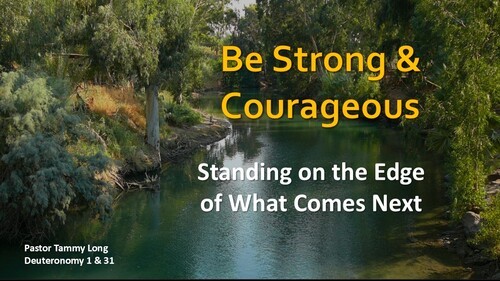
Be Strong and Courageous: Standing on the Edge of What Comes Next
For Your Heart Today
Standing on the edge of a new season often brings mixed emotions. Hope and hesitation can live side by side. Gratitude for what has been can coexist with uncertainty about what lies ahead. Scripture reminds us that these moments are not signs of failure—they are invitations.
In Deuteronomy, the people of Israel stand at the edge of the Promised Land. The wilderness is behind them. The future is in front of them. What they must decide is not whether God has been faithful, but whether they will trust Him enough to move forward.
God does not rush His people, nor does He abandon them at the threshold of change. He names reality honestly, gives direction faithfully, confirms purpose clearly, and goes before His people with unfailing presence.
Wherever you find yourself today—personally or communally—God meets you at the edge. And He speaks the same words still: Be strong and courageous. I will go before you.
4 Takeaways for the Journey Ahead
1. God names our reality.
Before movement comes honesty. God invites us to see where we truly are—emotionally, spiritually, and relationally—not to condemn us, but to ground us in truth so we can move forward faithfully.
2. God gives direction, not overwhelm.
God does not reveal the entire journey at once. He gives enough light for the next faithful step, inviting trust rather than control.
3. God confirms the mission.
Movement is never just about change—it is about purpose. God reminds His people that their next step is connected to a larger story and a lasting calling.
4. God goes before us.
Courage is not fearlessness; it is obedience in the presence of fear. We can move forward because God is already there, faithful and present.
Breath Prayer
Inhale: God, You go before me.
Exhale: I will not be afraid.
Full Manuscript
Estimated Reading Time: 25–30 minutes
Standing on the edge of a new season often brings mixed emotions. Hope and hesitation can live side by side. Gratitude for what has been can coexist with uncertainty about what lies ahead. Scripture reminds us that these moments are not signs of failure—they are invitations.
In Deuteronomy, the people of Israel stand at the edge of the Promised Land. The wilderness is behind them. The future is in front of them. What they must decide is not whether God has been faithful, but whether they will trust Him enough to move forward.
God does not rush His people, nor does He abandon them at the threshold of change. He names reality honestly, gives direction faithfully, confirms purpose clearly, and goes before His people with unfailing presence.
Wherever you find yourself today—personally or communally—God meets you at the edge. And He speaks the same words still: Be strong and courageous. I will go before you.
4 Takeaways for the Journey Ahead
1. God names our reality.
Before movement comes honesty. God invites us to see where we truly are—emotionally, spiritually, and relationally—not to condemn us, but to ground us in truth so we can move forward faithfully.
2. God gives direction, not overwhelm.
God does not reveal the entire journey at once. He gives enough light for the next faithful step, inviting trust rather than control.
3. God confirms the mission.
Movement is never just about change—it is about purpose. God reminds His people that their next step is connected to a larger story and a lasting calling.
4. God goes before us.
Courage is not fearlessness; it is obedience in the presence of fear. We can move forward because God is already there, faithful and present.
Breath Prayer
Inhale: God, You go before me.
Exhale: I will not be afraid.
Full Manuscript
Estimated Reading Time: 25–30 minutes
We’ve just sung a simple but powerful confession: my life is in Your hands.
For some, those words come easily — a declaration of trust.
For others, they are a prayer we’re still learning how to pray.
And for many of us, they’re probably both.
It is the first Sunday of a new year, and the truth is, we don’t all feel the same way as we look ahead.
Some of us step into this new year with eagerness — hopeful that something good might unfold, that what lies ahead might feel lighter or clearer than what came before.
Others arrive to this day with hesitation. The year behind us still lingers, unfinished and unresolved, and stepping forward feels less like excitement and more like uncertainty.
And as we step into Year Forty-One as a church family, we sense those same mixed emotions together.
In the coming weeks, I’ll share more fully from our recent church survey. There is much to celebrate — encouragement, positive feedback, a sense of momentum, gratitude for this community, and for God’s faithfulness among us.
And at the same time, there are honest concerns: about our aging demographic, about the limited number of children, about the need for more hands to help lead and serve.
Those mixed emotions are not unusual.
This moment today — the one many of us are standing in personally, and the one we are standing in together as a church — is a moment we see again and again in Scripture.
Moments where the future is not yet clear.
Moments marked by gratitude for what has been, questions about what lies ahead, and the awareness that staying exactly where we are is not the whole story.
It is in a moment like this that we hear Moses speak to the people of Israel.
I invite you to read with me from the book of Deuteronomy.
Deuteronomy 1:1-8
Deuteronomy 31:1-6
Unpacking the Text
To fully understand what we just read, we need to unpack the context and be clear about who Moses is speaking to and what is happening at this point in Israel’s history.
Moses is addressing people who did not stand at Mount Sinai, who were not enslaved in Egypt and didn’t experience the Exodus firsthand, who did not personally hear God give the law. They grew up hearing the stories. They were shaped by the journey. And now, they had to live the faith for themselves.
Throughout Deuteronomy, Moses revisits God’s law and God’s faithfulness in order to prepare this new generation for what lies ahead. He revisits the covenant established at Mount Sinai—where the Ten Commandments were given and where Israel learned what it meant to live in a relationship with God.
And in the words we read in Deuteronomy 1, we are reminded of a sobering reality. What should have been an eleven-day journey from Mount Sinai to the edge of the Promised Land turned into forty years in the wilderness. Not because God forgot His promise or changed His mind, but because of Israel’s distrust, fear, and disobedience.
So when Moses recalls God’s words to the first generation—“You have stayed at this mountain long enough”—they are not standing at that mountain now. They are standing on the plains of Moab, just across from the land God promised to give them. The wilderness is behind them. The land is in front of them.
They are literally standing at the edge of what comes next.
And that location matters, because they have a decision to make. Not about whether God is faithful or whether God has spoken, but about whether they will trust Him enough to move forward.
There is always the temptation to stay where things feel familiar, comfortable, and secure—even when God says, you’ve stayed here long enough.
By the time we get to Deuteronomy 31, our second text, Moses tells the people plainly that his leadership is coming to an end. The voice they have known, the presence they have relied on, will no longer guide them in the same way.
And it is in that moment—when leadership is changing, when the future feels uncertain, and when the path ahead is not fully clear—that Moses speaks these words to the people: “Be strong and courageous.”
In the original language, courage is not bravado or fearlessness. It is steady resolve—the strength to move forward even when fear is present. In fact, courage is not the absence of fear; it is obedience in the presence of fear.
And courage here is not a reflection of human character. It is a response to God’s character—to His faithfulness, His presence, and His promises.
Moses knows the people are facing a future that will look different from what they have known. And it’s in moments like these, when God invites His people to trust Him more deeply.
Not because everything is clear or fear is gone, but because God is faithful.
And that is where courage begins.
That’s where it began for the children of Israel.
And that’s where it begins for us.
Naming the Dilemma
Before we talk about what this story means for us, I want to take a brief sideroad and name something honestly.
Now for some of us, this part of the story is troubling—especially in a world shaped by oppression, colonization, and the harm done in God’s name, and the misuse of Scripture. I can feel that tension, too.
So how do we hold this?
First, we have to remember the setting of the ancient world—a world of conflict and survival, where warfare between nations was common. Scripture is not describing an ideal world; it is reflecting a broken one. A world in which God had to act within that reality.
Second, we have to hold this text alongside the wider witness of Scripture. The same Bible that includes these stories repeatedly commands care for the foreigner, the widow, and the orphan. God’s concern for human dignity runs through every story, even when it feels complicated to us.
And even as God works within the realities of history, He is always manifesting what looks to the world like an upside-down Kingdom.
And finally—and this is important—biblical passages like these do not give credence to a human-assumed divine authority for conquest, domination, or manifest destiny. Whenever Scripture has been used that way, it has led to profound injustice and suffering. We are not God, and Scripture does not invite us to play God with one another.
Stories like these can raise questions we may never fully understand this side of heaven. But God’s story as a whole consistently moves toward redemption, restoration, and the promise of peace on earth.
So let’s return to Moses and the children of Israel, and listen for what God might be saying to us as we stand at the edge of this new year—individually and as a church family.
From Moses’ words, I want to name four principles about how God leads when His people are standing on the edge of what comes next.
How God Leads Us
First, God names our reality.
The first thing we see in this story is this: God names where they are—their reality. In Deuteronomy 1:6, Moses reminds the people of God’s words when He said, “You have stayed at this mountain long enough.”
God begins by naming the moment honestly.
Even though this is a flashback to something God said to that first generation, it’s worth paying attention to for us as well. Because sometimes where we are is exactly where God wants us to be—and sometimes, it’s not.
And when we talk about God naming where we are—our reality—we’re talking about more than physical spaces. We’re also talking about where we are emotionally, spiritually, and relationally. We’re talking about how we are living, what is shaping us, and our reality in terms of how we are with God in this season.
Before we can move forward faithfully, it is helpful to be honest about where we are. Not where we think we should be. Not where we wish we were. Not even where we’re afraid to admit we are. But where we actually are.
God’s naming gives us a true starting point. It allows us to align ourselves with God’s vision rather than our assumptions. We may see our lives one way—through fear, fatigue, comfort, or uncertainty—but God sees clearly.
And when God names where we are, He does so not to condemn us, but to ground us in truth so we can move forward from that place of reality.
Sometimes the most faithful prayer we can pray is simply this:
God, where am I right now?
What is the reality You want me to see and understand?
What are You inviting me to be honest about before moving forward?
God names where we are so we can gain clarity, be ready to move, and respond faithfully to what He is inviting us into next.
Second, God gives direction.
After God names reality, He doesn’t leave His people guessing. In Deuteronomy 1:7–8, God says, “It is time to break camp and move on.”
God knows where they are—you’ve stayed at this mountain long enough—and He gives direction grounded in that reality. It’s time to break camp and move on.
He doesn’t overwhelm them with every detail. He doesn’t explain how everything will unfold. He simply gives them the next faithful step.
God’s direction always flows out of His clear view of reality and His timing.
And that’s important to remember, because the temptation for us is to move too quickly. We want change before discernment, and movement before listening. Saying, “I don’t know yet,” can feel uncomfortable. Waiting can feel like stagnation.
But Scripture shows us that waiting for God’s direction is not inactivity—it is an act of trust. If God is the one who gives direction, then part of faithfulness is knowing when to stay put until that direction becomes clear.
God gives just enough light for the next step—not the entire journey. Sometimes clarity comes quickly; sometimes it comes slowly. But here’s the bottom-line truth: God wants to guide His people.
God’s direction is not something we have to force. It becomes clear in time as we listen, trust, and wait.
Psalm 32:8 reminds us, “The Lord says, ‘I will guide you along the best pathway for your life. I will advise you and watch over you.’”
We may not know the full set of instructions, but God’s direction is always purposeful. It’s not rushed. It’s not reactive. And it’s not rooted in fear.
God names reality so we can begin to see clearly. And He gives direction so we can move faithfully—when the time is right.
Third, God confirms the mission.
In Deuteronomy 1:8, God says to the people, “See, I have given you this land. Go in and take possession of the land the Lord swore to give to your ancestors Abraham, Isaac, and Jacob.”
This moment is not just about moving forward. It’s about meaning and mission.
As Israel stands on the edge of what comes next, God is reminding them that their story is part of something larger. The direction is rooted in a promise. It is connected to a covenant that began long before them and will continue long after them.
God wants them to see that what lies ahead is not random. It is not about their comfort, convenience, or blessing in their retirement years. It is about who they are called to be in the world.
And that’s true for us as well.
When we are standing on the edge of what comes next—personally and as a church—it’s easy to narrow our focus. We ask practical questions. Necessary questions. We look at data, strategy, and logical next steps.
But again and again, God lifts our eyes beyond the immediate moment.
God confirms the mission so we remember that faithfulness is not just about the next step for me or for us. It’s about participating in the larger work of what God is doing in the world.
Israel was chosen not for privilege, but for purpose.
The promise was never just about them or the land. It was about blessing the world. Their movement forward was meant to reflect God’s heart and God’s Kingdom.
And the same is true for us.
Whatever comes next for us is part of God’s larger story. God’s direction is never disconnected from His larger mission in the world. He invites us to live in alignment with His purposes—loving God, loving others, and bearing witness to His grace in the world.
God confirms the mission so His people don’t mistake movement for meaning.
So the question for us is not only, What should we do next? But also, How do we remain faithful to who God has called me—called us—to be as we stand on the edge of what comes next?
And the final principle we see in this story is this:
God goes before us.
As Moses speaks to Israel on the edge of what comes next, he knows they are facing a future they cannot fully see. Change is coming. Leadership is changing. The path ahead is unfamiliar.
And into that moment, God reassures His people through Moses when he says, “Be strong and courageous. Do not be afraid and do not panic before them. For the Lord your God will personally go ahead of you. He will neither fail you nor abandon you.”
This is what God wants His people to know as they face this moment. They are not being asked to move forward alone. Before they take even one step, God assures them: I am already there, and I will go with you.
This is God’s Word for us, too.
As we stand at the edge of this new year—personally and as a church—we may have many emotions. Hopeful. Cautious. Uncertain. Even frightened.
But God’s promise does not depend on how we feel. It rests on who He is.
And because God goes before us, we can be strong. We can be courageous. Not because we are certain, but because He is faithful.
And His promise, that He will be with us, allows us to stand at the edge and trust Him with whatever comes next.
Because when God goes before us, we can move forward—not fearlessly, but faithfully.
For some, those words come easily — a declaration of trust.
For others, they are a prayer we’re still learning how to pray.
And for many of us, they’re probably both.
It is the first Sunday of a new year, and the truth is, we don’t all feel the same way as we look ahead.
Some of us step into this new year with eagerness — hopeful that something good might unfold, that what lies ahead might feel lighter or clearer than what came before.
Others arrive to this day with hesitation. The year behind us still lingers, unfinished and unresolved, and stepping forward feels less like excitement and more like uncertainty.
And as we step into Year Forty-One as a church family, we sense those same mixed emotions together.
In the coming weeks, I’ll share more fully from our recent church survey. There is much to celebrate — encouragement, positive feedback, a sense of momentum, gratitude for this community, and for God’s faithfulness among us.
And at the same time, there are honest concerns: about our aging demographic, about the limited number of children, about the need for more hands to help lead and serve.
Those mixed emotions are not unusual.
This moment today — the one many of us are standing in personally, and the one we are standing in together as a church — is a moment we see again and again in Scripture.
Moments where the future is not yet clear.
Moments marked by gratitude for what has been, questions about what lies ahead, and the awareness that staying exactly where we are is not the whole story.
It is in a moment like this that we hear Moses speak to the people of Israel.
I invite you to read with me from the book of Deuteronomy.
Deuteronomy 1:1-8
Deuteronomy 31:1-6
Unpacking the Text
To fully understand what we just read, we need to unpack the context and be clear about who Moses is speaking to and what is happening at this point in Israel’s history.
Moses is addressing people who did not stand at Mount Sinai, who were not enslaved in Egypt and didn’t experience the Exodus firsthand, who did not personally hear God give the law. They grew up hearing the stories. They were shaped by the journey. And now, they had to live the faith for themselves.
Throughout Deuteronomy, Moses revisits God’s law and God’s faithfulness in order to prepare this new generation for what lies ahead. He revisits the covenant established at Mount Sinai—where the Ten Commandments were given and where Israel learned what it meant to live in a relationship with God.
And in the words we read in Deuteronomy 1, we are reminded of a sobering reality. What should have been an eleven-day journey from Mount Sinai to the edge of the Promised Land turned into forty years in the wilderness. Not because God forgot His promise or changed His mind, but because of Israel’s distrust, fear, and disobedience.
So when Moses recalls God’s words to the first generation—“You have stayed at this mountain long enough”—they are not standing at that mountain now. They are standing on the plains of Moab, just across from the land God promised to give them. The wilderness is behind them. The land is in front of them.
They are literally standing at the edge of what comes next.
And that location matters, because they have a decision to make. Not about whether God is faithful or whether God has spoken, but about whether they will trust Him enough to move forward.
There is always the temptation to stay where things feel familiar, comfortable, and secure—even when God says, you’ve stayed here long enough.
By the time we get to Deuteronomy 31, our second text, Moses tells the people plainly that his leadership is coming to an end. The voice they have known, the presence they have relied on, will no longer guide them in the same way.
And it is in that moment—when leadership is changing, when the future feels uncertain, and when the path ahead is not fully clear—that Moses speaks these words to the people: “Be strong and courageous.”
In the original language, courage is not bravado or fearlessness. It is steady resolve—the strength to move forward even when fear is present. In fact, courage is not the absence of fear; it is obedience in the presence of fear.
And courage here is not a reflection of human character. It is a response to God’s character—to His faithfulness, His presence, and His promises.
Moses knows the people are facing a future that will look different from what they have known. And it’s in moments like these, when God invites His people to trust Him more deeply.
Not because everything is clear or fear is gone, but because God is faithful.
And that is where courage begins.
That’s where it began for the children of Israel.
And that’s where it begins for us.
Naming the Dilemma
Before we talk about what this story means for us, I want to take a brief sideroad and name something honestly.
Now for some of us, this part of the story is troubling—especially in a world shaped by oppression, colonization, and the harm done in God’s name, and the misuse of Scripture. I can feel that tension, too.
So how do we hold this?
First, we have to remember the setting of the ancient world—a world of conflict and survival, where warfare between nations was common. Scripture is not describing an ideal world; it is reflecting a broken one. A world in which God had to act within that reality.
Second, we have to hold this text alongside the wider witness of Scripture. The same Bible that includes these stories repeatedly commands care for the foreigner, the widow, and the orphan. God’s concern for human dignity runs through every story, even when it feels complicated to us.
And even as God works within the realities of history, He is always manifesting what looks to the world like an upside-down Kingdom.
And finally—and this is important—biblical passages like these do not give credence to a human-assumed divine authority for conquest, domination, or manifest destiny. Whenever Scripture has been used that way, it has led to profound injustice and suffering. We are not God, and Scripture does not invite us to play God with one another.
Stories like these can raise questions we may never fully understand this side of heaven. But God’s story as a whole consistently moves toward redemption, restoration, and the promise of peace on earth.
So let’s return to Moses and the children of Israel, and listen for what God might be saying to us as we stand at the edge of this new year—individually and as a church family.
From Moses’ words, I want to name four principles about how God leads when His people are standing on the edge of what comes next.
How God Leads Us
First, God names our reality.
The first thing we see in this story is this: God names where they are—their reality. In Deuteronomy 1:6, Moses reminds the people of God’s words when He said, “You have stayed at this mountain long enough.”
God begins by naming the moment honestly.
Even though this is a flashback to something God said to that first generation, it’s worth paying attention to for us as well. Because sometimes where we are is exactly where God wants us to be—and sometimes, it’s not.
And when we talk about God naming where we are—our reality—we’re talking about more than physical spaces. We’re also talking about where we are emotionally, spiritually, and relationally. We’re talking about how we are living, what is shaping us, and our reality in terms of how we are with God in this season.
Before we can move forward faithfully, it is helpful to be honest about where we are. Not where we think we should be. Not where we wish we were. Not even where we’re afraid to admit we are. But where we actually are.
God’s naming gives us a true starting point. It allows us to align ourselves with God’s vision rather than our assumptions. We may see our lives one way—through fear, fatigue, comfort, or uncertainty—but God sees clearly.
And when God names where we are, He does so not to condemn us, but to ground us in truth so we can move forward from that place of reality.
Sometimes the most faithful prayer we can pray is simply this:
God, where am I right now?
What is the reality You want me to see and understand?
What are You inviting me to be honest about before moving forward?
God names where we are so we can gain clarity, be ready to move, and respond faithfully to what He is inviting us into next.
Second, God gives direction.
After God names reality, He doesn’t leave His people guessing. In Deuteronomy 1:7–8, God says, “It is time to break camp and move on.”
God knows where they are—you’ve stayed at this mountain long enough—and He gives direction grounded in that reality. It’s time to break camp and move on.
He doesn’t overwhelm them with every detail. He doesn’t explain how everything will unfold. He simply gives them the next faithful step.
God’s direction always flows out of His clear view of reality and His timing.
And that’s important to remember, because the temptation for us is to move too quickly. We want change before discernment, and movement before listening. Saying, “I don’t know yet,” can feel uncomfortable. Waiting can feel like stagnation.
But Scripture shows us that waiting for God’s direction is not inactivity—it is an act of trust. If God is the one who gives direction, then part of faithfulness is knowing when to stay put until that direction becomes clear.
God gives just enough light for the next step—not the entire journey. Sometimes clarity comes quickly; sometimes it comes slowly. But here’s the bottom-line truth: God wants to guide His people.
God’s direction is not something we have to force. It becomes clear in time as we listen, trust, and wait.
Psalm 32:8 reminds us, “The Lord says, ‘I will guide you along the best pathway for your life. I will advise you and watch over you.’”
We may not know the full set of instructions, but God’s direction is always purposeful. It’s not rushed. It’s not reactive. And it’s not rooted in fear.
God names reality so we can begin to see clearly. And He gives direction so we can move faithfully—when the time is right.
Third, God confirms the mission.
In Deuteronomy 1:8, God says to the people, “See, I have given you this land. Go in and take possession of the land the Lord swore to give to your ancestors Abraham, Isaac, and Jacob.”
This moment is not just about moving forward. It’s about meaning and mission.
As Israel stands on the edge of what comes next, God is reminding them that their story is part of something larger. The direction is rooted in a promise. It is connected to a covenant that began long before them and will continue long after them.
God wants them to see that what lies ahead is not random. It is not about their comfort, convenience, or blessing in their retirement years. It is about who they are called to be in the world.
And that’s true for us as well.
When we are standing on the edge of what comes next—personally and as a church—it’s easy to narrow our focus. We ask practical questions. Necessary questions. We look at data, strategy, and logical next steps.
But again and again, God lifts our eyes beyond the immediate moment.
God confirms the mission so we remember that faithfulness is not just about the next step for me or for us. It’s about participating in the larger work of what God is doing in the world.
Israel was chosen not for privilege, but for purpose.
The promise was never just about them or the land. It was about blessing the world. Their movement forward was meant to reflect God’s heart and God’s Kingdom.
And the same is true for us.
Whatever comes next for us is part of God’s larger story. God’s direction is never disconnected from His larger mission in the world. He invites us to live in alignment with His purposes—loving God, loving others, and bearing witness to His grace in the world.
God confirms the mission so His people don’t mistake movement for meaning.
So the question for us is not only, What should we do next? But also, How do we remain faithful to who God has called me—called us—to be as we stand on the edge of what comes next?
And the final principle we see in this story is this:
God goes before us.
As Moses speaks to Israel on the edge of what comes next, he knows they are facing a future they cannot fully see. Change is coming. Leadership is changing. The path ahead is unfamiliar.
And into that moment, God reassures His people through Moses when he says, “Be strong and courageous. Do not be afraid and do not panic before them. For the Lord your God will personally go ahead of you. He will neither fail you nor abandon you.”
This is what God wants His people to know as they face this moment. They are not being asked to move forward alone. Before they take even one step, God assures them: I am already there, and I will go with you.
This is God’s Word for us, too.
As we stand at the edge of this new year—personally and as a church—we may have many emotions. Hopeful. Cautious. Uncertain. Even frightened.
But God’s promise does not depend on how we feel. It rests on who He is.
And because God goes before us, we can be strong. We can be courageous. Not because we are certain, but because He is faithful.
And His promise, that He will be with us, allows us to stand at the edge and trust Him with whatever comes next.
Because when God goes before us, we can move forward—not fearlessly, but faithfully.
Posted in Be Strong and Courageous:
Posted in New Year Sermon, Deuteronomy Devotional, Faith and Courage, Christian Leadership Transition, God’s Direction and Timing, Trusting God’s Promises, Church Vision and Mission, Spiritual Reflection and Renewal, Standing on the Edge of Change, Be Strong and Courageous Bible Study
Posted in New Year Sermon, Deuteronomy Devotional, Faith and Courage, Christian Leadership Transition, God’s Direction and Timing, Trusting God’s Promises, Church Vision and Mission, Spiritual Reflection and Renewal, Standing on the Edge of Change, Be Strong and Courageous Bible Study
Recent
Be Strong and Courageous in This Season: Being & Doing
September 28th, 2026
Be Strong and Courageous in This Season: God's Story in Your Story
September 21st, 2026
Be Strong Courageous in this Season
September 14th, 2026
Be Strong Courageous as Disciples: Get to Know Judas
September 7th, 2026
Be Strong Courageous as Disciples: Get to Know Simon
September 1st, 2026
Archive
2026
January
February
March
Be Strong Courageous in Body Mind Spirit: Care for the BodyBe Strong & Courageous in Body, Mind & Spirit: Care for the MindBe Strong & Courageous in Body, Mind & Spirit: Care for the SpiritBe Strong & Courageous in Body, Mind & Spirit Seeing the Peace We MissBe Strong & Courageous in Body, Mind & Spirit: Living Aligned
April
May
June
Be Strong Courageous in Community: Making Room for All Nations (AANHPI Heritage Month)Be Strong Courageous in Community: The Courage to Speak Truth in LoveBe Strong Courageous: The Courage to Choose WiselyBe Strong Courageous in Community The Courage to BlessBe Strong Courageous in Community: The Courage to Love Like Jesus
July
August
2025
January
February
March
April
May
June
July
August
September
October
November
2024
January
February
No Comments