
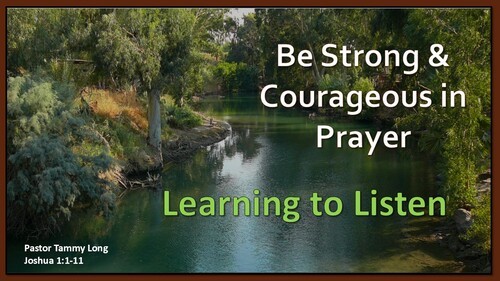
Be Strong & Courageous in Prayer: Learning to Listen
For Your Heart Today
Sometimes the deepest longing of our hearts is simply to hear from God.
Not because we lack faith, but because we want to be faithful. We want to make wise decisions. We want to move forward without the quiet fear of getting it wrong or disappointing God.
As we begin a new season shaped by the call to Be Strong and Courageous, Scripture reminds us that courage is not born from certainty alone. It is formed in prayerful listening—when we draw near to God, open our hearts, and trust that God will meet us there.
Joshua’s story invites us into that sacred space. Before movement, there is listening. Before courage, there is presence. And before action, there is prayer.
Wherever you find yourself today—uncertain, hopeful, hesitant, or ready—God is already speaking. The question is not whether God is present, but whether we are willing to slow down long enough to listen.
4 Takeaways for Learning to Listen
1. God speaks into real life, not ideal circumstances.
God begins by naming reality—loss, transition, responsibility. Listening starts when we allow God to meet us honestly where we are.
2. Courage grows out of trust, not clarity.
“Be strong and courageous” is spoken into uncertainty. God does not remove all questions before Joshua moves forward; He gives His presence instead.
3. God teaches us to listen through what He has already spoken.
God directs Joshua back to the Book of Instruction. Learning to hear God’s voice begins with familiarity—with God’s Word, character, and ways.
4. Listening prepares us before we act.
Joshua does not rush the people forward. Prayer shapes readiness, helping us discern timing and direction before movement begins.
Breath Prayer
Inhale: Speak, Lord.
Exhale: Your servant is listening.
Full Manuscript - Estimated Reading Time: 25–30 minutes
Sometimes the deepest longing of our hearts is simply to hear from God.
Not because we lack faith, but because we want to be faithful. We want to make wise decisions. We want to move forward without the quiet fear of getting it wrong or disappointing God.
As we begin a new season shaped by the call to Be Strong and Courageous, Scripture reminds us that courage is not born from certainty alone. It is formed in prayerful listening—when we draw near to God, open our hearts, and trust that God will meet us there.
Joshua’s story invites us into that sacred space. Before movement, there is listening. Before courage, there is presence. And before action, there is prayer.
Wherever you find yourself today—uncertain, hopeful, hesitant, or ready—God is already speaking. The question is not whether God is present, but whether we are willing to slow down long enough to listen.
4 Takeaways for Learning to Listen
1. God speaks into real life, not ideal circumstances.
God begins by naming reality—loss, transition, responsibility. Listening starts when we allow God to meet us honestly where we are.
2. Courage grows out of trust, not clarity.
“Be strong and courageous” is spoken into uncertainty. God does not remove all questions before Joshua moves forward; He gives His presence instead.
3. God teaches us to listen through what He has already spoken.
God directs Joshua back to the Book of Instruction. Learning to hear God’s voice begins with familiarity—with God’s Word, character, and ways.
4. Listening prepares us before we act.
Joshua does not rush the people forward. Prayer shapes readiness, helping us discern timing and direction before movement begins.
Breath Prayer
Inhale: Speak, Lord.
Exhale: Your servant is listening.
Full Manuscript - Estimated Reading Time: 25–30 minutes

The song Open My Heart captures something very real for many of us, just as it does for me. It gives voice to a prayer many of us have had—and perhaps still have right now. Sometimes it’s conscious, and sometimes it’s quietly beneath the surface: a longing to hear from God and to know what to do.
Our theme for 2026 is Be Strong and Courageous, and those words can sound good to us. They feel hopeful, even inspiring. And yet, if we’re honest, there’s a place many of us can get stuck.
We want to be strong and courageous in the Lord—in big decisions and small ones, in moments that clearly matter, and in moments that feel ordinary, everyday, almost insignificant. But often where we get stuck, what holds us back is uncertainty.
That’s what the soloist is singing about when she says,
Alone in a room, it's just me and you
I feel so lost 'cause I don't know what to do
Now what if choose the wrong thing to do
I'm so afraid, afraid of disappointing you
So, I need to talk to you
And ask you for your guidance
Especially today
When my life is so cloudy
Guide me until I'm sure
I open up my heart
That song resonates because it puts words to the space many of us can find ourselves in. We’re not sure what the right step is. We’re not sure whether to move or to wait. And sometimes, we’re not sure we trust ourselves to discern the difference.
And if we look closer, underneath that uncertainty is a quiet fear. Not the kind of fear that panics or runs, but the kind that hesitates. The fear of getting it wrong. Or, as the song says, the fear of disappointing God.
We yearn for guidance. We want to hear God’s voice.
But this is what I know: hearing God’s voice is not as clear-cut as we wish it were. We wonder—Is this God’s leading, or just my own thoughts? Is this something God is inviting, or just a coincidence? Is this a holy nudge, or simply my own hopes speaking loudly?
And then there are those moments when we step forward believing God is leading, and things don’t unfold the way we expected. We’re left with a lot of questions. Was that really God? Or is God inviting me to trust Him—stretching me—even though the outcome didn’t look the way I imagined?
So we pray, like another song says, “If I could just hear from You, then I’d know what to do.”
For those of us seriously seeking to follow God’s will and ways, this is the longing of our hearts: to hear God.
Which leads to an important question for us this year: How do we learn to listen for God’s voice as we seek to be strong and courageous? The two seem to go together.
And it’s on that note that we pick up our Scripture passage for today.
Joshua 1:1-11
Unpacking the Text
Joshua chapter 1 is a transition passage in the life of God’s people. We’re told plainly that Moses, the servant of the Lord, is dead, and now leadership has passed to Joshua. The people are still on the edge of the Promised Land—the same place where they heard Moses’ final instructions in the Deuteronomy passage we read last week—but everything has changed relationally.
The leader who carried them through the wilderness and spoke with God face to face is no longer with them. But God is there. And God speaks to Joshua.
The Lord says to Joshua, “The time has come for you to lead these people, the Israelites, across the Jordan River into the land I am giving them.”
The direction is clear. The moment for movement has arrived. And God reminds Joshua of the promise he will now carry forward: “I promise you what I promised Moses: Wherever you set foot, you will be on land I have given you.”
The land is still given. The future is still secured. The mission has not changed.
Then God offers incredible reassurance. He says, “No one will be able to stand against you as long as you live. For I will be with you as I was with Moses. I will not fail you or abandon you.”
In many ways, this passage feels like a recap of what we heard God say to the people through Moses last Sunday. The same principles are at work here. God leads by naming reality. God gives direction. God affirms the mission. And God promises His presence as His people move forward.
Moses is no longer there, but nothing has changed for God. There is no confusion about God’s will, and the path forward is clear. In short, they have their marching orders—and it’s almost time to start moving.
But what I love about this passage is not just what God says about the mission. It’s the exchange between God and Joshua, and the way God addresses something deeper—something that speaks directly to our own longing to hear God as well.
Joshua’s Experience in the Prayer
Let’s consider this passage again for a few moments, this time by stepping inside Joshua’s experience.
Think about it.
Moses has died. And Moses wasn’t just a powerful leader and prophet. For Joshua, Moses was a mentor, a spiritual father, and a friend—the one Joshua followed for decades, the one who heard God’s voice and carried the weight of leadership in a way Joshua never had to.
Joshua had spent most of his life assisting, observing, and learning from Moses. Moses’ death would have left a huge ache and a deep hole for Joshua.
And now, suddenly, the mantle has passed. Joshua stands at the edge of the Promised Land carrying grief, responsibility, and a quiet—perhaps unspoken—question: Am I really ready for this?
Scripture does not tell us what Joshua says to God in this passage, or even if he says anything at all. We don’t know how the conversation with God started. We don’t know whether Joshua’s thoughts and fears were spoken aloud or simply held in his heart.
Regardless, we do know this: somehow and in some way, Joshua drew near to God, and God drew near to him.
Once again, we see God naming reality.
God begins by saying, “Moses, my servant, is dead.”
That phrase matters more than we might realize. In all of Scripture up to this point, only Moses is called the servant of the Lord. That title speaks not only of obedience, but of the deeply personal relationship Moses shared with God. Moses wasn’t just a leader God used; he was someone God knew intimately.
So when God says, “Moses, my servant, is dead,” this is more than a statement of fact. It is an acknowledgment of loss. God is naming what Joshua is grieving—not just the death of a leader, but the absence of a relationship that had shaped Joshua’s life and faith.
I love that God does not ignore this moment, as if nothing has happened, or rush past it matter-of-factly. We may read it quickly, but there is a deeper nuance here. God speaks the truth Joshua is already living with, and they share that moment of loss together.
Then God speaks about what comes next. He says, “Therefore, the time has come for you to lead these people….”
Those words acknowledge the weight Joshua has inherited—the responsibility of leadership, the uncertainty of whether the people will follow, and the fear of stepping into a role once held by someone as renowned as Moses.
But God is not asking Joshua to be Moses 2.0 or a clone of Moses. God gently affirms Joshua for who he is—words Joshua needed to hear.
God says, “As I was with Moses, so I will be with you. I will never leave you nor forsake you.”
Can you imagine what it must have been like for Joshua to hear God say those words?
God meets Joshua right where he is with presence and promise, and with a gentle invitation to trust Him. God doesn’t say the words “trust me” outright, but that is the essence of what God is offering when He says, I will be with you. I will never leave you nor forsake you.
In other words, I’ve got you, and you can trust Me.
Then, three times, God says to Joshua, “Be strong and courageous.” And the second time, He intensifies it: “Be strong and very courageous.”
God does not repeat these words as a rallying cry for someone already assured. He repeats them because Joshua needs to hear them.
This is God’s courage speaking to fear. This is reassurance spoken into uncertainty. This is
God patiently pressing truth into a heart that needs time to receive it.
And once again, notice the embedded invitation. To be strong and courageous is, at its core, an invitation to trust God.
A Footnote on Repetition and Learning to Hear God
Here’s a footnote to keep in mind.
In Scripture, repetition is often one of the ways God makes Himself clear—especially when He wants to underscore a truth. God wants His words to be heard and to take root. And His Spirit helps us hear Him, helps us notice, even if God has to say the same thing or convey the same message multiple times.
God is patient and caring. He wants us to get it.
The same is true as we learn to listen for God today. When a Scripture, a phrase, or a nudge returns again and again; when something strikes us in a song; when the same idea shows up in a devotional we’re reading; when the preacher says something in a sermon; and then a friend, out of the blue, makes a statement that aligns with all of it—
Joshua’s story reminds us not to rush past those moments or dismiss them as coincidence, but to pause and ask, God, are You trying to get my attention? Are You trying to tell me something? Is there something You want me to hear?
I truly believe that if we genuinely want to hear from God, He will find a way to speak to us in a way we can understand—if we open our hearts and listen for Him.
Listening Through the Word God Has Already Given
The second time God tells Joshua to be strong and very courageous, He says more. In verse 7, God tells Joshua to be careful to obey all the instructions Moses gave him, not deviating from them, turning neither to the right nor to the left. God promises that when Joshua does this, he will be successful in everything he does.
This is such an important truth that God wants Joshua to hear it more than once. In fact, God essentially says it again and expands the thought in verse 8 when He says, “Study this Book of Instruction continually. Meditate on it day and night so you will be sure to obey everything written in it. Only then will you prosper and succeed in all you do.”
Studying and obeying God’s Word is so central to being strong and courageous that God repeats this instruction before and after His command to Joshua. It’s almost like pillars or bookends, holding this truth in place.
This nugget of truth is this: to be strong and courageous, we need to begin with the Word God has already given us. Study and obey. Meditate. Pray. Listen. Just as God commanded Joshua to begin with the words He had given to Moses.
As we do this, we not only come to know more about who God is, but we also learn how to recognize His voice when He is speaking.
Courage is not shaped by guessing God’s will; it is shaped by following the principles God has already spoken.
In other words, learning to listen to God is not about mystery or disembodied voices in our heads. It begins with familiarity—with God’s words, with God’s ways, and with God’s character.
In this passage, we’re reminded that prayer and God’s Word work together. God meets Joshua in prayer and teaches him to listen for His voice and direction through Scripture. Strength and courage are the fruit of that relationship.
Prayer, Presence, and Trust
As we read about Joshua’s experience with God, we are not witnessing a polished or eloquent prayer. What we see instead is a deeply personal encounter where God is responding to everything Joshua is carrying—whether Joshua has found the words for it or not.
Through this encounter, Joshua is strengthened. Not because everything suddenly becomes clear, but because he has been reminded of who goes with him and how to hear God’s voice.
Prayer does not eliminate uncertainty, but it generates trust. Strength and courage are formed here first—not in action or movement—but in God’s presence. In the quiet, unseen spaces where God speaks and we listen.
It’s only after Joshua has listened and been steadied in that space of prayer that the story begins to move forward and he turns toward the people.
Joshua Turns to the People
Up to this point, everything we’ve read in Joshua chapter 1 has been happening between Joshua and God. But after that encounter, the text shifts and Joshua turns outward.
With God’s words—be strong and courageous, for I will be with you—still echoing in his heart, Joshua speaks.
Picking up the Joshua 1 text at verse 10, we read:
Joshua then commanded the officers of Israel, “Go through the camp and tell the people to get their provisions ready. In three days you will cross the Jordan River and take possession of the land the Lord your God is giving you.” (Joshua 1:10–11, NLT)
Joshua is already embodying strength and courage. He speaks with authority and confidence—not from his own muster, but from his time with God. God has given him the strength and courage he needs, and Joshua has put his trust in God’s words.
From his time with God in prayer, Joshua has listened. He has heard. And now, he is ready to act.
What Joshua calls the people to do first is simply to prepare. They are not crossing the Jordan yet, but they are getting ready.
Listening to God leads to readiness.
Prayer prepares us for what comes next.
Joshua does not rush the people forward, butListen he does invite them to prepare for what God is about to do.
And that is exactly where we are right now—at a place of prepara
A Season of Preparation
Today we begin our 28 Days of Prayer and Fasting, but this first week is a week of prayer and preparation—just like the children of Israel. They had three days to prepare, but we have seven.
Now, we are not fasting yet. Let me say that again: we are not fasting yet.
That part will begin next week, when we will metaphorically “cross the Jordan” and begin the journey. But this week is about preparation.
This is a week to slow down, to create space, and to turn our attention toward God. It’s a time to practice listening well, so that when the fast begins, we will be attentive to God’s voice—not trusting in our ability to hear perfectly, but trusting God’s ability to guide us faithfully and help us hear Him.
As we listen individually, God is also shaping us collectively as a church family. The more we learn to hear and recognize God’s voice on our own, the stronger we will become at listening for and recognizing God’s voice together.
To help us grow in listening, we’ve created a simple prayer guide for this week—not as an assignment, but as a resource to guide us. Each day includes gentle practices that help us learn to listen by paying attention.
In the morning, we’re invited to meditate on God’s Word—to begin the day grounded in what God has already spoken. In the afternoon, we’re invited into embodied prayer—pausing in the middle of the day to bring our hearts, bodies, and minds back into awareness of God. And in the evening, there’s a simple examen practice, inviting us to look back over the day and notice where God may have been drawing our attention, prompting us, or quietly speaking along the way.
This week is also a time to pray about the fast itself, using the four P’s of preparation—to listen for what God may be inviting you to set aside in order to focus more fully on Him. Whether it’s food, media, a habit, or refraining from something else entirely, this is not about comparison or pressure. It’s about God.
We ask, God, how are You inviting me to connect with You in this fast season?
Because this whole journey—prayer, fasting, listening—is about aligning with where God is leading us, individually and as a church family, as we move forward exactly as God is inviting us to be strong and courageous.
Not in our own strength, but through God’s presence. With open, listening hearts that trust Him. As we learn to listen—through Scripture, prayer, and God’s presence—we discover that strength and courage are not something we manufacture. They are formed as we trust the God who goes with us.
Recent
Be Strong & Courageous as Disciples: Get to Know Andrew
July 6th, 2026
Be Strong Courageous in Community: The Courage to Love Like Jesus
June 30th, 2026
Be Strong Courageous in Community The Courage to Bless
June 23rd, 2026
Be Strong Courageous: The Courage to Choose Wisely
June 16th, 2026
Be Strong Courageous in Community: The Courage to Speak Truth in Love
June 9th, 2026
Archive
2026
January
February
March
Be Strong Courageous in Body Mind Spirit: Care for the BodyBe Strong & Courageous in Body, Mind & Spirit: Care for the MindBe Strong & Courageous in Body, Mind & Spirit: Care for the SpiritBe Strong & Courageous in Body, Mind & Spirit Seeing the Peace We MissBe Strong & Courageous in Body, Mind & Spirit: Living Aligned
April
May
June
Be Strong Courageous in Community: Making Room for All Nations (AANHPI Heritage Month)Be Strong Courageous in Community: The Courage to Speak Truth in LoveBe Strong Courageous: The Courage to Choose WiselyBe Strong Courageous in Community The Courage to BlessBe Strong Courageous in Community: The Courage to Love Like Jesus
2025
January
February
March
April
May
June
July
August
September
October
November
2024
January
February
March
April
May
No Comments