
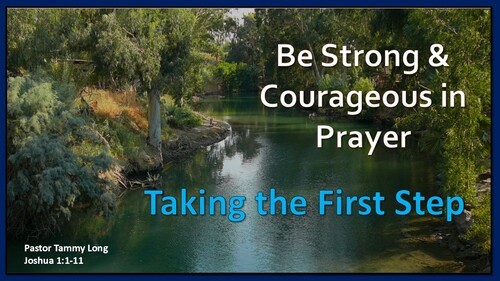
Be Strong & Courageous in Prayer: Taking The First Step
For Your Heart Today
Courage rarely begins with certainty. More often, it begins with listening—listening in the quiet work of preparation, listening for God’s direction before the waters part. Before Israel ever stepped into the Jordan, they were asked to pause, to consecrate themselves, and to position their hearts to recognize where God was already at work. The miracle did not begin with movement; it began with attention.
God did not give them the full picture—He gave them His presence. The ark went before them as a visible reminder that the living God was in their midst. And that made all the difference. The waters did not part while they stood safely on the shore; they parted when the priests’ feet touched the edge. Courage, it turns out, is not the absence of fear, but the willingness to take a faithful step while trusting God to meet us there.
So often, we want clarity before obedience and reassurance before action. But God invites us to trust that He is already ahead of us and preparing a way we cannot yet see. The call is not to rush forward, but neither is it to remain stuck in preparation. There comes a moment when listening leads to movement.
This is what it means to be strong and courageous—not because the path is clear, but because God is in our midst. Strength is formed in trust. Courage is found in the first step. And when we move forward with God present among us, even the waters that once felt impossible can become the place where faith is formed.
Takeaways: Taking the First Step
Breath Prayer
Inhale: God, You are with us.
Exhale: I will take the next faithful step.
Full Manuscript - Estimated Reading Time: 18–21 minutes
Courage rarely begins with certainty. More often, it begins with listening—listening in the quiet work of preparation, listening for God’s direction before the waters part. Before Israel ever stepped into the Jordan, they were asked to pause, to consecrate themselves, and to position their hearts to recognize where God was already at work. The miracle did not begin with movement; it began with attention.
God did not give them the full picture—He gave them His presence. The ark went before them as a visible reminder that the living God was in their midst. And that made all the difference. The waters did not part while they stood safely on the shore; they parted when the priests’ feet touched the edge. Courage, it turns out, is not the absence of fear, but the willingness to take a faithful step while trusting God to meet us there.
So often, we want clarity before obedience and reassurance before action. But God invites us to trust that He is already ahead of us and preparing a way we cannot yet see. The call is not to rush forward, but neither is it to remain stuck in preparation. There comes a moment when listening leads to movement.
This is what it means to be strong and courageous—not because the path is clear, but because God is in our midst. Strength is formed in trust. Courage is found in the first step. And when we move forward with God present among us, even the waters that once felt impossible can become the place where faith is formed.
Takeaways: Taking the First Step
- Be willing to move when God says it’s time.
There is a moment when preparation is over, and it’s time to move. - Keep your eyes on the Lord.
When the way forward is unclear, following God provides direction. - Trust that God is faithful to act.
The step of faith comes before the outcome is known. - Recognize that God is in our midst.
Strength and courage flow from knowing God is with us.
Breath Prayer
Inhale: God, You are with us.
Exhale: I will take the next faithful step.
Full Manuscript - Estimated Reading Time: 18–21 minutes
Be Strong and Courageous in Prayer: Taking the First Step
Joshua 3:1-17
By Pastor Tammy Long
Most of us know the 23rd Psalm. It begins with, “The Lord is my shepherd.” But what I appreciate about the song we just heard, Shepherd, sung by CeCe Winans, is that it doesn’t just name God as our Shepherd; it centers on the sheep's response to follow. It requires keeping our eyes on Him, trusting that as He leads, He will show us the way. And this we know to be true: when we follow Him, life is better.
This morning marks an important moment for us as a church. Today, we begin the fasting part of our 28 Days of Prayer and Fasting. This past week, we began with a week of preparation. On Friday night, many of us gathered for a powerful virtual prayer experience that was so fitting and Spirit-led as we launched this time together.
If you’re new to South Bay or haven’t been with us over the last few weeks, our theme for this year is Be Strong and Courageous. Not as a slogan, but as a way of orienting ourselves to God in this season. We can be strong and courageous—not by our might, but by His power and presence in our lives.
So as we enter into these three weeks of fasting and prayer, our posture is to be strong and courageous as God leads us forward.
This morning, for our Scripture text, we are going back to where we left off last week. The children of Israel have set up camp and are waiting for the next instructions.
Hear the Word of the Lord from Joshua 3:1-17.
II. Previously…
Before we look at today’s passage, let me do what TV shows often do when you jump into the middle of a season. You know, it’s when the narrator says, “Previously on…”—so you get caught up on how we got here.
So—previously, in the book of Joshua…
We learn in chapter 1 that Moses has died, and Joshua steps into leadership. God repeatedly encourages him to be strong and courageous—not because the journey will be easy, but because God promises to be with him wherever he goes. Joshua embraced the promise and the call, and he begins to prepare the people to move.
Then, in chapter 2, Joshua sends two spies into the land. They encounter Rahab—a woman on the margins, a Gentile, a prostitute—who nevertheless recognizes the God of Israel and chooses faithfulness. Through her story, we discover God is already at work on the other side. Before Israel ever moves forward, fear has already fallen on the land. They are about to inhabit what God has promised; God’s promise is already unfolding.
So, when we arrive at today’s chapter 3, the people are ready—not because they know what will happen next, but because they’ve been told it’s time to move. Moses has made it clear that God is about to fulfill His promise, and Joshua will lead them forward.
As they get ready to move, Joshua tells them to prepare themselves, which we’ve been doing over the past seven days, too.
And now, like the people of Israel standing at the edge of the Jordan, we too are ready to take our first step. We are standing on the bank of a new year—personally and together. And today, we begin a season of prayer and fasting, trusting God to lead us forward into greater things.
So, as they—and we—take those first steps, I want to walk through this passage and notice how God leads His people through four scenes.
Scene One: One Step Closer
The first scene is found in just one verse.
Joshua 3:1 says, “Early in the morning, Joshua and all the Israelites set out from Shittim and went to the Jordan, where they camped.”
This is one of those verses we could easily skip—but it matters. Because Joshua 3 doesn’t begin with a miracle. It begins with a response.
Joshua gives instructions, and the people do what they’re told. They break camp. They turn toward the river. They move closer to what God is doing without knowing what comes next.
And they move together. You know, in every group there are all kinds of people. I imagine some were excited—up early, packed and ready, eager to see what God would do. Others were inquisitive, the ones with lots of questions and plenty of ideas, jumping the gun with all the possibilities. You had the cautious crowd, too, wanting to move forward but feeling a little anxious, perhaps with flashbacks of hard times and worries about what was to come. And there were skeptics as well, looking at the river and thinking, there is no way we’re getting across that.
Different personalities. Different responses. But all God’s people together. And together, they moved.
They followed God’s instructions. They turned toward where God was leading. And that takes courage—especially when you don’t know what’s coming next.
That’s what this first scene shows us. Following God often begins right there—not with everything figured out, but with a willingness to step closer, to turn toward what God might be doing next.
Scene One invites us to move and take one step closer.
Scene Two – Fixing Our Eyes on God
The second scene is picked up in verses 2-5.
After three days, the officers go throughout the camp, giving instructions to the people: “When you see the ark of the covenant of the Lord your God, and the Levitical priests carrying it, you are to move out from your positions and follow it. Then you will know which way to go, since you have never been this way before…”
After days of waiting, more detailed instructions finally came. And what the people are told to watch for is very specific. They aren’t given a strategy or told how this is all going to work. They are told to watch for the Ark of the Covenant.
For Israel, the Ark mattered deeply. Inside it were sacred reminders of God’s covenant and provision—most notably the tablets of the Law and signs of God’s sustaining care. The Ark represented the very presence of God among them. When the Ark moved, it was a sign that God was going before them. So, the instruction is simple: when God moves, you move.
And then in verse 5, Joshua says, “Consecrate yourselves, for tomorrow the Lord will do amazing things among you.”
For the people of Israel, consecration wasn’t abstract. It involved ritual cleansing, washing, and intentional preparation—setting themselves apart physically and spiritually in anticipation of God’s action. It was a way of acknowledging God’s holiness and readying themselves to recognize God’s power at work among them.
That’s what our prayer and fasting are meant to be. A setting apart. A refocusing. A preparation for what God may do.
Prayers refocus us. Fasting reminds us that God is the source of our strength, our provision, and our future. This is the Shepherd we are following. And like the Israelites, we have not been this way before. Every day is a new day of mercies.
Scene One invited us to take a step closer. Scene Two reminds us to fix our eyes on God.
At this point in the story, Joshua steps fully into leadership. He tells the priests to take up the Ark of the Covenant and go ahead of the people. And that leads us to the next scene.
Scene Three: Stepping Forward
In Joshua 3:13–17, Joshua says, “As soon as the priests who carry the ark of the Lord—the Lord of all the earth—set foot in the Jordan, its waters flowing downstream will be cut off and stand up in a heap.”
And that’s exactly what happens. The priests step forward, carrying the Ark, and they move toward the river. Now, the picture we’ve been using for this series looks tranquil, but actually at this point in the story the Jordan River is not calm.
This happens during flood season. According to one biblical scholar, the river would have been wider than its normal width of 90–100 feet and deeper than its average depth of 3–10 feet. The southern flow of the Jordan is turbulent—fast-moving and dangerous. It is the most difficult moment. And yet, this is the moment God chooses.
The priests carrying the Ark are to go to the river’s edge, step in, and stand in the river. And as soon as they do, the river begins to change. Upstream—near a place called Adam—the water stops flowing. Downstream, the riverbed begins to dry. What had appeared impassable becomes a path.
And the significance of this moment is not lost on the people.
This generation knows its history. They have grown up hearing the stories of the Exodus—how God parted the Red Sea and led their ancestors out of bondage in Egypt. They know what it means when God holds back the waters. They know this is not a coincidence.
There may even be some plausible explanations for how this happened. But Scripture is clear about this: the timing is an unmistakable act of God.
The water is held back when the priests step forward. And for the people standing there, that is enough. God is with them. God is going before them. God is making a way.
Family, this is more than just a crossing. It is a confirmation of God’s presence and promise. The God who made a way before is making a way again.
So, Scene One invited us to take a step closer. Scene Two invited us to fix our eyes on God. And Scene Three shows us that when God leads, He is faithful to act.
Which brings us to Scene Four.
Scene Four: God in the Midst
Joshua 3:17 (NIV) reads, “The priests who carried the ark of the covenant of the Lord stopped in the middle of the Jordan and stood on dry ground, while all Israel passed by…”
Now, let’s imagine this scene for a moment. The priests stop. The Ark is steady as the water is held back. And the people move forward.
It may seem like a minute detail, but it’s actually central to this story. It’s important to note how different this moment is from what the people had known before. In the Exodus, God went before them—appearing as a cloud by day and a pillar of fire by night. Through Moses’ raised staff, God opened the Red Sea, and the people followed Moses to the other side.
But here, God leading His people unfolds with a slightly different nuance. Yes, the Ark enters first, and God leads the way into the Jordan. But then the passage says the Lord stopped in the middle of the Jordan.
God stays right in the center of it all. Which means that every person who crossed the Jordan passed by the Ark. Every step forward was taken in full view of the visible sign of God’s presence. However they moved—quickly or slowly—God was right there.
And that’s worth pondering, because this Jordan moment is about God’s power over nature, yes. It’s about God fulfilling His promise as they head toward the Promised Land, yes. It’s about God leading His people, absolutely. But it’s also about presence. God is with them. God remains steady and steadfast as they move.
And as we step into fasting this week, that matters. We don’t fast hoping God will show up. We fast to become more attentive to the God who is already present.
Fasting creates space—space to notice, to listen, and to remember who God is and where God already stands. Not just ahead of us, or on the other side, but present with us as we move, step by step.
As I’ve been sitting with this truth, a line from an old song we’ve sung here rose in my heart: “The Lord, thy God, in the midst of thee, is mighty.”
That’s the message this scene offers us. Scene One invited us to take a step closer. Scene Two invited us to fix our eyes on God. Scene Three reminded us that when God leads, He is faithful to act. This scene—Scene Four—assures us that God is in our midst.
And that is enough to take the next step—strong and courageous.
A Lived Example
You know, as we sit here today on the eve of celebrating the birth of Martin Luther King Jr., I’m reminded that Dr. King was a man who lived what we’ve been talking about.
He was someone who took steps forward without knowing exactly how things would unfold—someone who moved again and again in faith, even when the path ahead was unclear and frightening.
The Kitchen Prayer of Dr. Martin Luther King
There were moments like this one, when the risks were real, the opposition loud, and the cost high.
And yet, Dr. King kept moving. Not because he could see the whole path, but because he trusted the God who was leading and with him in the struggle.
There’s a quote attributed to Dr. King that says, “Faith is taking the first step, even when you don’t see the whole staircase.”
That quote captures something essential. It names a kind of courage that doesn’t come from certainty, but from trust. Faith that moves before clarity. And courage that steps forward without guarantees.
Dr. King didn’t always know what the next chapter would hold. But he knew who was with him in the midst, and he trusted the Author of his story. And that made it possible for him to keep going—strong and courageous.
An Invitation — Taking Our First Step
So, as we begin this time of fasting and prayer, I want to invite you to respond as we’ve seen throughout this story—not by trying to figure everything out, but by taking a step.
For some, that step may feel small. For others, it may feel significant. It might be choosing how you will fast. It might be making space to pray. It might simply be saying, “God, I want to move closer. I want to trust You.” What matters is not the size of the step, but the willingness to take it.
Let this prayer guide us as we begin.
God who goes before us,
we trust You with our next step.
God who is holy and near,
we make space for You in our lives.
As we begin this time of prayer and fasting,
we offer ourselves to You.
Be with us in our midst,
and lead us forward to be strong and courageous in Your name.
Amen.
Joshua 3:1-17
By Pastor Tammy Long
Most of us know the 23rd Psalm. It begins with, “The Lord is my shepherd.” But what I appreciate about the song we just heard, Shepherd, sung by CeCe Winans, is that it doesn’t just name God as our Shepherd; it centers on the sheep's response to follow. It requires keeping our eyes on Him, trusting that as He leads, He will show us the way. And this we know to be true: when we follow Him, life is better.
This morning marks an important moment for us as a church. Today, we begin the fasting part of our 28 Days of Prayer and Fasting. This past week, we began with a week of preparation. On Friday night, many of us gathered for a powerful virtual prayer experience that was so fitting and Spirit-led as we launched this time together.
If you’re new to South Bay or haven’t been with us over the last few weeks, our theme for this year is Be Strong and Courageous. Not as a slogan, but as a way of orienting ourselves to God in this season. We can be strong and courageous—not by our might, but by His power and presence in our lives.
So as we enter into these three weeks of fasting and prayer, our posture is to be strong and courageous as God leads us forward.
This morning, for our Scripture text, we are going back to where we left off last week. The children of Israel have set up camp and are waiting for the next instructions.
Hear the Word of the Lord from Joshua 3:1-17.
II. Previously…
Before we look at today’s passage, let me do what TV shows often do when you jump into the middle of a season. You know, it’s when the narrator says, “Previously on…”—so you get caught up on how we got here.
So—previously, in the book of Joshua…
We learn in chapter 1 that Moses has died, and Joshua steps into leadership. God repeatedly encourages him to be strong and courageous—not because the journey will be easy, but because God promises to be with him wherever he goes. Joshua embraced the promise and the call, and he begins to prepare the people to move.
Then, in chapter 2, Joshua sends two spies into the land. They encounter Rahab—a woman on the margins, a Gentile, a prostitute—who nevertheless recognizes the God of Israel and chooses faithfulness. Through her story, we discover God is already at work on the other side. Before Israel ever moves forward, fear has already fallen on the land. They are about to inhabit what God has promised; God’s promise is already unfolding.
So, when we arrive at today’s chapter 3, the people are ready—not because they know what will happen next, but because they’ve been told it’s time to move. Moses has made it clear that God is about to fulfill His promise, and Joshua will lead them forward.
As they get ready to move, Joshua tells them to prepare themselves, which we’ve been doing over the past seven days, too.
And now, like the people of Israel standing at the edge of the Jordan, we too are ready to take our first step. We are standing on the bank of a new year—personally and together. And today, we begin a season of prayer and fasting, trusting God to lead us forward into greater things.
So, as they—and we—take those first steps, I want to walk through this passage and notice how God leads His people through four scenes.
Scene One: One Step Closer
The first scene is found in just one verse.
Joshua 3:1 says, “Early in the morning, Joshua and all the Israelites set out from Shittim and went to the Jordan, where they camped.”
This is one of those verses we could easily skip—but it matters. Because Joshua 3 doesn’t begin with a miracle. It begins with a response.
Joshua gives instructions, and the people do what they’re told. They break camp. They turn toward the river. They move closer to what God is doing without knowing what comes next.
And they move together. You know, in every group there are all kinds of people. I imagine some were excited—up early, packed and ready, eager to see what God would do. Others were inquisitive, the ones with lots of questions and plenty of ideas, jumping the gun with all the possibilities. You had the cautious crowd, too, wanting to move forward but feeling a little anxious, perhaps with flashbacks of hard times and worries about what was to come. And there were skeptics as well, looking at the river and thinking, there is no way we’re getting across that.
Different personalities. Different responses. But all God’s people together. And together, they moved.
They followed God’s instructions. They turned toward where God was leading. And that takes courage—especially when you don’t know what’s coming next.
That’s what this first scene shows us. Following God often begins right there—not with everything figured out, but with a willingness to step closer, to turn toward what God might be doing next.
Scene One invites us to move and take one step closer.
Scene Two – Fixing Our Eyes on God
The second scene is picked up in verses 2-5.
After three days, the officers go throughout the camp, giving instructions to the people: “When you see the ark of the covenant of the Lord your God, and the Levitical priests carrying it, you are to move out from your positions and follow it. Then you will know which way to go, since you have never been this way before…”
After days of waiting, more detailed instructions finally came. And what the people are told to watch for is very specific. They aren’t given a strategy or told how this is all going to work. They are told to watch for the Ark of the Covenant.
For Israel, the Ark mattered deeply. Inside it were sacred reminders of God’s covenant and provision—most notably the tablets of the Law and signs of God’s sustaining care. The Ark represented the very presence of God among them. When the Ark moved, it was a sign that God was going before them. So, the instruction is simple: when God moves, you move.
And then in verse 5, Joshua says, “Consecrate yourselves, for tomorrow the Lord will do amazing things among you.”
For the people of Israel, consecration wasn’t abstract. It involved ritual cleansing, washing, and intentional preparation—setting themselves apart physically and spiritually in anticipation of God’s action. It was a way of acknowledging God’s holiness and readying themselves to recognize God’s power at work among them.
That’s what our prayer and fasting are meant to be. A setting apart. A refocusing. A preparation for what God may do.
Prayers refocus us. Fasting reminds us that God is the source of our strength, our provision, and our future. This is the Shepherd we are following. And like the Israelites, we have not been this way before. Every day is a new day of mercies.
Scene One invited us to take a step closer. Scene Two reminds us to fix our eyes on God.
At this point in the story, Joshua steps fully into leadership. He tells the priests to take up the Ark of the Covenant and go ahead of the people. And that leads us to the next scene.
Scene Three: Stepping Forward
In Joshua 3:13–17, Joshua says, “As soon as the priests who carry the ark of the Lord—the Lord of all the earth—set foot in the Jordan, its waters flowing downstream will be cut off and stand up in a heap.”
And that’s exactly what happens. The priests step forward, carrying the Ark, and they move toward the river. Now, the picture we’ve been using for this series looks tranquil, but actually at this point in the story the Jordan River is not calm.
This happens during flood season. According to one biblical scholar, the river would have been wider than its normal width of 90–100 feet and deeper than its average depth of 3–10 feet. The southern flow of the Jordan is turbulent—fast-moving and dangerous. It is the most difficult moment. And yet, this is the moment God chooses.
The priests carrying the Ark are to go to the river’s edge, step in, and stand in the river. And as soon as they do, the river begins to change. Upstream—near a place called Adam—the water stops flowing. Downstream, the riverbed begins to dry. What had appeared impassable becomes a path.
And the significance of this moment is not lost on the people.
This generation knows its history. They have grown up hearing the stories of the Exodus—how God parted the Red Sea and led their ancestors out of bondage in Egypt. They know what it means when God holds back the waters. They know this is not a coincidence.
There may even be some plausible explanations for how this happened. But Scripture is clear about this: the timing is an unmistakable act of God.
The water is held back when the priests step forward. And for the people standing there, that is enough. God is with them. God is going before them. God is making a way.
Family, this is more than just a crossing. It is a confirmation of God’s presence and promise. The God who made a way before is making a way again.
So, Scene One invited us to take a step closer. Scene Two invited us to fix our eyes on God. And Scene Three shows us that when God leads, He is faithful to act.
Which brings us to Scene Four.
Scene Four: God in the Midst
Joshua 3:17 (NIV) reads, “The priests who carried the ark of the covenant of the Lord stopped in the middle of the Jordan and stood on dry ground, while all Israel passed by…”
Now, let’s imagine this scene for a moment. The priests stop. The Ark is steady as the water is held back. And the people move forward.
It may seem like a minute detail, but it’s actually central to this story. It’s important to note how different this moment is from what the people had known before. In the Exodus, God went before them—appearing as a cloud by day and a pillar of fire by night. Through Moses’ raised staff, God opened the Red Sea, and the people followed Moses to the other side.
But here, God leading His people unfolds with a slightly different nuance. Yes, the Ark enters first, and God leads the way into the Jordan. But then the passage says the Lord stopped in the middle of the Jordan.
God stays right in the center of it all. Which means that every person who crossed the Jordan passed by the Ark. Every step forward was taken in full view of the visible sign of God’s presence. However they moved—quickly or slowly—God was right there.
And that’s worth pondering, because this Jordan moment is about God’s power over nature, yes. It’s about God fulfilling His promise as they head toward the Promised Land, yes. It’s about God leading His people, absolutely. But it’s also about presence. God is with them. God remains steady and steadfast as they move.
And as we step into fasting this week, that matters. We don’t fast hoping God will show up. We fast to become more attentive to the God who is already present.
Fasting creates space—space to notice, to listen, and to remember who God is and where God already stands. Not just ahead of us, or on the other side, but present with us as we move, step by step.
As I’ve been sitting with this truth, a line from an old song we’ve sung here rose in my heart: “The Lord, thy God, in the midst of thee, is mighty.”
That’s the message this scene offers us. Scene One invited us to take a step closer. Scene Two invited us to fix our eyes on God. Scene Three reminded us that when God leads, He is faithful to act. This scene—Scene Four—assures us that God is in our midst.
And that is enough to take the next step—strong and courageous.
A Lived Example
You know, as we sit here today on the eve of celebrating the birth of Martin Luther King Jr., I’m reminded that Dr. King was a man who lived what we’ve been talking about.
He was someone who took steps forward without knowing exactly how things would unfold—someone who moved again and again in faith, even when the path ahead was unclear and frightening.
The Kitchen Prayer of Dr. Martin Luther King
There were moments like this one, when the risks were real, the opposition loud, and the cost high.
And yet, Dr. King kept moving. Not because he could see the whole path, but because he trusted the God who was leading and with him in the struggle.
There’s a quote attributed to Dr. King that says, “Faith is taking the first step, even when you don’t see the whole staircase.”
That quote captures something essential. It names a kind of courage that doesn’t come from certainty, but from trust. Faith that moves before clarity. And courage that steps forward without guarantees.
Dr. King didn’t always know what the next chapter would hold. But he knew who was with him in the midst, and he trusted the Author of his story. And that made it possible for him to keep going—strong and courageous.
An Invitation — Taking Our First Step
So, as we begin this time of fasting and prayer, I want to invite you to respond as we’ve seen throughout this story—not by trying to figure everything out, but by taking a step.
For some, that step may feel small. For others, it may feel significant. It might be choosing how you will fast. It might be making space to pray. It might simply be saying, “God, I want to move closer. I want to trust You.” What matters is not the size of the step, but the willingness to take it.
Let this prayer guide us as we begin.
God who goes before us,
we trust You with our next step.
God who is holy and near,
we make space for You in our lives.
As we begin this time of prayer and fasting,
we offer ourselves to You.
Be with us in our midst,
and lead us forward to be strong and courageous in Your name.
Amen.
Recent
Be Strong Courageous in Community: Making Room for All Nations (AANHPI Heritage Month)
June 2nd, 2026
Be Strong Courageous in Community The Courage to Restrain
May 27th, 2026
Be Strong and Courageous in Community: The Courage to Stay
May 20th, 2026
Be Strong Courageous in Community The Courage to Entrust
May 12th, 2026
Be Strong Courageous in Community: The Courage to Love at All
May 5th, 2026
Archive
2026
January
February
March
Be Strong Courageous in Body Mind Spirit: Care for the BodyBe Strong & Courageous in Body, Mind & Spirit: Care for the MindBe Strong & Courageous in Body, Mind & Spirit: Care for the SpiritBe Strong & Courageous in Body, Mind & Spirit Seeing the Peace We MissBe Strong & Courageous in Body, Mind & Spirit: Living Aligned
April
May
2025
January
February
March
April
May
June
July
August
September
October
November
2024
January
February
March
April
May
June
No Comments