
Be Strong Courageous as Disciples: Get to Know Philip
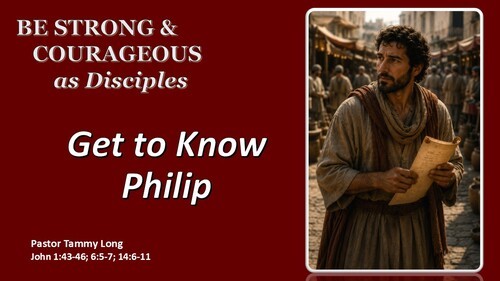
Be Strong and Courageous as Disciples: Get to Know Philip
John 1:43-46; 6:5-7; 14:6-11
By Pastor Tammy Long
For Your Heart Today
One of the beautiful truths we discover as we spend time with Jesus' friends is that they were wonderfully different from one another. They each experienced the world through their own personalities, perspectives, strengths, and questions. Yet Jesus never asked them to become someone else. Instead, He patiently formed each of them into the disciple God had created them to be.
Philip reminds us that discipleship is not about abandoning the way God has wired us but allowing Jesus to enlarge the way we see. Practical and thoughtful, Philip naturally began with what could be counted, measured, and understood. Again and again, Jesus met him there-not to dismiss those gifts, but to stretch them beyond what could be calculated into a deeper trust.
Perhaps you can relate. Maybe you've looked at your circumstances, counted the cost, and wondered how God could possibly make a way. Or perhaps you've longed to know God more deeply and found yourself praying Philip's heartfelt request: "Lord, show us the Father."
Philip's story reminds us that the answer to both longings is found in Jesus. The One who sought Philip is still seeking us. The One who patiently formed Philip is still forming us. And the One who revealed the Father to Philip continues to make the Father known to all who will look at Him.
This week, may we pray with fresh expectancy, "Jesus, help me to see You again."
Takeaways
- Jesus seeks us before we ever think to seek Him. Philip's journey begins not with his search for Jesus, but with Jesus finding him and inviting him to follow.
- Jesus forms the way He created us. Rather than rejecting Philip's practical and thoughtful nature, Jesus patiently stretched those gifts into deeper faith.
- Faith invites us to trust beyond what we can calculate. God often calls us to look beyond what can be counted, measured, or planned without abandoning wisdom or faithful stewardship.
- If you want to know what God is like, look at Jesus. In Christ we see the Father's compassion, grace, truth, mercy, and love revealed.
- The invitation remains the same: keep looking at Jesus. The more clearly we see Him, the more clearly we come to know the heart of the Father.
Breath Prayer
Inhale: Jesus, help me
Exhale: To see You.
Full Sermon Estimated Reading Time: ~ 24-26 minutes

Be Strong and Courageous as Disciples: Get to Know Philip
John 1:43-46; 6:5-7; 14:6-11
By Pastor Tammy Long
Introduction
I'm not a huge camper, but I do love a good campfire. There's something warm, inviting, and intimate about gathering around one to enjoy sharing stories, laughing, and simply being together.
If you were here last week, you know that is the image we are holding for our summer series, Be Strong and Courageous as Disciples. We're imagining those moments at the end of the day when Jesus and His friends might have gathered around the fire to unwind, enjoy one another's company, and talk about everything that had happened.
Last week we got to know Jesus' friend Andrew, who accepted Jesus' invitation to "Come and see." We discovered Andrew to be a spiritual seeker who loved bringing others to Jesus.
Today we're going to meet another friend of Jesus who had a very different personality.
I doubt they talked much about personality types in Jesus' day. It was what it was.
But I can remember when I was first introduced to the Myers-Briggs Personality Inventory many years ago. I don't even know if it's still used as much today, but for years it was a common tool in leadership development, team building, and human resources.
One of the things I appreciated about it wasn't so much the personality labels themselves, but that it gave language to something we already knew to be true: that God has wonderfully wired us to experience the world differently.
As I share a few examples of these different ways of experiencing the world, I wonder who comes to your mind. It might be a spouse, one of your children, a close friend, or a coworker. Or perhaps you'll simply smile and say, "That's me."
I know you know them. The people who draw energy from being around others. Put them in a room full of people and they come alive. Then there are those who enjoy people, yes, but after a while they're ready for some quiet. Solitude is where they get their energy.
There are people who naturally begin with what is concrete-what they can see, touch, hear, measure, and verify. Others naturally begin with a vision. They focus on what could be, the possibilities, patterns, and connections that aren't always tangible or obvious.
And then when it comes to making decisions, there are those who instinctively start with, "What's the most logical or practical thing to do?" While others naturally begin with, "How will this affect the people involved? Or how does it align with what matters most?" They naturally begin with the relationships and the values they hold deeply.
None of these ways of experiencing the world are better or worse. And most of us don't fit neatly into one category or another. We usually find ourselves somewhere along the continuum.
Isn't it amazing that God created such wonderful diversity? Every personality, every temperament, every strength reflects something of His creativity and something about God Himself. However God has wired us, we were created with intention and purpose.
As we gather around the campfire and get to know Jesus' friends, we'll discover the disciples weren't all alike either. They all experienced the world differently. They each brought unique strengths, perspectives, and areas for growth.
The way we experience the world-how we are wired-shapes what we naturally see and who we are. Jesus doesn't erase that when He calls disciples. Instead, He patiently forms each of us into the disciple God created us to be.
We'll see that firsthand as we meet Philip.
Getting to Know Philip
Philip is one of the Twelve disciples listed in all four Gospels, but the stories that allow us to get to know him are almost entirely found in the Gospel of John. John doesn't give us a full biography, but he does give us several revealing snapshots into his life.
Every time we encounter Philip, he's remarkably consistent. Different moments. Different conversations. But the same man.
As we get to know him, we begin to recognize one of those wonderfully unique ways of experiencing the world we talked about just a few moments ago.
Philip was from Bethsaida, the same hometown as Andrew, Peter, James, and John. So, while Scripture doesn't tell us how well they knew one another before following Jesus, it's hard to imagine they weren't at least acquainted. They likely worshiped in the same synagogue and shared many of the same community rhythms.
Now, Philip's name is an interesting detail. We know all the disciples were Jewish, yet the name Philip is actually Greek rather than Hebrew. Somewhere in his family's story there appears to have been a Greek influence or cultural connection.
Bethsaida itself was located in a region where Jewish and Greek cultures regularly intersected, and Philip seems to have moved comfortably between those worlds.
In fact, you may remember from last week's message that when some Greeks wanted to meet Jesus, they approached Philip. Philip, in turn, brought them to Andrew, and together they brought them to Jesus.
I love that small glimpse into Philip's life. It suggests he was approachable, and it speaks to the power of the Gospel to cross cultural, ethnic, and social boundaries. Perhaps Philip's background uniquely prepared him to help build that bridge.
We don't know the details of the story, but we do know this: Jesus has a way of preparing us through our experiences to help others find their way to Him.
As I prepared this message, I noticed that Philip is sometimes described with words that aren't especially complimentary. Slow to understand. Unimaginative. Overly materialistic. Weak in faith.
I can understand how people arrive at those conclusions from the biblical stories. But it also made me wonder how often we evaluate people through the lens of our own personalities and preferred ways of experiencing the world.
The truth is, none of us were there to meet Philip personally. We're piecing together his story from the glimpses John gives us.
What if we looked at Philip through a different lens?
As we get to know Philip, I see a man who is practical, thoughtful, concrete, and logical. He naturally begins with what can be seen, measured, counted, and verified. Those same qualities some have dismissed may well have been among the very gifts Jesus intended to shape and use.
Jesus knew Philip completely. He knew exactly how Philip was wired. And He knew exactly how to form those gifts into the strong and courageous disciple He had created him to become.
In fact, before Philip ever went looking for Jesus, Jesus went looking for Philip.
Which brings us to the story of our text. John 1:43-46 (NLT)
43 The next day Jesus decided to go to Galilee. He found Philip and said to him, "Come, follow me." 44 Philip was from Bethsaida, Andrew and Peter's hometown.
45 Philip went to look for Nathanael and told him, "We have found the very person Moses[a] and the prophets wrote about! His name is Jesus, the son of Joseph from Nazareth."
46 "Nazareth!" exclaimed Nathanael. "Can anything good come from Nazareth?"
"Come and see for yourself," Philip replied.
Glimpse One: Jesus Found Philip
I think my favorite phrase in this entire passage is, "Jesus found Philip."
Last week we watched Andrew seeking Jesus. This week we see the flip side of reality: Jesus was seeking Philip. Both are true. We seek Him because He first seeks us.
We often emphasize our search for God, but John reminds us of an equally beautiful truth: before Philip ever went looking for Jesus, Jesus had already gone looking for him. Out of all the people Jesus could have sought that day, John says, "He found Philip."
It really shouldn't surprise us because this is who Jesus is. Throughout the Gospels we see Him seeking people. He is the Good Shepherd who leaves the ninety-nine to go looking for the one. On that day, Philip was one of those Jesus went to find.
The same is true for us. Jesus knows us. He knows where to find us, and He still comes looking for those who don't yet know Him.
The question is not whether Jesus is seeking us. The question is, how will we respond when He says, "Come, follow me"?
John doesn't tell us what happened when Jesus found Philip. We don't know what Jesus said beyond His simple invitation. We simply know there was something about Jesus, something so compelling, that Philip followed Him immediately.
Now notice what Philip does next. The text says he goes and finds Nathanael. He tells him, "We have found the very person Moses and the prophets wrote about! His name is Jesus, the son of Joseph from Nazareth."
Now Nathanael isn't convinced. He has questions, even some bias. We'll come back to his story another week.
But Philip's response is classic. He doesn't argue. He doesn't try to answer Nathanael's objections. He doesn't feel the need to build a case for Jesus. Instead, what we see is a beautiful, non-anxious, invitational moment. He simply says, "Come and see for yourself." That's all. Philip had experienced enough of Jesus to invite someone else to meet Jesus for himself.
You know, that's a good model for us.
We don't have to have all the answers or know everything about the Bible and theology. Sometimes all we have to do is say, "Come and see," because Jesus is already seeking people with the invitation, "Come, follow Me."
That was Philip's story, and he was excited to share it.
Glimpse Two: Jesus Enlarges Philip's Vision
When we meet up with Philip again, we are where we were last week with Andrew, when Andrew brought the little boy with five loaves and two fish.
Today I want to step back into that very same story, only this time we're going to stand beside Philip.
5 When Jesus looked up and saw a great crowd coming toward him, he said to Philip, "Where shall we buy bread for these people to eat?" 6 He asked this only to test him, for he already had in mind what he was going to do.
7 Philip answered him, "It would take more than half a year's wages[a] to buy enough bread for each one to have a bite!"
Now this is an interesting exchange because we see that Jesus turned directly to Philip and asked, "Where can we buy bread to feed all these people?" Then the Gospel writer immediately adds that Jesus was asking to test him, for He already had in mind what He was going to do.
Now, the word test here doesn't mean Jesus was trying to trap Philip or make him fail. The word also carries the idea of examining or stretching someone for the purpose of growth. From the context, we can tell that is exactly what Jesus is doing. Jesus' question wasn't for information. It was for formation.
Remember, Philip naturally experiences the world through the practical, concrete, measurable, and logical. So, when Jesus asked where they were going to buy bread, Philip was ready. I imagine he had already surveyed the situation and assessed the need.
He knew the size of the crowd. He knew how much was in the purse. He knew what bread cost. And he knew two hundred denarii, about eight months' wages, wouldn't be enough.
Now some have critiqued Philip for focusing on the practical realities, but I want to encourage us to remember that the Kingdom of God needs people like Philip. The Kingdom needs logical planners, people who ask thoughtful questions, people who understand budgets, count the cost, and steward God's resources wisely.
So to me, Philip was faithfully answering the question Jesus had asked through the way he naturally experienced the world.
But Jesus was also inviting him to think beyond what he could calculate-not to ignore the numbers or stop being practical, but to allow faith to enlarge both the way he saw the situation and what he believed God could do.
I wonder if, after walking with Jesus another year or so, Philip might answer this question quite differently.
I can almost hear him saying,
"Lord, we have two hundred denarii. I know that's not enough to feed this crowd. But I've walked with You long enough to know that somehow You're going to make a way."
How many of you have experienced exactly that?
You've looked at the numbers. You tried to balance the budget. You paid the bills you could. And it still just doesn't look like enough.
But somehow, God made a way, just as He made a way that day by multiplying five loaves and two fish.
Every year as a church we prepare what we call a faith-stretch budget. We begin exactly where Philip began. We count carefully. We seek to steward wisely.
Then we pray, "Lord, what might You choose to do beyond what we can presently calculate?" And we prayerfully set the budget with a faith stretch.
Sometimes God exceeds what we could have imagined. Sometimes He provides exactly what we need. Sometimes He gives wisdom for a lean season.
Whatever the outcome, we've learned to trust Him.
That was the invitation Jesus was placing before Philip: to trust beyond what he could touch, count, or plan because he could trust Jesus.
I wonder if Jesus is placing that very same invitation before some of us today-to stretch beyond what we can count, touch, or plan.
Glimpse Three: Jesus Reveals the Father
Well, continuing with Philip, when we meet him again, several years have now passed since Jesus first found Philip. He has watched Jesus teach, heal, feed the hungry, calm storms, raise the dead, and love people with extraordinary compassion.
Philip has been walking with Jesus every day, and now, on the night before the crucifixion, Jesus gathers His disciples for one final conversation.
6 Jesus answered, "I am the way and the truth and the life. No one comes to the Father except through me. 7 If you really know me, you will know[a] my Father as well. From now on, you do know him and have seen him."
8 Philip said, "Lord, show us the Father and that will be enough for us."
9 Jesus answered: "Don't you know me, Philip, even after I have been among you such a long time? Anyone who has seen me has seen the Father. How can you say, 'Show us the Father'? 10 Don't you believe that I am in the Father, and that the Father is in me? The words I say to you I do not speak on my own authority. Rather, it is the Father, living in me, who is doing his work. 11 Believe me when I say that I am in the Father and the Father is in me; or at least believe on the evidence of the works themselves.
Jesus has just said, "I am the way, the truth, and the life... If you really know Me, you will know My Father as well. From now on, you do know Him and have seen Him."
It is those words that prompt Philip's question. "Lord, show us the Father, and that will be enough for us."
I have to admit, I love Philip's question because I hear the earnest heart of a disciple who genuinely longs to know God. Someone who longs to see, to understand, to experience as clearly as possible. So it doesn't surprise me that Philip is the one to ask, "Show us the Father."
To which Jesus answers,
"Don't you know me, Philip, even after I have been among you such a long time? Anyone who has seen me has seen the Father. How can you say, 'Show us the Father'? 10 Don't you believe that I am in the Father, and that the Father is in me? The words I say to you I do not speak on my own authority. Rather, it is the Father, living in me, who is doing his work. 11 Believe me when I say that I am in the Father and the Father is in me… (John 14:9-11a, NIV)
Now I want to pause for just a moment here because, to our modern ears, those words can sound like a harsh rebuke, especially depending on what Bible translation you read.
But here's the thing to keep in mind. We can't hear Jesus' tone of voice. We don't know His facial expression or see His body language. We tend to hear through the voices in our heads-harsh voices, kind voices. You see that through text messages, right? We can interpret tone differently and be completely wrong.
So, in moments like this, we have to let the full character of Jesus shape the way we hear His words. The Jesus who welcomed little children, restored Peter after his failure, wept with Mary and Martha, and prayed for those who crucified Him. Jesus' love is consistently tender and compassionate. He's not suddenly impatient with Philip.
When I hear these words, I don't hear anger or even reprimand. I hear a kind of grief. Not grief because Philip is slow to understand or because he has asked a foolish question, but the sadness of Someone who deeply loves His friend and longs for him to recognize the truth of what has been before him all along.
Have you ever felt that ache because someone doesn't understand something you really, really want them to understand?
I hear Jesus saying, in essence,
"Philip... you've been walking with Me. You've been listening to Me. You've watched Me heal, forgive, teach, feed, and love. And every act of compassion, every miracle, every word of truth has been revealing the very heart of the Father. Philip, when you've been looking at Me, you've been looking at the Father."
Now, for someone wired like Philip-and I doubt he was the only one-that probably took a moment to absorb because Jesus wasn't saying, "Let me tell you about the Father." And He wasn't saying, "I know the Father." He wasn't even saying, "I represent the Father."
He was saying, "If you have seen Me, you have seen the Father."
Let's not rush past those words.
If you've ever wondered what God is like... look at Jesus.
If you've ever wondered whether God welcomes the broken... look at Jesus.
If you've ever wondered whether God forgives... look at Jesus.
If you've ever wondered whether God is compassionate... look at Jesus.
Look at Jesus.
Continuing with verse 11, Jesus goes on to say,
… or at least believe on the evidence of the works themselves.
That really touched me because I see Jesus graciously meeting Philip in the way he naturally experiences the world.
Jesus has just revealed His oneness with the Father. And it was an astonishing and mysterious claim. No wonder Philip needed a minute to take it in.
It's no wonder Jesus immediately points Philip to everything he has seen and experienced. In effect, Jesus says, "Philip, start there with the evidence of the works themselves. Think about everything you've witnessed. And connect the dots."
Jesus doesn't dismiss the way Philip is wired. He uses it, to help Philip recognize the One those works have been revealing all along.
Closing
As I prayed through Philip's story this week, I found myself asking that same question:
"Lord, what do You want to say to us through Philip?"
First, I think we are reminded that we all have a natural way of experiencing the world, a certain lens through which we see life. We see this in Philip and how Jesus didn't reject the way Philip was wired. He lovingly stretched him beyond it.
But I don't think that's the only invitation of this story.
I wonder if Philip would also say, "Look at Jesus."
Don't make Jesus smaller than He is. Sometimes our picture of Jesus is too narrow, too limited by our own vantage point. Like Philip, we can spend years walking with Jesus and still miss so much because there's so much more to see.
What if the invitation isn't to try harder, but to look at Jesus again?
Look again at how He loved people.
Look again at how He treated those everyone else overlooked.
Look again at His compassion, His grace, His truth, His courage, His mercy.
Because the more clearly we see Jesus, the more clearly we see the Father.
The promise of Philip's story is that the same Jesus who found Philip has found us.
The same Jesus who patiently formed Philip is patiently forming us.
And the same Jesus who revealed the Father to Philip is still making the Father known to us today through His Spirit.
May we have eyes to see Him afresh.
No Comments