
Loving The Stranger: Rooted in Truth, Rising in Hope — A Thanksgiving of Lament and Liberation
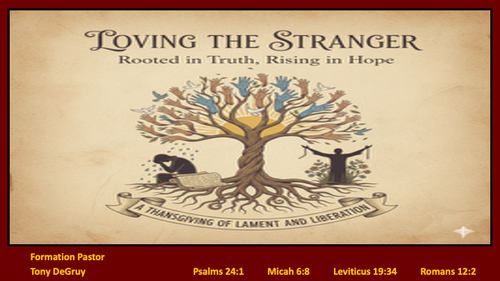
For Your Heart Today
As we enter Thanksgiving week, many of us prepare to gather around tables filled with food, gratitude, and tradition. Yet for followers of Jesus, this season is more than a celebration — it is an invitation to step into truth, lament, justice, and hope.
Today’s message calls us to love the stranger, confront the myths we’ve inherited, and see Thanksgiving through a gospel lens: one that tells the truth, laments what is broken, honors the original stewards of this land, and points us toward shalom — God’s vision of wholeness and restoration for all creation.
This message will challenge, stretch, and deepen us. And it will invite us to rise in hope.
3 Takeaways
1. Truth-Telling
Thanksgiving without truth becomes sentimentality. Thanksgiving with truth becomes holy.
We tell the truth because the gospel compels it — and because reconciliation cannot begin without it.
2. Lament
Lament is not despair. It is honest grief before God that makes room for healing and hope.
Lament keeps our hearts tender and responsive to justice.
3. Hope-Filled Action
Shalom comes through repentance, repair, justice, solidarity, and radical welcome — including welcoming immigrants, refugees, Indigenous neighbors, and the strangers among us.
Breath Prayer
Inhale: Open my eyes to truth…
Exhale: …and guide my steps toward justice.
Full manuscript — estimated reading time: 16–18 minutes
As we enter Thanksgiving week, many of us prepare to gather around tables filled with food, gratitude, and tradition. Yet for followers of Jesus, this season is more than a celebration — it is an invitation to step into truth, lament, justice, and hope.
Today’s message calls us to love the stranger, confront the myths we’ve inherited, and see Thanksgiving through a gospel lens: one that tells the truth, laments what is broken, honors the original stewards of this land, and points us toward shalom — God’s vision of wholeness and restoration for all creation.
This message will challenge, stretch, and deepen us. And it will invite us to rise in hope.
3 Takeaways
1. Truth-Telling
Thanksgiving without truth becomes sentimentality. Thanksgiving with truth becomes holy.
We tell the truth because the gospel compels it — and because reconciliation cannot begin without it.
2. Lament
Lament is not despair. It is honest grief before God that makes room for healing and hope.
Lament keeps our hearts tender and responsive to justice.
3. Hope-Filled Action
Shalom comes through repentance, repair, justice, solidarity, and radical welcome — including welcoming immigrants, refugees, Indigenous neighbors, and the strangers among us.
Breath Prayer
Inhale: Open my eyes to truth…
Exhale: …and guide my steps toward justice.
Full manuscript — estimated reading time: 16–18 minutes
Introduction
Good morning, SBCC family. Let me begin by saying that as I wrestled with this message, I was all over the place. By that, I mean I kept asking God, “Are You sure?” “Are You really sure?” You see, my original title for this message was” Welcoming the Stranger: Thanksgiving Myth Busters”. In fact, when I shared it with Iris, she asked, somewhat jokingly, “Are you gonna get fired? Are we going to have to leave the church?” I believe she was joking; however, she may have been serious. You can ask her yourself.
Nevertheless, I have come to know that we are not going to leave the church every Sunday, having heard a message that leaves us feeling all “sunshine and puppies”. There will be times when the message from the pulpit will challenge us in myriad ways. This, family, will be one of those Sundays for some of you.
I want to call out a couple of things for this message:
First, for this message, any New Testament passages will be read from the First Nations Version, An Indigenous Translation of the New Testament. If you do not have one, I strongly encourage you to add one to your library.
Secondly, I want to call your attention to the intentionality of this pulpit to ensure that we are threading messages across themes in an attempt to have us connect the dots to see what God is doing and calling us to do in a particular area, in this case, what He is doing and calling us to do as it relates to loving those we consider others. Also, while the title of the book is Welcoming the Stranger, and welcoming speaks to hospitality and is powerful, Pastor Tammy reminded me that the act of loving the stranger takes it to the next level of intentionality, engagement, and action.
Lastly, for me, this is yet another message rooted in justice, for which I am passionate, like Dr. King, I will continue to sound the alarm for racial righteousness and reconciliation “until justice rolls down like water and righteousness like a mighty stream.”
This coming Thursday, many of us will gather around tables filled with food, laughter, and gratitude. Thanksgiving is a beautiful tradition—but it’s also a complicated one.
We’ve been taught a story: Pilgrims and Native Americans sharing a peaceful meal, a picture of harmony. But the truth? That story hides a history of broken treaties, stolen land, and cultural genocide. The first Thanksgiving feast was followed by centuries of violence against Indigenous peoples.
So what do we do with that? Do we cancel Thanksgiving? No, absolutely not. We redeem it. We tell the truth. We lament. And we live into the hope of God’s shalom—a world made whole.
As we embark on this message, I want to state that, as my friend and brother, Dominique Gilliard reminds us, “Truth and reconciliation are not simultaneous. They are sequential. Tell the truth first, and it’s the truth that motivates you to understand what it will take to recover, repair, endure—to reconcile.”
Today, we’ll explore three movements: truth-telling, lament, and hope-filled action.
Psalm 24:1 – “The earth is the Lord’s and everything in it.” (NLT)
Micah 6:8 – “Do justice, love mercy, walk humbly.” (NLT)
Leviticus 19:34 – “The alien who resides with you shall be to you as the native-born among you; you shall love the alien as yourself, for you were aliens in the land of Egypt: I am the Lord your God.” (NRSVUE)
Romans 12:2 – “Do not permit the ways of this world to mold and shape you. Instead, let Creator change you from the inside out, in the way a caterpillar becomes a butterfly. He will do this by giving you a new way of thinking, seeing, and walking. Then you will know for sure what the Great Spirit wants for you, things that are good, that make the heart glad, and that help you walk the path of becoming a mature and true human being.” (FNV)
Truth-telling
The Thanksgiving myth is neat and tidy: Pilgrims and “Indians” sharing turkey and gratitude. But the truth is messy, real messy. After that meal, land was seized, treaties broken, and Indigenous peoples enslaved or killed.
Something else very interesting took place on that dreadful Thanksgiving Day, as Anna Ross, a member of the Turtle Mountain Band of Ojibwe of Chippewa Indians, shares in her liturgical reflection based on the book, “Welcoming the Stranger. “Several years ago, I sat in a conference listening to the opening remarks from a young woman from the Wampanoag tribe. What she shared is something I will never forget. She spoke candidly about growing up feeling embarrassed to say she was Wampanoag, the tribe known for having first contact with the “Pilgrims.” That historical association had long carried a weight of shame. But then her voice shifted when she shared that she no longer felt that weight—instead, she felt pride. Her ancestors were not merely present at the beginning of colonization—they were instrumental to the settlers’ survival. They taught the English how to plant crops, where to fish and hunt, and how to live in harmony with the land. These were the actions, not of a conquered people but of a people rooted in wisdom, hospitality, and strength.
This sanitized version is, in fact, less teaching and more indoctrination. We take people who were starved, diseased, and dying in droves, and we sanitize the picture by saying they were hungry and sick. We tell the story from the pilgrims’ perspective and end it at the feast. We don’t continue to the part where the pilgrims, many of whom, if not all, were peasants, and later the Puritans, felt the crush of European immigration and broke the covenant with the Wampanoag people. The Puritans warred for more land, and eventually, Rev. John Eliot led the movement to convert the enemy rather than kill them outright. So they set up 14 prayer towns — whole towns dedicated to transforming the Wampanoag, Pequot, Algonquin, and Mohegan peoples, migratory hunting peoples, into sedentary praying subjects of the English crown. Those who did not convert were enslaved and shipped to islands in the Caribbean or enslaved by Puritans throughout the colonies. In fact, this past Wednesday, a friend shared that one of her ancestors was one of the folks sent to one of the prayer towns. If you join us for Glow Up following today’s service, I will share the details with you.
What’s more, in the telling of these stories, the church was complicit. The Doctrine of Discovery—a 15th-century papal decree—gave theological cover for colonization. It said Christian nations had the right to claim lands and dominate non-Christian peoples. This doctrine institutionalized white supremacy and American triumphalism, deeply damaging Indigenous peoples and corrupting Christian theology.
That’s not the Gospel. That’s empire.
Even today, the Evangelical Covenant Church has publicly repudiated this doctrine, calling it “fundamentally opposed to the gospel of Jesus Christ.” This document is available on the Advocates4Justice website if you are interested in reading or sharing it.
Family, while that’s a start, true repentance requires action.
Why does this matter for us? Because Jesus said, “Then you will see and understand the truth that sets all people free.” Thanksgiving without truth is sentimentality. Thanksgiving with truth becomes holy.
Lament
This brings us to lament, which, family, I want us to look at through Jesus’ eyes. Lament is more than feeling bad about the choices we have made. Lament is a spiritual discipline; it is the faithful practice of bringing our sorrow, pain, and confusion before God in honest prayer. It is not merely an emotional outpouring but a sacred act of trust, acknowledging that God can handle our most profound grief and unanswered questions.
Through lament, we refuse to suppress suffering or disguise despair with shallow optimism; instead, we enter into a dialogue with a God who listens, grieves, and redeems. In Scripture, lament is woven throughout the Old Testament and even the life of Jesus, teaching that sorrow expressed in faith can become a pathway to hope. Practicing lament cultivates spiritual maturity by keeping our hearts tender, attentive to injustice, and anchored in the steadfast love of God even in seasons of silence or chaos. Lament is not despair—it’s honest grief before God. One-third of the Psalms are laments. They teach us that faith is not pretending everything is fine. Lastly, lament is both an individual and corporate practice within communities of faith.
Today, we lament corporately, we lament:
For stolen lands and broken treaties.
For churches that blessed oppression.
For creation groaning under exploitation.
Randy Woodley, an Indigenous theologian, says we must leave behind the “American dream—an Indigenous nightmare” and walk toward harmony with creation. That’s what lament does: it clears space for new life.
Let’s pause for a moment of silence and then read this prayer:
Leader: O Great Spirit, Creator of all things, we come with heavy hearts.
People: Hear our sorrow, heal this land, and guide us on your Good Road.
Leader: We lament the broken treaties and stolen lands.
People: Restore harmony and teach us to walk humbly.
Leader: We grieve for the voices silenced and the stories untold.
People: Help us listen with open hearts and honor every nation.
Leader: We confess the harm done by those who claimed your name.
People: Lead us away from the broken ways and into your way of peace.
Leader: Creator, make us instruments of healing and justice.
People: Together we walk the Good Road toward harmony and hope.
Hope-filled Action
Decolonizing Christianity means disentangling our faith from the cultural, political, and racial power structures that European colonialism attached to it. It calls for a return to the liberating message of Jesus that uplifts the oppressed and exposes systems of domination. This work involves re-examining biblical interpretation, theology, and church practices to uncover colonial assumptions—such as equating whiteness with holiness or Western culture with divine truth. It also affirms the diverse ways people around the world have encountered and expressed the gospel long before and beyond European influence. At its heart, decolonizing Christianity seeks to restore the faith’s global, justice-centered, and incarnational character, grounded in the reconciling love of God for all peoples.
One of my professors, Dr. Gigi Khanyezi, shared this. I want to share it with you: "The greatest act of solidarity in all of history was God putting Himself on earth in the form of Jesus of Nazareth, a brown, colonized, marginalized, wrongly arrested, wrongly incarcerated Jewish man who was lynched by the state."
Family, decolonizing Christianity means rejecting any sort of supremacy and embracing liberation. Romans 12:2 says, “Do not permit the ways of this world to mold and shape you…” Colonialism is a pattern of domination.
What does decolonizing look like?
Repentance: Naming complicity in injustice.
Reconstruction: Re-centering voices of color, Indigenous wisdom, and justice.
Thanksgiving is not just about gratitude—it’s about justice at the table. Who is missing from our tables? Whose stories are silenced?
Welcoming the Stranger calls the church to respond to immigrants and refugees through a lens shaped by scripture, compassion, and justice. The book challenges contemporary believers to move beyond political debates and instead remember that immigration is, first and foremost, about people—real lives, hopes, and fears, often marked by suffering and resilience. Grounded in biblical mandates from both the Old and New Testaments, the authors remind us that identifying with and offering hospitality to the stranger is core to the Christian tradition, urging followers of Jesus to reclaim the radical ethic of welcoming outsiders as an expression of God’s love.
Drawing on stories, policy analysis, and profound theological reflection, Welcoming the Stranger demonstrates that treating immigrants with dignity and care is not merely a social project but a reflection of the heart of the gospel itself. The authors offer practical guidance for us as we seek to minister to newcomers and challenge us to reexamine our priorities, ensuring they are rooted in scriptural values rather than political identity. Ultimately, we are called to embody a Christianity marked by justice, redemption, and mutual transformation—a faith in which welcoming the stranger becomes a prophetic witness to God’s expansive grace.
Family, I submit to you that hospitality is a biblical mandate, not a political option. Immigration debates today echo the historic exclusion of Indigenous peoples. We can, and we must do better than this.
Leviticus 19:34 says, “The stranger who resides with you shall be to you as the native among you.” God calls us to welcome radically!.
This Thanksgiving, again, I challenge each of us to ask: Who is missing from our tables? Refugees? Immigrants? Neighbors who feel unseen? And, as Pastor Tammy reminded us last Sunday, perhaps even estranged family members?
Lisa Sharon Harper writes in her seminal work, “The Very Good Gospel”, that God’s original intent was shalom—wholeness, justice, reconciliation for all creation. She goes on to say that if the Gospel is not “good news” for everyone—especially those who are poor, oppressed, or marginalized—then it is not truly the Gospel of Jesus.
This vision of Shalom, Colonialism shattered that. But Jesus came to restore it.
Thanksgiving can be a foretaste of shalom when:
We honor the land and its original stewards.
We share resources equitably.
We commit to repairing broken relationships.
Family, we are called to move from lament to action. From myth to truth. From domination to harmony.
May the God who created all things very good restore shalom in our hearts, our homes, and this land. May our tables be places of truth, justice, and radical welcome. Go forth as rooted, liberated, and courageous disciples.
Amen.
Good morning, SBCC family. Let me begin by saying that as I wrestled with this message, I was all over the place. By that, I mean I kept asking God, “Are You sure?” “Are You really sure?” You see, my original title for this message was” Welcoming the Stranger: Thanksgiving Myth Busters”. In fact, when I shared it with Iris, she asked, somewhat jokingly, “Are you gonna get fired? Are we going to have to leave the church?” I believe she was joking; however, she may have been serious. You can ask her yourself.
Nevertheless, I have come to know that we are not going to leave the church every Sunday, having heard a message that leaves us feeling all “sunshine and puppies”. There will be times when the message from the pulpit will challenge us in myriad ways. This, family, will be one of those Sundays for some of you.
I want to call out a couple of things for this message:
First, for this message, any New Testament passages will be read from the First Nations Version, An Indigenous Translation of the New Testament. If you do not have one, I strongly encourage you to add one to your library.
Secondly, I want to call your attention to the intentionality of this pulpit to ensure that we are threading messages across themes in an attempt to have us connect the dots to see what God is doing and calling us to do in a particular area, in this case, what He is doing and calling us to do as it relates to loving those we consider others. Also, while the title of the book is Welcoming the Stranger, and welcoming speaks to hospitality and is powerful, Pastor Tammy reminded me that the act of loving the stranger takes it to the next level of intentionality, engagement, and action.
Lastly, for me, this is yet another message rooted in justice, for which I am passionate, like Dr. King, I will continue to sound the alarm for racial righteousness and reconciliation “until justice rolls down like water and righteousness like a mighty stream.”
This coming Thursday, many of us will gather around tables filled with food, laughter, and gratitude. Thanksgiving is a beautiful tradition—but it’s also a complicated one.
We’ve been taught a story: Pilgrims and Native Americans sharing a peaceful meal, a picture of harmony. But the truth? That story hides a history of broken treaties, stolen land, and cultural genocide. The first Thanksgiving feast was followed by centuries of violence against Indigenous peoples.
So what do we do with that? Do we cancel Thanksgiving? No, absolutely not. We redeem it. We tell the truth. We lament. And we live into the hope of God’s shalom—a world made whole.
As we embark on this message, I want to state that, as my friend and brother, Dominique Gilliard reminds us, “Truth and reconciliation are not simultaneous. They are sequential. Tell the truth first, and it’s the truth that motivates you to understand what it will take to recover, repair, endure—to reconcile.”
Today, we’ll explore three movements: truth-telling, lament, and hope-filled action.
Psalm 24:1 – “The earth is the Lord’s and everything in it.” (NLT)
Micah 6:8 – “Do justice, love mercy, walk humbly.” (NLT)
Leviticus 19:34 – “The alien who resides with you shall be to you as the native-born among you; you shall love the alien as yourself, for you were aliens in the land of Egypt: I am the Lord your God.” (NRSVUE)
Romans 12:2 – “Do not permit the ways of this world to mold and shape you. Instead, let Creator change you from the inside out, in the way a caterpillar becomes a butterfly. He will do this by giving you a new way of thinking, seeing, and walking. Then you will know for sure what the Great Spirit wants for you, things that are good, that make the heart glad, and that help you walk the path of becoming a mature and true human being.” (FNV)
Truth-telling
The Thanksgiving myth is neat and tidy: Pilgrims and “Indians” sharing turkey and gratitude. But the truth is messy, real messy. After that meal, land was seized, treaties broken, and Indigenous peoples enslaved or killed.
Something else very interesting took place on that dreadful Thanksgiving Day, as Anna Ross, a member of the Turtle Mountain Band of Ojibwe of Chippewa Indians, shares in her liturgical reflection based on the book, “Welcoming the Stranger. “Several years ago, I sat in a conference listening to the opening remarks from a young woman from the Wampanoag tribe. What she shared is something I will never forget. She spoke candidly about growing up feeling embarrassed to say she was Wampanoag, the tribe known for having first contact with the “Pilgrims.” That historical association had long carried a weight of shame. But then her voice shifted when she shared that she no longer felt that weight—instead, she felt pride. Her ancestors were not merely present at the beginning of colonization—they were instrumental to the settlers’ survival. They taught the English how to plant crops, where to fish and hunt, and how to live in harmony with the land. These were the actions, not of a conquered people but of a people rooted in wisdom, hospitality, and strength.
This sanitized version is, in fact, less teaching and more indoctrination. We take people who were starved, diseased, and dying in droves, and we sanitize the picture by saying they were hungry and sick. We tell the story from the pilgrims’ perspective and end it at the feast. We don’t continue to the part where the pilgrims, many of whom, if not all, were peasants, and later the Puritans, felt the crush of European immigration and broke the covenant with the Wampanoag people. The Puritans warred for more land, and eventually, Rev. John Eliot led the movement to convert the enemy rather than kill them outright. So they set up 14 prayer towns — whole towns dedicated to transforming the Wampanoag, Pequot, Algonquin, and Mohegan peoples, migratory hunting peoples, into sedentary praying subjects of the English crown. Those who did not convert were enslaved and shipped to islands in the Caribbean or enslaved by Puritans throughout the colonies. In fact, this past Wednesday, a friend shared that one of her ancestors was one of the folks sent to one of the prayer towns. If you join us for Glow Up following today’s service, I will share the details with you.
What’s more, in the telling of these stories, the church was complicit. The Doctrine of Discovery—a 15th-century papal decree—gave theological cover for colonization. It said Christian nations had the right to claim lands and dominate non-Christian peoples. This doctrine institutionalized white supremacy and American triumphalism, deeply damaging Indigenous peoples and corrupting Christian theology.
That’s not the Gospel. That’s empire.
Even today, the Evangelical Covenant Church has publicly repudiated this doctrine, calling it “fundamentally opposed to the gospel of Jesus Christ.” This document is available on the Advocates4Justice website if you are interested in reading or sharing it.
Family, while that’s a start, true repentance requires action.
Why does this matter for us? Because Jesus said, “Then you will see and understand the truth that sets all people free.” Thanksgiving without truth is sentimentality. Thanksgiving with truth becomes holy.
Lament
This brings us to lament, which, family, I want us to look at through Jesus’ eyes. Lament is more than feeling bad about the choices we have made. Lament is a spiritual discipline; it is the faithful practice of bringing our sorrow, pain, and confusion before God in honest prayer. It is not merely an emotional outpouring but a sacred act of trust, acknowledging that God can handle our most profound grief and unanswered questions.
Through lament, we refuse to suppress suffering or disguise despair with shallow optimism; instead, we enter into a dialogue with a God who listens, grieves, and redeems. In Scripture, lament is woven throughout the Old Testament and even the life of Jesus, teaching that sorrow expressed in faith can become a pathway to hope. Practicing lament cultivates spiritual maturity by keeping our hearts tender, attentive to injustice, and anchored in the steadfast love of God even in seasons of silence or chaos. Lament is not despair—it’s honest grief before God. One-third of the Psalms are laments. They teach us that faith is not pretending everything is fine. Lastly, lament is both an individual and corporate practice within communities of faith.
Today, we lament corporately, we lament:
For stolen lands and broken treaties.
For churches that blessed oppression.
For creation groaning under exploitation.
Randy Woodley, an Indigenous theologian, says we must leave behind the “American dream—an Indigenous nightmare” and walk toward harmony with creation. That’s what lament does: it clears space for new life.
Let’s pause for a moment of silence and then read this prayer:
Leader: O Great Spirit, Creator of all things, we come with heavy hearts.
People: Hear our sorrow, heal this land, and guide us on your Good Road.
Leader: We lament the broken treaties and stolen lands.
People: Restore harmony and teach us to walk humbly.
Leader: We grieve for the voices silenced and the stories untold.
People: Help us listen with open hearts and honor every nation.
Leader: We confess the harm done by those who claimed your name.
People: Lead us away from the broken ways and into your way of peace.
Leader: Creator, make us instruments of healing and justice.
People: Together we walk the Good Road toward harmony and hope.
Hope-filled Action
Decolonizing Christianity means disentangling our faith from the cultural, political, and racial power structures that European colonialism attached to it. It calls for a return to the liberating message of Jesus that uplifts the oppressed and exposes systems of domination. This work involves re-examining biblical interpretation, theology, and church practices to uncover colonial assumptions—such as equating whiteness with holiness or Western culture with divine truth. It also affirms the diverse ways people around the world have encountered and expressed the gospel long before and beyond European influence. At its heart, decolonizing Christianity seeks to restore the faith’s global, justice-centered, and incarnational character, grounded in the reconciling love of God for all peoples.
One of my professors, Dr. Gigi Khanyezi, shared this. I want to share it with you: "The greatest act of solidarity in all of history was God putting Himself on earth in the form of Jesus of Nazareth, a brown, colonized, marginalized, wrongly arrested, wrongly incarcerated Jewish man who was lynched by the state."
Family, decolonizing Christianity means rejecting any sort of supremacy and embracing liberation. Romans 12:2 says, “Do not permit the ways of this world to mold and shape you…” Colonialism is a pattern of domination.
What does decolonizing look like?
Repentance: Naming complicity in injustice.
Reconstruction: Re-centering voices of color, Indigenous wisdom, and justice.
Thanksgiving is not just about gratitude—it’s about justice at the table. Who is missing from our tables? Whose stories are silenced?
Welcoming the Stranger calls the church to respond to immigrants and refugees through a lens shaped by scripture, compassion, and justice. The book challenges contemporary believers to move beyond political debates and instead remember that immigration is, first and foremost, about people—real lives, hopes, and fears, often marked by suffering and resilience. Grounded in biblical mandates from both the Old and New Testaments, the authors remind us that identifying with and offering hospitality to the stranger is core to the Christian tradition, urging followers of Jesus to reclaim the radical ethic of welcoming outsiders as an expression of God’s love.
Drawing on stories, policy analysis, and profound theological reflection, Welcoming the Stranger demonstrates that treating immigrants with dignity and care is not merely a social project but a reflection of the heart of the gospel itself. The authors offer practical guidance for us as we seek to minister to newcomers and challenge us to reexamine our priorities, ensuring they are rooted in scriptural values rather than political identity. Ultimately, we are called to embody a Christianity marked by justice, redemption, and mutual transformation—a faith in which welcoming the stranger becomes a prophetic witness to God’s expansive grace.
Family, I submit to you that hospitality is a biblical mandate, not a political option. Immigration debates today echo the historic exclusion of Indigenous peoples. We can, and we must do better than this.
Leviticus 19:34 says, “The stranger who resides with you shall be to you as the native among you.” God calls us to welcome radically!.
This Thanksgiving, again, I challenge each of us to ask: Who is missing from our tables? Refugees? Immigrants? Neighbors who feel unseen? And, as Pastor Tammy reminded us last Sunday, perhaps even estranged family members?
Lisa Sharon Harper writes in her seminal work, “The Very Good Gospel”, that God’s original intent was shalom—wholeness, justice, reconciliation for all creation. She goes on to say that if the Gospel is not “good news” for everyone—especially those who are poor, oppressed, or marginalized—then it is not truly the Gospel of Jesus.
This vision of Shalom, Colonialism shattered that. But Jesus came to restore it.
Thanksgiving can be a foretaste of shalom when:
We honor the land and its original stewards.
We share resources equitably.
We commit to repairing broken relationships.
Family, we are called to move from lament to action. From myth to truth. From domination to harmony.
May the God who created all things very good restore shalom in our hearts, our homes, and this land. May our tables be places of truth, justice, and radical welcome. Go forth as rooted, liberated, and courageous disciples.
Amen.
Recent
Be Strong Courageous In This Season: My Story In Gods Story
October 6th, 2026
Be Strong and Courageous in This Season: Being & Doing
September 28th, 2026
Be Strong and Courageous in This Season: God's Story in Your Story
September 21st, 2026
Be Strong Courageous in this Season
September 14th, 2026
Be Strong Courageous as Disciples: Get to Know Judas
September 7th, 2026
Archive
2026
January
February
March
Be Strong Courageous in Body Mind Spirit: Care for the BodyBe Strong & Courageous in Body, Mind & Spirit: Care for the MindBe Strong & Courageous in Body, Mind & Spirit: Care for the SpiritBe Strong & Courageous in Body, Mind & Spirit Seeing the Peace We MissBe Strong & Courageous in Body, Mind & Spirit: Living Aligned
April
May
June
Be Strong Courageous in Community: Making Room for All Nations (AANHPI Heritage Month)Be Strong Courageous in Community: The Courage to Speak Truth in LoveBe Strong Courageous: The Courage to Choose WiselyBe Strong Courageous in Community The Courage to BlessBe Strong Courageous in Community: The Courage to Love Like Jesus
July
August
September
2025
January
February
March
April
May
June
July
August
September
October
November
2024
January
February
No Comments