
Be Strong Courageous in the Word: A Word That Reads Us
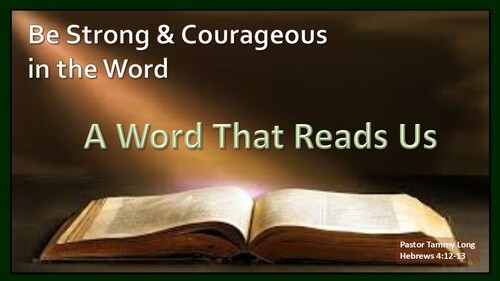
For Your Heart Today
Many of us love the parts of Scripture that comfort and encourage—and God does use His Word that way. But Hebrews reminds us that God’s Word also reads us. It is alive and active, precise and penetrating, able to reach beneath the surface of what we present to others (and even to ourselves). Not to shame us—but to bring clarity, healing, and deeper trust. The goal isn’t exposure for embarrassment; it’s invitation into rest: fully seen, fully known, and fully loved.
3 Takeaways
Breath Prayer
Inhale: Lord, let Your Word read me.
Exhale: Lead me into trust and rest.
Full Manuscript — Estimated Reading Time: 20–25 minutes
Many of us love the parts of Scripture that comfort and encourage—and God does use His Word that way. But Hebrews reminds us that God’s Word also reads us. It is alive and active, precise and penetrating, able to reach beneath the surface of what we present to others (and even to ourselves). Not to shame us—but to bring clarity, healing, and deeper trust. The goal isn’t exposure for embarrassment; it’s invitation into rest: fully seen, fully known, and fully loved.
3 Takeaways
- God’s Word is alive and active.
Scripture is not static information—it is God speaking in the present through the Spirit. - God’s Word is precise.
Like a scalpel, it reaches beneath the surface and brings clarity to what is tangled within us—motives, fears, desires, and faith. - God’s Word exposes so we can heal and rest.
Being “seen” by God is not condemnation—it’s an invitation to stop hiding, trust God’s love, and draw near with courage.
Breath Prayer
Inhale: Lord, let Your Word read me.
Exhale: Lead me into trust and rest.
Full Manuscript — Estimated Reading Time: 20–25 minutes
Be Strong and Courageous in the Word: A Word That Reads Us
Hebrews 4:12–13 (NLT)
By Pastor Tammy Long
Introduction
I want to begin today with a memory. You know how sometimes things pop into your head that can feel quite random? Well, recently I remembered something from my childhood.
I grew up in New Jersey, and one place I remember going to as a little girl was Palisades Amusement Park. It was one of those old, classic amusement parks—built long before polished theme parks were a thing. It opened in 1898, ten years before the Santa Cruz Beach Boardwalk on this coast. I remember there were arcade games, a Ferris wheel, a giant wooden roller coaster, even a tunnel of love, but my favorite attraction back then was the fun house.
Just getting into the fun house was an adventure. There were these moving steps that immediately threw off your balance, making you slow down just to ascend. Once inside, there was a maze you had to find your way through—twists, turns, and dead ends—until eventually you reached the exit, which, if I remember correctly, was a giant slide. But right before you got out, you had to walk through the hall of mirrors.
Do you remember those?
Every mirror had a different view. One mirror stretched you tall and thin, another shrunk you down and squatty. One stretched you wide and distorted everything; still another distorted your reflection in a scary way.
We laughed, pointed at each other, and moved from mirror to mirror. It was fun because we knew the mirrors weren’t true.
In some ways, I think we prefer mirrors like that. Not that we want to be deceived, but the truth can be hard to look at sometimes.
We tend to prefer mirrors with just the right lighting—not harsh or magnified, not the kind that shows every detail we’d rather not see. We prefer mirrors that provide comforting reflections, mirrors that affirm us, mirrors that show us our best selves.
The truth is, if we’re honest, we can feel that way about God’s Word too. We gravitate toward passages of comfort, affirmation, encouragement, and reassurance, and that’s not a bad thing. God does want to comfort us. God does want to affirm and encourage us.
But if we are going to be people of God’s Word—strong and courageous followers of Jesus—there’s more.
Please turn in your Bibles to our passage for today, found in Hebrews 4:12-13.
Context: Why This Word, Here, Now
To understand what God is saying to us about His Word in this passage, we need to consider the larger conversation Hebrews is having. Hebrews 4:12–13 doesn’t appear in isolation. It comes in the middle of a reflection about God’s promise of rest.
Now, in the Bible, rest is not simply about stopping work or recovering from exhaustion. Rest is about trust. It’s about resting in God’s promises, resting in God’s sovereignty, resting in God’s peace.
It is rest shaped by obedience and rooted in confidence in God’s faithfulness.
In the verses and chapters before our passage, the Hebrews writer looks back on Israel’s journey from Egypt to the Promised Land—a journey marked by both God’s faithfulness and their resistance. The issue the writer names is that God did not fail to offer rest. The issue is that many heard God’s Word and still did not enter it.
They knew the promises. They saw God act. They heard God speak. And yet, over time, their hearts grew cold. Scripture describes it as a hardening—not sudden rebellion, but a gradual reluctance to trust God fully.
This is where the Hebrews writer turns to God’s Word itself and says, “For the word of God is alive and powerful.”
God’s Word Is Alive and Active
This relates to what we talked about last Sunday in 2 Timothy about Scripture being God-breathed. God’s breath guided the writing, but God’s breath did not stop there. God did not breathe once and then was done.
The same living God continues to speak through His Word today. Scripture is alive because God Himself is alive and present through His Spirit and still breathing, if you will.
Some translations say God’s word is “alive” and “active,” meaning God’s Word continues to move. It carries agency. It accomplishes exactly what God intends. As Isaiah said, God’s Word does not return empty or void; it fulfills the purpose for which God sends it.
So hearing God’s Word is never a neutral act. Even when we think we are simply listening, God’s Word is at work. It is not background music in the life of faith, nor is it merely information to be absorbed. God’s Word is actively speaking, shaping, and engaging our lives in the present.
And because God’s Word is alive and active, it meets us personally as well as corporately. Two people can hear the same passage, in the same room, at the same moment, and yet hear something different—not because the Word has changed, but because God meets each person where they are.
When we come open, God’s Word often feels like guidance. When we come guarded, it can feel unsettling. Not because God’s Word has shifted, but because it is alive and actively engaging what is already present within us.
God’s Word Is Precise
Then the Hebrews writer goes on to describe God’s Word as “sharper than the sharpest two-edged sword, cutting between soul and spirit, between joint and marrow.”
Now, these images are not casual or merely poetic. They would have been immediately meaningful and compelling to the original hearers.
A two-edged sword in the first century was not a broad or clumsy weapon. It was designed for precision. Sharp on both sides, so it could cut in any direction. It required skill and control from the one holding it.
However, notice the emphasis here is not on destruction, but on effectiveness—on something capable of reaching exactly where it was intended to go.
Precision.
The same idea is carried in the images of joint and marrow. A joint is where connection and movement occur with our bones. Marrow lies deeper within the bone, hidden from sight, sustaining life itself.
These are closely related and deeply connected, but not easily separated. You cannot reach marrow casually or from the surface. Doing so requires accuracy and care.
The writer is not making a point about anatomy; it’s about depth. God’s Word reaches places that are both connected and concealed.
The same idea is in the soul and spirit imagery. For the original hearers, “soul” meant one’s whole self—one’s life, one’s seat of desire, one’s identity. “Spirit” was the animating breath of life, one’s inner orientation toward God.
But soul and spirit are deeply intertwined. To ancient listeners, this language spoke to the intricate complexity of the inner life.
The writer is not saying that God’s Word dissects us into little parts, but that it can distinguish what we cannot. It can bring clarity to our layered lives—where motives, intentions, desires, and faith are intertwined and co-mingled.
As we hear and study God’s Word, it is alive and active through the Spirit, reaching into the most delicate and difficult places of our inner life, bringing clarity to what is otherwise complicated and tangled.
I love how The Message paraphrases this passage. It says that God’s Word is “sharp as a surgeon’s scalpel.” That word—scalpel—is perfect here. It speaks to precision. It speaks to work that is intentional and precise, designed to focus where attention is needed, especially in the most delicate and hard-to-reach spaces of our lives.
God’s Word Exposes
Now this precision idea is interesting because the writer explains that God’s Word “exposes our innermost thoughts and desires,” which leads to “nothing in all creation is hidden from God. Everything is naked and exposed before his eyes.”
Now, I don’t know about you, but those words can feel unsettling. None of us wants to be exposed and known that deeply. That’s why Adam and Eve hid. Once sin entered the world, we became vulnerable.
We know the thoughts that run through our minds, the things we don’t tell anyone, the desires we quietly wrestle with, the parts of ourselves we’re afraid to share and keep hidden.
And that doesn’t even include all the things we aren’t even conscious of—the depths of our egos, selfishness, pride, envy, greed, and so on.
And yet, Hebrews is clear. It says that we are “naked and exposed” before God. The language is straight up, real, and raw. There is nothing we can think, do, or feel that God does not see at its deep and honest core.
But if we pause for a moment, I’m struck by how we got here in this passage. The truth that we are naked and exposed is not introduced as a threat, punishment, or judgment. It is not about being caught or condemned. It is simply naming a fact. God sees all. Period.
As humans, we tend to hide instinctively, just like the first humans. We learn how to manage appearances, how to soften the story, how to keep certain parts of ourselves guarded, and present ourselves in the best light.
But because God’s Word is alive and active, and because it is precise, God’s Word is able to reach the deepest places of our inner life. It doesn’t just stop at what we say, what we think, or even what we intend.
It can reach deep into those places where faith and fear live side by side, where trust and resistance coexist, and where longing and hesitation are often co-mingled.
And here’s what this all means for you and for me.
As we deepen our understanding of God’s Word, God brings those complex realities into the light. Not all at once, and not harshly, but faithfully.
Much of what shapes us is beneath the surface. Under the iceberg.
We don’t always understand why we react the way we do or what is driving us.
But God’s Word has a way of gently illuminating those places so that we can see more clearly.
When we study God’s Word, and allow God’s Word to do this work in us—to read us—something shifts.
We stop hiding.
We stop striving to manage what God already knows.
We stop pretending.
Because we’re learning.
We learn what it means to be naked before God, strong and courageous even, fully seen, because we’re learning to trust His love and the work He is doing in us to heal us, to make us whole.
We’re learning what it means to rest in Him.
A Story of God Reading Us
I want to tell you a story I heard from a friend the other day that has stayed with me all week. In fact, I believe God had her share it for this message.
My friend told me that recently, she had just finished working out at the gym. As she was leaving, she put her jacket and bag down and stepped away for a quick moment, and when she returned, just that fast, her jacket was gone. It had been stolen.
Now, even as she’s telling me, I can feel the weight of this incident. She said it was one of her favorite jackets, and immediately she was both angry that someone would be that bold—and devastated because, in her words, she really, really liked that jacket.
At the same time, she went on to say, she felt conflicted by everything she was feeling. It was just a jacket, after all. She said she didn’t want to overreact. She didn’t want the jacket to be an idol. She didn’t want to place so much weight on something material.
In the hours and days that followed, she said she found herself wrestling not only with the loss, but even more with her response to the loss.
What lingered wasn’t just the sadness, but uncertainty about what all the feelings meant. She wondered what God was perhaps trying to show her. She said she didn’t want some old jacket to take up more space in her heart and mind than it deserved. And yet—she was really saddened by the loss.
She kept turning it over in her mind and in her prayers, just wanting to be honest with herself about what mattered most.
As the sting of the stolen jacket began to subside, she told me that she decided to look online at a secondhand site she likes to use, just to see if perhaps she could find another one.
She said she didn’t expect much, and by now, she had made peace with the fact that the jacket was gone. She said it was, after all, just a jacket.
When she found one on the used clothing site, it wasn’t exactly the same, but it was close—close enough to consider. And once again, she told me she wrestled. She wrestled with whether to get it at all, or whether she was trying to replace something God wanted her simply to let go of.
She said she waited a little longer and then decided just to order it—with guarded expectations. She half-expected that it wouldn’t fit, or that it wouldn’t quite feel right, but she was okay with that. It was just a jacket.
And I love this part because she shared it with such wonder and amazement. She said when the jacket arrived, not only did it fit perfectly, but when she saw it for real, she actually liked it better than the one that was taken.
I was blown away by the whole story, but she wasn’t done. She said she’s still asking herself what it all means and what to make of it. She said she didn’t want to make more out of it than it was. Perhaps it was all just a coincidence.
And then she said, “But I keep wondering, would God really do something like this for me?”
As I was working on this message, I kept thinking about her story because I believe it’s a beautiful example of everything we’ve been talking about this morning.
As I thought about it, I realized that God’s Word was at work in her. She knew what it means to seek first the Kingdom of God. She knew the quiet warnings about loving things more than God. That’s what the wrestling was about.
And I believe God’s Word through His Spirit was a two-edged sword—a scalpel, if you will—examining her motives, examining her desires, examining her emotions and her responses. Her wrestling really wasn’t about the jacket. It was about what God was doing in a heart that was open and exposed.
Her story reminded me of David’s words in Psalm 139, when he writes,
“Search me, O God, and know my heart;
test me and know my anxious thoughts.
Point out anything in me that offends you,
and lead me along the path of everlasting life.”
She may not have sat down and literally prayed those words, but her heart was very much there.
And God’s Word, through the Spirit, did exactly that. God’s Word read her.
She was searched. And she was seen—not with condemnation, but in grace and truth.
And what I could see, even if she couldn’t, was a heart that loved God more than the jacket. And a desire for that to be true, even if she was struggling with it. And I believe God saw that, too.
And as we talked more, it became clear that the experience didn’t just bring clarity—it drew her closer to God. She said it made her love God even more, not because of the jacket, but because she felt cared for by God in such a personal way.
Because as she allowed God’s Word to read her and search her heart, He drew her closer to Him.
Let me put it another way.
Just to be clear, this story isn’t about how to get God to give us what we want. It’s not about name it and claim it or prosperity or material blessings.
In fact, in many ways it’s the opposite. It’s about allowing God’s Word to do its quiet, careful work in our hearts—so that what we want becomes clearer, truer, more aligned with Him.
Sometimes that means letting go.
Sometimes it means being surprised.
But it always means growing to the place where all we really want is God—or the desire to want more of God, even when we’re not quite there yet.
Closing
As we prepare to close, there is one more thing the writer of Hebrews wants us to know.
Right after reminding us of the rest God offers, and telling us that nothing is hidden, that we are naked and exposed before God, the writer continues with,
“Therefore, since we have a great High Priest who has entered heaven, Jesus the Son of God, let us hold firmly to what we believe.”
That word therefore matters.
It tells us how to hear everything that has come before it.
Including this: we are not left naked, exposed, and alone.
The God who sees and knows all is the same God who has given us Jesus—a High Priest who understands our weakness, who knows our inner life, who stands with us, and who promises never to leave.
This is why God’s Word can read us and search us without destroying us.
This is why being naked and exposed before God does not end in shame or condemnation.
It ends with an invitation to draw near and enter into peace with God.
We are fully known, and fully loved.
And because of that, we can be strong and courageous enough to let God’s Word read us—and to find rest there.
Hebrews 4:12–13 (NLT)
By Pastor Tammy Long
Introduction
I want to begin today with a memory. You know how sometimes things pop into your head that can feel quite random? Well, recently I remembered something from my childhood.
I grew up in New Jersey, and one place I remember going to as a little girl was Palisades Amusement Park. It was one of those old, classic amusement parks—built long before polished theme parks were a thing. It opened in 1898, ten years before the Santa Cruz Beach Boardwalk on this coast. I remember there were arcade games, a Ferris wheel, a giant wooden roller coaster, even a tunnel of love, but my favorite attraction back then was the fun house.
Just getting into the fun house was an adventure. There were these moving steps that immediately threw off your balance, making you slow down just to ascend. Once inside, there was a maze you had to find your way through—twists, turns, and dead ends—until eventually you reached the exit, which, if I remember correctly, was a giant slide. But right before you got out, you had to walk through the hall of mirrors.
Do you remember those?
Every mirror had a different view. One mirror stretched you tall and thin, another shrunk you down and squatty. One stretched you wide and distorted everything; still another distorted your reflection in a scary way.
We laughed, pointed at each other, and moved from mirror to mirror. It was fun because we knew the mirrors weren’t true.
In some ways, I think we prefer mirrors like that. Not that we want to be deceived, but the truth can be hard to look at sometimes.
We tend to prefer mirrors with just the right lighting—not harsh or magnified, not the kind that shows every detail we’d rather not see. We prefer mirrors that provide comforting reflections, mirrors that affirm us, mirrors that show us our best selves.
The truth is, if we’re honest, we can feel that way about God’s Word too. We gravitate toward passages of comfort, affirmation, encouragement, and reassurance, and that’s not a bad thing. God does want to comfort us. God does want to affirm and encourage us.
But if we are going to be people of God’s Word—strong and courageous followers of Jesus—there’s more.
Please turn in your Bibles to our passage for today, found in Hebrews 4:12-13.
Context: Why This Word, Here, Now
To understand what God is saying to us about His Word in this passage, we need to consider the larger conversation Hebrews is having. Hebrews 4:12–13 doesn’t appear in isolation. It comes in the middle of a reflection about God’s promise of rest.
Now, in the Bible, rest is not simply about stopping work or recovering from exhaustion. Rest is about trust. It’s about resting in God’s promises, resting in God’s sovereignty, resting in God’s peace.
It is rest shaped by obedience and rooted in confidence in God’s faithfulness.
In the verses and chapters before our passage, the Hebrews writer looks back on Israel’s journey from Egypt to the Promised Land—a journey marked by both God’s faithfulness and their resistance. The issue the writer names is that God did not fail to offer rest. The issue is that many heard God’s Word and still did not enter it.
They knew the promises. They saw God act. They heard God speak. And yet, over time, their hearts grew cold. Scripture describes it as a hardening—not sudden rebellion, but a gradual reluctance to trust God fully.
This is where the Hebrews writer turns to God’s Word itself and says, “For the word of God is alive and powerful.”
God’s Word Is Alive and Active
This relates to what we talked about last Sunday in 2 Timothy about Scripture being God-breathed. God’s breath guided the writing, but God’s breath did not stop there. God did not breathe once and then was done.
The same living God continues to speak through His Word today. Scripture is alive because God Himself is alive and present through His Spirit and still breathing, if you will.
Some translations say God’s word is “alive” and “active,” meaning God’s Word continues to move. It carries agency. It accomplishes exactly what God intends. As Isaiah said, God’s Word does not return empty or void; it fulfills the purpose for which God sends it.
So hearing God’s Word is never a neutral act. Even when we think we are simply listening, God’s Word is at work. It is not background music in the life of faith, nor is it merely information to be absorbed. God’s Word is actively speaking, shaping, and engaging our lives in the present.
And because God’s Word is alive and active, it meets us personally as well as corporately. Two people can hear the same passage, in the same room, at the same moment, and yet hear something different—not because the Word has changed, but because God meets each person where they are.
When we come open, God’s Word often feels like guidance. When we come guarded, it can feel unsettling. Not because God’s Word has shifted, but because it is alive and actively engaging what is already present within us.
God’s Word Is Precise
Then the Hebrews writer goes on to describe God’s Word as “sharper than the sharpest two-edged sword, cutting between soul and spirit, between joint and marrow.”
Now, these images are not casual or merely poetic. They would have been immediately meaningful and compelling to the original hearers.
A two-edged sword in the first century was not a broad or clumsy weapon. It was designed for precision. Sharp on both sides, so it could cut in any direction. It required skill and control from the one holding it.
However, notice the emphasis here is not on destruction, but on effectiveness—on something capable of reaching exactly where it was intended to go.
Precision.
The same idea is carried in the images of joint and marrow. A joint is where connection and movement occur with our bones. Marrow lies deeper within the bone, hidden from sight, sustaining life itself.
These are closely related and deeply connected, but not easily separated. You cannot reach marrow casually or from the surface. Doing so requires accuracy and care.
The writer is not making a point about anatomy; it’s about depth. God’s Word reaches places that are both connected and concealed.
The same idea is in the soul and spirit imagery. For the original hearers, “soul” meant one’s whole self—one’s life, one’s seat of desire, one’s identity. “Spirit” was the animating breath of life, one’s inner orientation toward God.
But soul and spirit are deeply intertwined. To ancient listeners, this language spoke to the intricate complexity of the inner life.
The writer is not saying that God’s Word dissects us into little parts, but that it can distinguish what we cannot. It can bring clarity to our layered lives—where motives, intentions, desires, and faith are intertwined and co-mingled.
As we hear and study God’s Word, it is alive and active through the Spirit, reaching into the most delicate and difficult places of our inner life, bringing clarity to what is otherwise complicated and tangled.
I love how The Message paraphrases this passage. It says that God’s Word is “sharp as a surgeon’s scalpel.” That word—scalpel—is perfect here. It speaks to precision. It speaks to work that is intentional and precise, designed to focus where attention is needed, especially in the most delicate and hard-to-reach spaces of our lives.
God’s Word Exposes
Now this precision idea is interesting because the writer explains that God’s Word “exposes our innermost thoughts and desires,” which leads to “nothing in all creation is hidden from God. Everything is naked and exposed before his eyes.”
Now, I don’t know about you, but those words can feel unsettling. None of us wants to be exposed and known that deeply. That’s why Adam and Eve hid. Once sin entered the world, we became vulnerable.
We know the thoughts that run through our minds, the things we don’t tell anyone, the desires we quietly wrestle with, the parts of ourselves we’re afraid to share and keep hidden.
And that doesn’t even include all the things we aren’t even conscious of—the depths of our egos, selfishness, pride, envy, greed, and so on.
And yet, Hebrews is clear. It says that we are “naked and exposed” before God. The language is straight up, real, and raw. There is nothing we can think, do, or feel that God does not see at its deep and honest core.
But if we pause for a moment, I’m struck by how we got here in this passage. The truth that we are naked and exposed is not introduced as a threat, punishment, or judgment. It is not about being caught or condemned. It is simply naming a fact. God sees all. Period.
As humans, we tend to hide instinctively, just like the first humans. We learn how to manage appearances, how to soften the story, how to keep certain parts of ourselves guarded, and present ourselves in the best light.
But because God’s Word is alive and active, and because it is precise, God’s Word is able to reach the deepest places of our inner life. It doesn’t just stop at what we say, what we think, or even what we intend.
It can reach deep into those places where faith and fear live side by side, where trust and resistance coexist, and where longing and hesitation are often co-mingled.
And here’s what this all means for you and for me.
As we deepen our understanding of God’s Word, God brings those complex realities into the light. Not all at once, and not harshly, but faithfully.
Much of what shapes us is beneath the surface. Under the iceberg.
We don’t always understand why we react the way we do or what is driving us.
But God’s Word has a way of gently illuminating those places so that we can see more clearly.
When we study God’s Word, and allow God’s Word to do this work in us—to read us—something shifts.
We stop hiding.
We stop striving to manage what God already knows.
We stop pretending.
Because we’re learning.
We learn what it means to be naked before God, strong and courageous even, fully seen, because we’re learning to trust His love and the work He is doing in us to heal us, to make us whole.
We’re learning what it means to rest in Him.
A Story of God Reading Us
I want to tell you a story I heard from a friend the other day that has stayed with me all week. In fact, I believe God had her share it for this message.
My friend told me that recently, she had just finished working out at the gym. As she was leaving, she put her jacket and bag down and stepped away for a quick moment, and when she returned, just that fast, her jacket was gone. It had been stolen.
Now, even as she’s telling me, I can feel the weight of this incident. She said it was one of her favorite jackets, and immediately she was both angry that someone would be that bold—and devastated because, in her words, she really, really liked that jacket.
At the same time, she went on to say, she felt conflicted by everything she was feeling. It was just a jacket, after all. She said she didn’t want to overreact. She didn’t want the jacket to be an idol. She didn’t want to place so much weight on something material.
In the hours and days that followed, she said she found herself wrestling not only with the loss, but even more with her response to the loss.
What lingered wasn’t just the sadness, but uncertainty about what all the feelings meant. She wondered what God was perhaps trying to show her. She said she didn’t want some old jacket to take up more space in her heart and mind than it deserved. And yet—she was really saddened by the loss.
She kept turning it over in her mind and in her prayers, just wanting to be honest with herself about what mattered most.
As the sting of the stolen jacket began to subside, she told me that she decided to look online at a secondhand site she likes to use, just to see if perhaps she could find another one.
She said she didn’t expect much, and by now, she had made peace with the fact that the jacket was gone. She said it was, after all, just a jacket.
When she found one on the used clothing site, it wasn’t exactly the same, but it was close—close enough to consider. And once again, she told me she wrestled. She wrestled with whether to get it at all, or whether she was trying to replace something God wanted her simply to let go of.
She said she waited a little longer and then decided just to order it—with guarded expectations. She half-expected that it wouldn’t fit, or that it wouldn’t quite feel right, but she was okay with that. It was just a jacket.
And I love this part because she shared it with such wonder and amazement. She said when the jacket arrived, not only did it fit perfectly, but when she saw it for real, she actually liked it better than the one that was taken.
I was blown away by the whole story, but she wasn’t done. She said she’s still asking herself what it all means and what to make of it. She said she didn’t want to make more out of it than it was. Perhaps it was all just a coincidence.
And then she said, “But I keep wondering, would God really do something like this for me?”
As I was working on this message, I kept thinking about her story because I believe it’s a beautiful example of everything we’ve been talking about this morning.
As I thought about it, I realized that God’s Word was at work in her. She knew what it means to seek first the Kingdom of God. She knew the quiet warnings about loving things more than God. That’s what the wrestling was about.
And I believe God’s Word through His Spirit was a two-edged sword—a scalpel, if you will—examining her motives, examining her desires, examining her emotions and her responses. Her wrestling really wasn’t about the jacket. It was about what God was doing in a heart that was open and exposed.
Her story reminded me of David’s words in Psalm 139, when he writes,
“Search me, O God, and know my heart;
test me and know my anxious thoughts.
Point out anything in me that offends you,
and lead me along the path of everlasting life.”
She may not have sat down and literally prayed those words, but her heart was very much there.
And God’s Word, through the Spirit, did exactly that. God’s Word read her.
She was searched. And she was seen—not with condemnation, but in grace and truth.
And what I could see, even if she couldn’t, was a heart that loved God more than the jacket. And a desire for that to be true, even if she was struggling with it. And I believe God saw that, too.
And as we talked more, it became clear that the experience didn’t just bring clarity—it drew her closer to God. She said it made her love God even more, not because of the jacket, but because she felt cared for by God in such a personal way.
Because as she allowed God’s Word to read her and search her heart, He drew her closer to Him.
Let me put it another way.
Just to be clear, this story isn’t about how to get God to give us what we want. It’s not about name it and claim it or prosperity or material blessings.
In fact, in many ways it’s the opposite. It’s about allowing God’s Word to do its quiet, careful work in our hearts—so that what we want becomes clearer, truer, more aligned with Him.
Sometimes that means letting go.
Sometimes it means being surprised.
But it always means growing to the place where all we really want is God—or the desire to want more of God, even when we’re not quite there yet.
Closing
As we prepare to close, there is one more thing the writer of Hebrews wants us to know.
Right after reminding us of the rest God offers, and telling us that nothing is hidden, that we are naked and exposed before God, the writer continues with,
“Therefore, since we have a great High Priest who has entered heaven, Jesus the Son of God, let us hold firmly to what we believe.”
That word therefore matters.
It tells us how to hear everything that has come before it.
Including this: we are not left naked, exposed, and alone.
The God who sees and knows all is the same God who has given us Jesus—a High Priest who understands our weakness, who knows our inner life, who stands with us, and who promises never to leave.
This is why God’s Word can read us and search us without destroying us.
This is why being naked and exposed before God does not end in shame or condemnation.
It ends with an invitation to draw near and enter into peace with God.
We are fully known, and fully loved.
And because of that, we can be strong and courageous enough to let God’s Word read us—and to find rest there.
Recent
Be Strong Courageous In This Season: My Story In Gods Story
October 6th, 2026
Be Strong and Courageous in This Season: Being & Doing
September 28th, 2026
Be Strong and Courageous in This Season: God's Story in Your Story
September 21st, 2026
Be Strong Courageous in this Season
September 14th, 2026
Be Strong Courageous as Disciples: Get to Know Judas
September 7th, 2026
Archive
2026
January
February
March
Be Strong Courageous in Body Mind Spirit: Care for the BodyBe Strong & Courageous in Body, Mind & Spirit: Care for the MindBe Strong & Courageous in Body, Mind & Spirit: Care for the SpiritBe Strong & Courageous in Body, Mind & Spirit Seeing the Peace We MissBe Strong & Courageous in Body, Mind & Spirit: Living Aligned
April
May
June
Be Strong Courageous in Community: Making Room for All Nations (AANHPI Heritage Month)Be Strong Courageous in Community: The Courage to Speak Truth in LoveBe Strong Courageous: The Courage to Choose WiselyBe Strong Courageous in Community The Courage to BlessBe Strong Courageous in Community: The Courage to Love Like Jesus
July
August
September
2025
January
February
March
April
May
June
July
August
September
October
November
2024
January
February
No Comments