
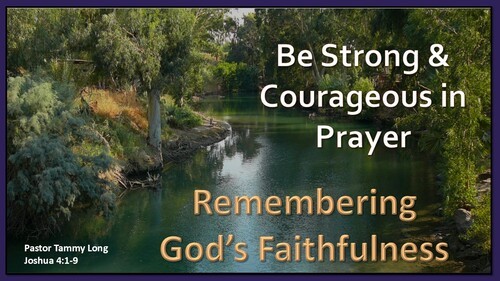
Be Strong & Courageous in Prayer: Remembering God’s Faithfulness
For Your Heart Today
Remembering is not simply about looking backward—it is about holding onto meaning.
In a world that moves quickly toward what’s next, memory is fragile. Stories fade. Meaning can be lost. And yet, Scripture reminds us again and again that remembering is essential to faith. God knows that His people are shaped not only by where they are going, but by what they carry with them.
In Joshua 4, the people of Israel have just crossed the Jordan River on dry ground. God has made a way where there was no way. They are finally standing on the edge of the Promised Land.
But before they move forward, God tells them to stop.
Twelve stones are taken from the middle of the river—the very place where the Ark of the Covenant stood—and carried into the camp. These stones are not decoration. They are testimony. They are meant to provoke questions, invite stories, and anchor meaning for generations to come.
Remembering, Scripture teaches us, is not accidental. It is a spiritual practice God intentionally gives His people so that faith, courage, and trust can be carried forward.
4 Takeaways for Remembering God’s Faithfulness
1. Reflect – Pause long enough for meaning to surface.
Before the people advance into the future, God invites them to stop and reflect. Meaning does not surface when we rush; it emerges when we pause long enough to notice where God has been at work.
2. Remember – Recognize what God has revealed about Himself.
The stones remind Israel that God was present in the crossing. The same God who brought a previous generation through the Red Sea has brought this generation through the Jordan. God is faithful—and God can be trusted.
3. Rejoice – Let gratitude rise from remembered meaning.
Joshua sets up a second memorial in the middle of the river—a response of worship that will soon be covered by water. Rejoicing flows naturally when remembered meaning takes root in the heart.
4. Retell – Carry remembered meaning forward.
God anticipates the question: “What do these stones mean?” Faith is sustained through story. Retelling is not about convincing others—it is about bearing witness to what God has done and what it has meant.
Breath Prayer
Inhale: Faithful God…
Exhale: …thank You for bringing me through.
Full Manuscript – Estimated Reading Time: 25–30 minutes
Remembering is not simply about looking backward—it is about holding onto meaning.
In a world that moves quickly toward what’s next, memory is fragile. Stories fade. Meaning can be lost. And yet, Scripture reminds us again and again that remembering is essential to faith. God knows that His people are shaped not only by where they are going, but by what they carry with them.
In Joshua 4, the people of Israel have just crossed the Jordan River on dry ground. God has made a way where there was no way. They are finally standing on the edge of the Promised Land.
But before they move forward, God tells them to stop.
Twelve stones are taken from the middle of the river—the very place where the Ark of the Covenant stood—and carried into the camp. These stones are not decoration. They are testimony. They are meant to provoke questions, invite stories, and anchor meaning for generations to come.
Remembering, Scripture teaches us, is not accidental. It is a spiritual practice God intentionally gives His people so that faith, courage, and trust can be carried forward.
4 Takeaways for Remembering God’s Faithfulness
1. Reflect – Pause long enough for meaning to surface.
Before the people advance into the future, God invites them to stop and reflect. Meaning does not surface when we rush; it emerges when we pause long enough to notice where God has been at work.
2. Remember – Recognize what God has revealed about Himself.
The stones remind Israel that God was present in the crossing. The same God who brought a previous generation through the Red Sea has brought this generation through the Jordan. God is faithful—and God can be trusted.
3. Rejoice – Let gratitude rise from remembered meaning.
Joshua sets up a second memorial in the middle of the river—a response of worship that will soon be covered by water. Rejoicing flows naturally when remembered meaning takes root in the heart.
4. Retell – Carry remembered meaning forward.
God anticipates the question: “What do these stones mean?” Faith is sustained through story. Retelling is not about convincing others—it is about bearing witness to what God has done and what it has meant.
Breath Prayer
Inhale: Faithful God…
Exhale: …thank You for bringing me through.
Full Manuscript – Estimated Reading Time: 25–30 minutes
Be Strong and Courageous: Remembering God’s Faithfulness
Joshua 4:1–9
By Pastor Tammy Long
Earlier in the service, we honored Black History Month by remembering the life and legacy of Dr. Charles Drew. As we begin this morning, I brought something with me—a little show and tell.
This is a bust of Dr. Drew. My parents have had this for as long as I can remember. It traveled to every house we ever lived in. And as a child, I remember being fascinated by how lifelike it was—especially the eyes. They followed you around the room.
But more than that, this, as well as so many other pieces of art, taught me something early on: my history matters. Knowing the stories that came before mine matters. Remembering matters.
Right now, across our country, in public spaces meant to tell our shared story, memorials and historical displays are being removed or revised. Exhibits about people who were enslaved have been taken down at historic sites. And in several U.S. national parks, signage telling the story of Native American suffering and displacement has been removed or rewritten.
These are not just news stories. They remind us that memory is fragile. And when we forget or erase the markers of our past, we risk losing a part of who we are—individually and communally.
Some nations have wrestled with this honestly. Germany, for example, made a deliberate choice not to forget the Holocaust—not to deny it, minimize it, or rush past it. Memorials, museums, even plaques embedded into sidewalks are visible reminders that say, this happened.
Healthy communities remember—even when remembering is uncomfortable—because forgetting is dangerous. And it’s important to note, we aren’t just talking about remembering hard things. We also remember victories. Survival. Courage. Faithfulness.
Moments of joy that tell the story not just of what was lost, but of what was overcome—reminders that we made it through. Like the song says, my soul looks back and wonders how I got over. Because as believers, we know we didn’t make it through alone.
And that’s where we find ourselves today in the story of Joshua. We’ve been journeying with Israel in our Strong and Courageous series. They have just crossed the Jordan River on dry land. The Ark of the Covenant has gone before them. God made a way where there was no way.
Now they’re on the other side—about to inhabit the Promised Land. But before they go any farther, before they tackle this new land, God does something significant.
Let’s pick up the story in Joshua 4:1–9.
Joshua 4:1-9
Unpacking the Text
Joshua 4 is a straightforward story, but it’s not one to rush past—because it teaches us something important about God and what God desires for His people.
The children of Israel have crossed the Jordan River. God has done what only God can do. The waters were held back, and the Ark of the Covenant—the visible sign of God’s presence—stood in the river as the people passed through. Now they are safe on the other side.
It would be natural to assume that everyone is eager to keep moving—to get to camp, to settle in, to rest and celebrate the fact that they made it.
But God has a different vision, and He gives Joshua specific instructions.
The Lord said to Joshua, “Now choose twelve men, one from each tribe. Tell them, ‘Take twelve stones from the very place where the priests are standing in the middle of the Jordan. Carry them out and pile them up at the place where you will camp tonight.’”
Those stones are to become a memorial. And this is not just a God-and-Joshua moment. This is for the entire community—each tribe. What God is doing is meant to be shared, seen, and remembered together.
And the stones are not gathered at random. They are taken from the place where the Ark stood—the place of God’s presence, where God met His people.
God is also clear about why He wants this done. He outlines a twofold purpose:
First, to help the people remember what the Lord has done.
Second, to prompt a story for the next generation—so that when children ask, “What do these stones mean?” the people will tell how the Lord made a way and brought them through the Jordan on dry ground.
Now, here’s one thing that stood out to me.
All of this was God’s idea.
God initiates it.
God commands it.
God explains its purpose.
God institutes remembering as part of the rhythm of life for His people.
In other words, remembering is not an afterthought or a happenstance occurrence. It is something God wants His people to practice intentionally.
And we know this because this moment in Joshua is not isolated.
Over and over again throughout Scripture, God tells His people to remember.
In Deuteronomy, God says, “Be careful that you do not forget the Lord who brought you out of Egypt.”
Later He says, “Remember how the Lord your God led you all the way in the wilderness.”
In the book of Psalms alone, we are invited to remember again and again—remembering God’s deeds, God’s faithfulness, God’s covenant love. Over thirty times, the writers choose to remember, often in moments of fear or uncertainty.
And this theme carries into the New Testament, too.
For example, in a moment that requires endurance and courage, Paul writes to Timothy, “Remember Jesus Christ, raised from the dead.”
Family, remembering matters to God.
Which could beg the question—why?
Neuroscience Catching Up to God
Why do the Scriptures return to this command again and again?
Well, neuroscience and psychology give us some insight into what God already knows about how we are made.
For instance, research shows that when we are under stress, in transition, or focused on the future, our brains naturally shift into problem-solving and survival mode.
When we are focused on what’s next—what needs to be done, where we’re going, what we’re facing—our access to memories becomes more limited.
It’s also been found that meaningful experiences fade quickly if they are not intentionally noticed, named, and revisited.
In other words, we are predisposed not to remember. Forgetting is part of our human condition.
But here’s the thing.
We want to remember.
Remembering speaks to significance, purpose, and meaning for our lives. We long to remember. That’s why we take pictures, journal, and tell the same stories over and over again.
This longing also shows up unconsciously through embodied memories. We’ve all had the experience of hearing a song and suddenly being transported back to a moment we hadn’t thought about in years. Smelling a scent or picking up a meaningful object and remembering not just what happened, but how it felt.
Memory lives in the body as much as in the mind.
So back to Joshua, it makes sense that God didn’t simply say, “Just think about what I did.”
He says, pick up stones. Carry them. Put them somewhere visible.
All of this helps us see that God’s command to remember is not just a nice idea. God is appealing to something He has placed in us.
And He’s nurturing and caring for His people—strengthening their faith and their courage—by teaching them to remember.
We serve an invisible God. A faithful God. A present God. But a God who can easily drift out of sight and out of mind.
Commanding us to remember is one of the ways God invites us into a deeper relationship with Him. Remembering what God has done helps us recognize what God is doing and strengthens trust for what God will do next.
That’s why remembering isn’t something we do just once. Remembering is a spiritual practice God invites—and commands—that we do over and over again.
In Joshua 4, we see four elements to that practice. And each one starts with the letter R.
Remembering as a Spiritual Practice
Reflect — Pausing Long Enough for Meaning to Surface
Before Israel even begins to gather stones, they pause before moving forward. And that momentary pause is important.
There’s an interesting word that appears throughout the Psalms—seventy-one times, in fact. It’s the word Selah. It’s not a word we translate so much as a word we practice.
Selah is an invitation to pause. To stop. To breathe. To let what has just been said—or sung—settle before moving on. That’s what it means to reflect—to slow down and look back with intention. To stay with what has happened long enough for meaning or insight to surface.
If you’ve been using the prayer guide during our 28 Days of Prayer and Fasting, you know that the evening examen ends with a simple question:
What do I sense God saying to me today?
Or we might ask,
Where do I see God’s hand in that?
These are reflection questions. Selah moments. They invite us to look back on the unfolding of the day and notice where God’s fingerprints might be found.
Now the truth is, reflection doesn’t come easily—and if we’re honest, most of us are not very good at it. It requires slowing down. It requires intention. It requires resisting the urge to rush on to what’s next. And that’s why it’s hard for us.
We live in a world shaped by speed and efficiency. In that kind of environment, reflection doesn’t happen accidentally. It has to be chosen.
While I was working on this sermon, I came across a blog for runners, and one of the titles just kept echoing in my mind:
“Ten years of running without reflection is just one year of running repeated ten times.”
That’s true in running—and it’s true in life.
Reflection creates space to review and ponder. It creates room for meaning to surface, and creates the pause that makes remembering possible.
Selah.
Remember — Recognizing the Meaning That Emerges When We Reflect
In Joshua 4, God has the people stop before moving forward—and through that pause, God invites His people into remembrance. He does not want this crossing to pass without meaning.
So what is it that God wants His people to remember as they enter a new land?
First, God wants them to remember who brought them through.
This crossing is not the result of Israel’s strength, planning, or courage. The stones stand as a reminder that the Lord made a way where there was no way. What they are to carry forward is this truth: God is not only the One who brings His people through, but God is faithful—and God can be trusted. They will need to remember this as they move forward.
Second, God wants them to remember what God is like.
The memorial stones are taken from the very place where the Ark stood. God was not distant or detached. God was present in the crossing. The same God who brought a previous generation through the Red Sea has now brought this generation through the Jordan.
This tells them something about God’s character—that He goes with His people and cares for them. When God said He would never leave them or abandon them, He meant it. He just showed them. They will need to remember that.
Third, God wants them to remember who they are and whose they are.
They are a people who have been brought through. A people covered and protected by God’s faithfulness. Long before the Psalms were written, they experienced this truth:
“For He is our God, and we are the people of His pasture, the flock under His care.” (Psalm 95:7)
As they face uncertainty and challenges in a new land, this meaning will matter. They need to remember.
And woven through all of this is something God is already anticipating. The stones are not only for those who crossed the river. They are for the questions that will come later:
“What do these stones mean?”
God knows that meaning must be recognized and named in ways that can be shared—so that what is remembered can one day be retold. Because meaning is always bigger than facts and figures. Meaning is what endures. It’s what strengthens faith, and it’s what carries the story forward.
When we talk about meaning here, we’re not talking about having all the answers to what God is doing. We’re talking about recognizing what God has shown us about Himself.
Remembering, as a spiritual practice, then, is not simply about recalling an event. It is recognizing what has been learned about God, about trust, and about who we are—and it’s that recognition that gives us strength and courage to move forward.
That is why God teaches His people how to remember.
But remembering as a spiritual practice doesn’t stop there.
Rejoice — Letting Gratitude Rise from Remembered Meaning
Remembering God’s faithfulness is not meant to remain flat or simply a teachable moment. Remembering who God is and who we are is meant to move our hearts.
What’s especially interesting in Joshua 4 is that we see a second memorial. There is the memorial God instructs to be carried to the camp, as a reminder and a way to help future generations remember and understand what God has done.
But in verse nine, the passage tells us something more. Joshua also set up another pile of twelve stones in the middle of the Jordan, at the place where the priests who carried the Ark of the Covenant were standing.
That second memorial isn’t explained. In fact, it feels less like a teaching moment and more like a response—a moment of acknowledgment, gratitude, even worship offered back to God.
Once the priests step out and God releases the river, those stones will be covered anyway. This memorial won’t be seen again. It is a response in the moment. This is remembering that gives way to rejoicing.
And rejoicing often looks like that. It is the fruit of recognizing meaning deeply enough that gratitude rises. When we remember not just what God has done, but what it means, joy begins to surface.
Scripture often holds remembering and rejoicing together. Listen to the words of Isaiah:
“Give praise to the Lord, proclaim his name; make known among the nations what he has done… Sing to the Lord—for he has done glorious things.” (Isaiah 12:4–5)
We rejoice because we remember what God has done.
Rejoicing doesn’t ignore what’s still hard. It doesn’t pretend the future is easy. And it doesn’t mean we have everything figured out or fully understand what God is doing. But rejoicing does acknowledge that God has been present—and is still present. And for that, we are grateful.
Gratitude strengthens courage. Joy deepens trust. And rejoicing keeps hope alive—keeping the memory of the God we serve alive in our hearts.
Lastly, when gratitude takes root in remembered meaning, it naturally turns outward—which leads us to the final R.
Retell — Carrying Remembered Meaning Forward
In Joshua 4, God’s vision is unmistakably clear. The stones are not only for the people who crossed the Jordan. They are for the ones who will come later. The Scripture says, “In the future, when your children ask you, ‘What do these stones mean?’ then you are to tell them….”
God knows something about faith that we sometimes forget: our faith is sustained through story—through testimony.
The question is not necessarily if the story will be told. The question is what meaning will be carried with it.
God does not instruct Israel to retell every detail of the crossing—not the water levels, timeline, or logistics. He invites them to retell the meaning: the Lord made a way. God was faithful. We were brought through.
Retelling the story is how remembering becomes communal. It is how meaning moves from one generation to the next. And it is how faith outlives a single moment in time.
Did you notice, retelling begins with a question: “What do these stones mean?” God anticipates curiosity. He expects questions. And He creates space for testimony to emerge naturally, not forcefully.
Retelling is not about convincing. It is about bearing witness.
This is how faith has always been passed down—through lived stories of God’s faithfulness that are remembered and named. Stories told at dinner tables. Stories remembered in worship. Stories shared in moments of doubt, transition, or fear.
Retelling does not require a microphone or a platform. It simply requires remembering what God has done and being willing to share what it meant to you. When we retell the story of our experience—what God has done—we are not just preserving the past. We are shaping hope for the future.
The goodness and faithfulness of God is not meant to stop with us. It is meant to be remembered, rejoiced over, and carried forward.
Reflect. Remember. Rejoice. Retell.
This is the rhythm God invites His people into—a rhythm that shapes faith, forms community, and carries meaning forward. It is the rhythm of a people who are strong and courageous in the power of the Lord.
Closing Reflection
The rhythm of remembering we see in Joshua ultimately leads us to Jesus.
In Scripture, God does not leave remembering to chance. God gives His people practices that help memory take root and meaning endure. Communion becomes one of those practices.
At the table, we reflect—pausing long enough to attend to Christ’s presence and to the love that has brought us here.
We remember—not simply recalling events, but recognizing what God has revealed about Himself through the life, death, and resurrection of Jesus.
As we remember, we rejoice—allowing gratitude to rise for grace given, forgiveness offered, and hope secured.
And when we leave the table, we retell—carrying that remembered meaning forward in lives shaped by Christ’s love and faithfulness.
In Christ, remembrance is relationship. We are not only recalling what God has done; we are being formed by who God has revealed Himself to be.
And when Jesus says, “Do this in remembrance of me,” He is inviting us into a way of remembering that shapes how we live—day by day, with Him.
Joshua 4:1–9
By Pastor Tammy Long
Earlier in the service, we honored Black History Month by remembering the life and legacy of Dr. Charles Drew. As we begin this morning, I brought something with me—a little show and tell.
This is a bust of Dr. Drew. My parents have had this for as long as I can remember. It traveled to every house we ever lived in. And as a child, I remember being fascinated by how lifelike it was—especially the eyes. They followed you around the room.
But more than that, this, as well as so many other pieces of art, taught me something early on: my history matters. Knowing the stories that came before mine matters. Remembering matters.
Right now, across our country, in public spaces meant to tell our shared story, memorials and historical displays are being removed or revised. Exhibits about people who were enslaved have been taken down at historic sites. And in several U.S. national parks, signage telling the story of Native American suffering and displacement has been removed or rewritten.
These are not just news stories. They remind us that memory is fragile. And when we forget or erase the markers of our past, we risk losing a part of who we are—individually and communally.
Some nations have wrestled with this honestly. Germany, for example, made a deliberate choice not to forget the Holocaust—not to deny it, minimize it, or rush past it. Memorials, museums, even plaques embedded into sidewalks are visible reminders that say, this happened.
Healthy communities remember—even when remembering is uncomfortable—because forgetting is dangerous. And it’s important to note, we aren’t just talking about remembering hard things. We also remember victories. Survival. Courage. Faithfulness.
Moments of joy that tell the story not just of what was lost, but of what was overcome—reminders that we made it through. Like the song says, my soul looks back and wonders how I got over. Because as believers, we know we didn’t make it through alone.
And that’s where we find ourselves today in the story of Joshua. We’ve been journeying with Israel in our Strong and Courageous series. They have just crossed the Jordan River on dry land. The Ark of the Covenant has gone before them. God made a way where there was no way.
Now they’re on the other side—about to inhabit the Promised Land. But before they go any farther, before they tackle this new land, God does something significant.
Let’s pick up the story in Joshua 4:1–9.
Joshua 4:1-9
Unpacking the Text
Joshua 4 is a straightforward story, but it’s not one to rush past—because it teaches us something important about God and what God desires for His people.
The children of Israel have crossed the Jordan River. God has done what only God can do. The waters were held back, and the Ark of the Covenant—the visible sign of God’s presence—stood in the river as the people passed through. Now they are safe on the other side.
It would be natural to assume that everyone is eager to keep moving—to get to camp, to settle in, to rest and celebrate the fact that they made it.
But God has a different vision, and He gives Joshua specific instructions.
The Lord said to Joshua, “Now choose twelve men, one from each tribe. Tell them, ‘Take twelve stones from the very place where the priests are standing in the middle of the Jordan. Carry them out and pile them up at the place where you will camp tonight.’”
Those stones are to become a memorial. And this is not just a God-and-Joshua moment. This is for the entire community—each tribe. What God is doing is meant to be shared, seen, and remembered together.
And the stones are not gathered at random. They are taken from the place where the Ark stood—the place of God’s presence, where God met His people.
God is also clear about why He wants this done. He outlines a twofold purpose:
First, to help the people remember what the Lord has done.
Second, to prompt a story for the next generation—so that when children ask, “What do these stones mean?” the people will tell how the Lord made a way and brought them through the Jordan on dry ground.
Now, here’s one thing that stood out to me.
All of this was God’s idea.
God initiates it.
God commands it.
God explains its purpose.
God institutes remembering as part of the rhythm of life for His people.
In other words, remembering is not an afterthought or a happenstance occurrence. It is something God wants His people to practice intentionally.
And we know this because this moment in Joshua is not isolated.
Over and over again throughout Scripture, God tells His people to remember.
In Deuteronomy, God says, “Be careful that you do not forget the Lord who brought you out of Egypt.”
Later He says, “Remember how the Lord your God led you all the way in the wilderness.”
In the book of Psalms alone, we are invited to remember again and again—remembering God’s deeds, God’s faithfulness, God’s covenant love. Over thirty times, the writers choose to remember, often in moments of fear or uncertainty.
And this theme carries into the New Testament, too.
For example, in a moment that requires endurance and courage, Paul writes to Timothy, “Remember Jesus Christ, raised from the dead.”
Family, remembering matters to God.
Which could beg the question—why?
Neuroscience Catching Up to God
Why do the Scriptures return to this command again and again?
Well, neuroscience and psychology give us some insight into what God already knows about how we are made.
For instance, research shows that when we are under stress, in transition, or focused on the future, our brains naturally shift into problem-solving and survival mode.
When we are focused on what’s next—what needs to be done, where we’re going, what we’re facing—our access to memories becomes more limited.
It’s also been found that meaningful experiences fade quickly if they are not intentionally noticed, named, and revisited.
In other words, we are predisposed not to remember. Forgetting is part of our human condition.
But here’s the thing.
We want to remember.
Remembering speaks to significance, purpose, and meaning for our lives. We long to remember. That’s why we take pictures, journal, and tell the same stories over and over again.
This longing also shows up unconsciously through embodied memories. We’ve all had the experience of hearing a song and suddenly being transported back to a moment we hadn’t thought about in years. Smelling a scent or picking up a meaningful object and remembering not just what happened, but how it felt.
Memory lives in the body as much as in the mind.
So back to Joshua, it makes sense that God didn’t simply say, “Just think about what I did.”
He says, pick up stones. Carry them. Put them somewhere visible.
All of this helps us see that God’s command to remember is not just a nice idea. God is appealing to something He has placed in us.
And He’s nurturing and caring for His people—strengthening their faith and their courage—by teaching them to remember.
We serve an invisible God. A faithful God. A present God. But a God who can easily drift out of sight and out of mind.
Commanding us to remember is one of the ways God invites us into a deeper relationship with Him. Remembering what God has done helps us recognize what God is doing and strengthens trust for what God will do next.
That’s why remembering isn’t something we do just once. Remembering is a spiritual practice God invites—and commands—that we do over and over again.
In Joshua 4, we see four elements to that practice. And each one starts with the letter R.
Remembering as a Spiritual Practice
Reflect — Pausing Long Enough for Meaning to Surface
Before Israel even begins to gather stones, they pause before moving forward. And that momentary pause is important.
There’s an interesting word that appears throughout the Psalms—seventy-one times, in fact. It’s the word Selah. It’s not a word we translate so much as a word we practice.
Selah is an invitation to pause. To stop. To breathe. To let what has just been said—or sung—settle before moving on. That’s what it means to reflect—to slow down and look back with intention. To stay with what has happened long enough for meaning or insight to surface.
If you’ve been using the prayer guide during our 28 Days of Prayer and Fasting, you know that the evening examen ends with a simple question:
What do I sense God saying to me today?
Or we might ask,
Where do I see God’s hand in that?
These are reflection questions. Selah moments. They invite us to look back on the unfolding of the day and notice where God’s fingerprints might be found.
Now the truth is, reflection doesn’t come easily—and if we’re honest, most of us are not very good at it. It requires slowing down. It requires intention. It requires resisting the urge to rush on to what’s next. And that’s why it’s hard for us.
We live in a world shaped by speed and efficiency. In that kind of environment, reflection doesn’t happen accidentally. It has to be chosen.
While I was working on this sermon, I came across a blog for runners, and one of the titles just kept echoing in my mind:
“Ten years of running without reflection is just one year of running repeated ten times.”
That’s true in running—and it’s true in life.
Reflection creates space to review and ponder. It creates room for meaning to surface, and creates the pause that makes remembering possible.
Selah.
Remember — Recognizing the Meaning That Emerges When We Reflect
In Joshua 4, God has the people stop before moving forward—and through that pause, God invites His people into remembrance. He does not want this crossing to pass without meaning.
So what is it that God wants His people to remember as they enter a new land?
First, God wants them to remember who brought them through.
This crossing is not the result of Israel’s strength, planning, or courage. The stones stand as a reminder that the Lord made a way where there was no way. What they are to carry forward is this truth: God is not only the One who brings His people through, but God is faithful—and God can be trusted. They will need to remember this as they move forward.
Second, God wants them to remember what God is like.
The memorial stones are taken from the very place where the Ark stood. God was not distant or detached. God was present in the crossing. The same God who brought a previous generation through the Red Sea has now brought this generation through the Jordan.
This tells them something about God’s character—that He goes with His people and cares for them. When God said He would never leave them or abandon them, He meant it. He just showed them. They will need to remember that.
Third, God wants them to remember who they are and whose they are.
They are a people who have been brought through. A people covered and protected by God’s faithfulness. Long before the Psalms were written, they experienced this truth:
“For He is our God, and we are the people of His pasture, the flock under His care.” (Psalm 95:7)
As they face uncertainty and challenges in a new land, this meaning will matter. They need to remember.
And woven through all of this is something God is already anticipating. The stones are not only for those who crossed the river. They are for the questions that will come later:
“What do these stones mean?”
God knows that meaning must be recognized and named in ways that can be shared—so that what is remembered can one day be retold. Because meaning is always bigger than facts and figures. Meaning is what endures. It’s what strengthens faith, and it’s what carries the story forward.
When we talk about meaning here, we’re not talking about having all the answers to what God is doing. We’re talking about recognizing what God has shown us about Himself.
Remembering, as a spiritual practice, then, is not simply about recalling an event. It is recognizing what has been learned about God, about trust, and about who we are—and it’s that recognition that gives us strength and courage to move forward.
That is why God teaches His people how to remember.
But remembering as a spiritual practice doesn’t stop there.
Rejoice — Letting Gratitude Rise from Remembered Meaning
Remembering God’s faithfulness is not meant to remain flat or simply a teachable moment. Remembering who God is and who we are is meant to move our hearts.
What’s especially interesting in Joshua 4 is that we see a second memorial. There is the memorial God instructs to be carried to the camp, as a reminder and a way to help future generations remember and understand what God has done.
But in verse nine, the passage tells us something more. Joshua also set up another pile of twelve stones in the middle of the Jordan, at the place where the priests who carried the Ark of the Covenant were standing.
That second memorial isn’t explained. In fact, it feels less like a teaching moment and more like a response—a moment of acknowledgment, gratitude, even worship offered back to God.
Once the priests step out and God releases the river, those stones will be covered anyway. This memorial won’t be seen again. It is a response in the moment. This is remembering that gives way to rejoicing.
And rejoicing often looks like that. It is the fruit of recognizing meaning deeply enough that gratitude rises. When we remember not just what God has done, but what it means, joy begins to surface.
Scripture often holds remembering and rejoicing together. Listen to the words of Isaiah:
“Give praise to the Lord, proclaim his name; make known among the nations what he has done… Sing to the Lord—for he has done glorious things.” (Isaiah 12:4–5)
We rejoice because we remember what God has done.
Rejoicing doesn’t ignore what’s still hard. It doesn’t pretend the future is easy. And it doesn’t mean we have everything figured out or fully understand what God is doing. But rejoicing does acknowledge that God has been present—and is still present. And for that, we are grateful.
Gratitude strengthens courage. Joy deepens trust. And rejoicing keeps hope alive—keeping the memory of the God we serve alive in our hearts.
Lastly, when gratitude takes root in remembered meaning, it naturally turns outward—which leads us to the final R.
Retell — Carrying Remembered Meaning Forward
In Joshua 4, God’s vision is unmistakably clear. The stones are not only for the people who crossed the Jordan. They are for the ones who will come later. The Scripture says, “In the future, when your children ask you, ‘What do these stones mean?’ then you are to tell them….”
God knows something about faith that we sometimes forget: our faith is sustained through story—through testimony.
The question is not necessarily if the story will be told. The question is what meaning will be carried with it.
God does not instruct Israel to retell every detail of the crossing—not the water levels, timeline, or logistics. He invites them to retell the meaning: the Lord made a way. God was faithful. We were brought through.
Retelling the story is how remembering becomes communal. It is how meaning moves from one generation to the next. And it is how faith outlives a single moment in time.
Did you notice, retelling begins with a question: “What do these stones mean?” God anticipates curiosity. He expects questions. And He creates space for testimony to emerge naturally, not forcefully.
Retelling is not about convincing. It is about bearing witness.
This is how faith has always been passed down—through lived stories of God’s faithfulness that are remembered and named. Stories told at dinner tables. Stories remembered in worship. Stories shared in moments of doubt, transition, or fear.
Retelling does not require a microphone or a platform. It simply requires remembering what God has done and being willing to share what it meant to you. When we retell the story of our experience—what God has done—we are not just preserving the past. We are shaping hope for the future.
The goodness and faithfulness of God is not meant to stop with us. It is meant to be remembered, rejoiced over, and carried forward.
Reflect. Remember. Rejoice. Retell.
This is the rhythm God invites His people into—a rhythm that shapes faith, forms community, and carries meaning forward. It is the rhythm of a people who are strong and courageous in the power of the Lord.
Closing Reflection
The rhythm of remembering we see in Joshua ultimately leads us to Jesus.
In Scripture, God does not leave remembering to chance. God gives His people practices that help memory take root and meaning endure. Communion becomes one of those practices.
At the table, we reflect—pausing long enough to attend to Christ’s presence and to the love that has brought us here.
We remember—not simply recalling events, but recognizing what God has revealed about Himself through the life, death, and resurrection of Jesus.
As we remember, we rejoice—allowing gratitude to rise for grace given, forgiveness offered, and hope secured.
And when we leave the table, we retell—carrying that remembered meaning forward in lives shaped by Christ’s love and faithfulness.
In Christ, remembrance is relationship. We are not only recalling what God has done; we are being formed by who God has revealed Himself to be.
And when Jesus says, “Do this in remembrance of me,” He is inviting us into a way of remembering that shapes how we live—day by day, with Him.
Recent
Be Strong Courageous In This Season: My Story In Gods Story
October 6th, 2026
Be Strong and Courageous in This Season: Being & Doing
September 28th, 2026
Be Strong and Courageous in This Season: God's Story in Your Story
September 21st, 2026
Be Strong Courageous in this Season
September 14th, 2026
Be Strong Courageous as Disciples: Get to Know Judas
September 7th, 2026
Archive
2026
January
February
March
Be Strong Courageous in Body Mind Spirit: Care for the BodyBe Strong & Courageous in Body, Mind & Spirit: Care for the MindBe Strong & Courageous in Body, Mind & Spirit: Care for the SpiritBe Strong & Courageous in Body, Mind & Spirit Seeing the Peace We MissBe Strong & Courageous in Body, Mind & Spirit: Living Aligned
April
May
June
Be Strong Courageous in Community: Making Room for All Nations (AANHPI Heritage Month)Be Strong Courageous in Community: The Courage to Speak Truth in LoveBe Strong Courageous: The Courage to Choose WiselyBe Strong Courageous in Community The Courage to BlessBe Strong Courageous in Community: The Courage to Love Like Jesus
July
August
September
2025
January
February
March
April
May
June
July
August
September
October
November
2024
January
February
No Comments