
Be Strong & Courageous as Disciples: Get to Know Andrew
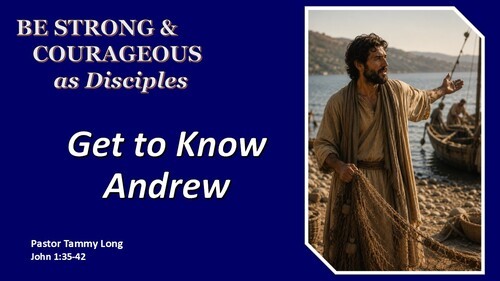
Be Strong and Courageous as Disciples: Get to Know Andrew
John 1:35-42
By Pastor Tammy Long
For Your Heart Today
Most of us know Andrew as "Peter's brother," but when we slow down and spend time with his story, we discover a disciple whose quiet faithfulness speaks powerfully into our own lives.
Andrew was not the loudest disciple, nor the one most often in the spotlight. He wasn't part of Jesus' inner circle like Peter, James, and John. Yet each time the Gospels mention Andrew, we find someone paying attention to what God is doing and responding with quiet faithfulness.
He first accepted Jesus' invitation, "Come and see." Then he brought his brother Peter to Jesus. Later, while others focused on what was lacking, Andrew noticed a little boy with five loaves and two fish and believed they were worth bringing to Christ. Still later, when some Greeks wanted to meet Jesus, Andrew helped create space for them to encounter Christ.
Andrew reminds us that discipleship is first and foremost about remaining close to Jesus. As we walk with Him, He shapes how we see the world, how we respond to others, and how we faithfully follow Him.
The invitation Jesus extended to Andrew has never ended.
He still says to each of us, "Come and see."
Takeaways
- Discipleship begins by accepting Jesus' invitation to "Come and see." Before Andrew ever invited anyone else to Jesus, he first accepted Jesus' invitation himself.
- Hopeful realism sees what is present without denying what is lacking. Andrew acknowledged that five loaves and two fish were not enough, yet he believed they were worth bringing to Jesus because he trusted who Jesus is.
- God is often at work before we recognize it. Andrew teaches us to remain attentive to the people, conversations, and opportunities God is already preparing around us.
- Quiet faithfulness keeps our focus on Jesus. Whether our role is seen or unseen, the invitation remains the same: faithfully follow Christ and help others encounter Him.
Breath Prayer
Inhale: Jesus, teach me
Exhale: To follow You.
Full Manuscript - Estimated Reading Time ~22-24 minutes

Be Strong and Courageous as Disciples: Get to Know Andrew
John 1:35-42
By Pastor Tammy Long
Introduction
Last month I had the privilege of spending a week at a professional development intensive with colleagues I'll be learning alongside for the next three years. Although we had met online a few times, this was our first time meeting in person.
Of course, every good instructor wants the class to get to know one another, especially since we'll be learning and growing together for a while. So our instructor used some creative ways to help us move beyond simply knowing the names on a class roster.
One of the first things we were asked to do was tell the story behind our names. Some people were named after parents or grandparents or carried family names that had been passed down for generations. Others were named because of what their names meant. Several of us, including me, were named simply because the name was popular that year. There were four Jennifers-Jenns or Jennys-two Sarahs, and even another Tammy! Both of us were named after the Debbie Reynolds movie Tammy and the Bachelor.
It was interesting how quickly a simple name became more meaningful and memorable once we knew the story behind it.
Later in the week we played a "guess who" game. We each wrote down three things about ourselves, and the group had to guess who it was. We learned one of our classmates had been to forty-nine of the fifty states. Another had been an ice-skating dancer. Someone had once roomed with the actor Val Kilmer. I even got some appreciative nods when people learned I'm a pickleball enthusiast.
There were other exercises as well, each one giving us a chance to share our stories. By the end of the week, we had moved beyond our name tags. We were beginning to know one another.
This summer, we're going to spend some time getting to know some of Jesus' friends beyond their names, too. If you've been around the church for a while, you probably know many of the stories they're remembered for. But there's always more to a person's story.
The disciples may seem larger than life to us twenty centuries later, but when Jesus first called them, they were ordinary people living ordinary lives. They had jobs and families, questions, strengths, and weaknesses. Yet over time, as they walked with Jesus, they were slowly formed into the people we remember today-strong and courageous disciples.
One of the beautiful things about hearing stories is that we often find ourselves in them. It may not be the exact same experience, but another person's journey helps us see our own a little more clearly. We discover courage as we watch someone else's faithfulness. We find hope through someone else's encounter with God. We begin to recognize that perhaps God is writing a story in us, too.
As I began preparing this series, one image kept coming to mind: a campfire. I can't help but imagine the stories that must have been shared with Jesus at the end of a long day of ministry and the simple joy of getting to know one another and being together.
That's the spirit I hope we'll capture this summer. I want us to slow down, listen well, and spend time with Jesus' friends, trusting that their stories may have something to say to ours.
So this morning, let's pull up a log around the campfire and get to know Jesus' friend, Andrew.
Please turn with me to John 1:35-42.
Getting to Know Andrew
This is where Andrew's life with Jesus begins. But before we walk with him through this encounter, let me back up and tell you a little about the man we're getting to know.
Andrew was a fisherman from a small village on the northern shore of the Sea of Galilee. Fishing wasn't simply what he did; it was how he made his living, and it was backbreaking work. Long nights on the water. Heavy nets hauled in by hand. It required strength every day and perseverance to begin again the next, whether the night's catch had been plentiful or disappointing. It was intense physical and emotional labor.
Andrew didn't fish alone. He fished with his brother Peter. In Luke's Gospel we're told that Peter was in partnership with James and John. So before Andrew, Peter, James, and John were ever disciples, they were friends and business partners. They spent long days and nights on the Sea of Galilee together. Imagine the conversations they shared while mending nets, repairing boats, or rowing through all kinds of weather. Their lives were already intertwined.
But Andrew wasn't only a fisherman. He was also a spiritual seeker. He had a heart for the things of God.
When we first meet him in Scripture, he isn't following Jesus yet. He's following John the Baptist. That tells us something about Andrew's heart.
John the Baptist wasn't your typical Jewish leader. The Bible tells us he lived in the wilderness, dressed in camel's hair, and ate locusts and wild honey. His message was bold, unconventional, and unsettling enough that some people believed he was a prophet, while others thought he was out of his mind.
Yet something about John's message resonated with Andrew. He listened.
Like many faithful people in Israel, Andrew was waiting for the Messiah. He wasn't content simply to go through the motions of religion. He was watching, waiting, and praying. So when John the Baptist appeared in the wilderness calling people to repentance and proclaiming that God was preparing the way for the Messiah, Andrew recognized something he had been waiting for. He left what was familiar and began following John because he believed God was at work.
Before Jesus ever called Andrew, Andrew was already seeking and paying attention.
And that's where today's story begins, which brings us back to our text.
Andrew's First Encounter with Jesus
Andrew is standing with John the Baptist, who sees Jesus walking by. But this isn't the first time John has spoken about Jesus. Just the day before, John saw Jesus coming toward him and declared,
Look, the Lamb of God, who takes away the sin of the world! (John 1:29)
For those standing there with him, those words would have carried tremendous weight. Every Jewish person understood the significance of a lamb. They would have thought of the Passover lamb whose blood spared God's people in Egypt. They would have thought of the sacrifices offered in the temple for the forgiveness of sins. John was making an astonishing claim. He was saying, "The One we've been waiting for is here."
Now, the next day, when John sees Jesus again, he simply says,
Look, there is the Lamb of God! (John 1:36)
The Bible tells us, "When the two disciples heard him say this, they followed Jesus" (John 1:37).
A few verses later, we're told one of those disciples is Andrew. Most scholars believe the other disciple was John himself, the one who wrote this Gospel and, remember, one of Andrew's closest friends.
Notice what they do.
The Bible says they begin walking behind Jesus, which isn't unusual because that's what disciples did. They wanted to be near the teacher-to watch Him, to listen to Him, and to learn from Him. Andrew had been seeking the Messiah, and now he longs to know whether Jesus really is the One, just as John had said.
Scripture tells us that, as they are following, Jesus turns and asks,
What do you want? (John 1:38)
Some translations ask, "What are you seeking?" Others say, "What are you looking for?" However it's translated, it's a profound question. We could spend the entire sermon right there because Jesus is asking so much more than, "Why are you following Me?" He is inviting Andrew and John to consider what they are really after-the deeper longing of their hearts.
It is Andrew who answers. Continuing on, we read,
Rabbi (which means "Teacher"), where are you staying? (John 1:38)
At first, it sounds like Andrew doesn't answer the question. But remembering the culture of that day, Andrew was not asking for an address. To ask, "Where are you staying?" was really to ask, "May we spend time with You?"
John tells us it was about four o'clock in the afternoon. By that hour, the day was drawing to a close. Hospitality was deeply woven into Jewish life, so travelers were welcomed. That's exactly what Jesus is inviting them to.
Jesus says,
Come and see. (John 1:39)
John tells us that it was about four o'clock in the afternoon when they went with Him to the place where He was staying, and they remained with Him the rest of the day.
I love that John remembers the hour. By the time he writes this Gospel, decades have passed since that afternoon, yet he still remembers the time of day. It must have been a memorable time. There's something uniquely warm and relational about spending time in someone's home.
John doesn't tell us what they talked about. He leaves that to our holy imaginations. I can imagine, as was the custom, they shared a meal. Perhaps Andrew asked question after question. Maybe there were long stretches of simply listening. I can even imagine Jesus asking questions, too. After all, it was one of His favorite things to do. Whatever the conversation held, they were getting to know one another and simply enjoying being together.
We may not know the details of that afternoon, but we do know this: Andrew accepted Jesus' invitation. He came. He stayed. Whatever happened during those hours became the beginning of a lifetime with Jesus.
In fact, we don't have to wonder very long what kind of impact Andrew's time with Jesus had. John tells us,
The first thing Andrew did was to find his brother Simon and tell him, 'We have found the Messiah' (that is, the Christ). And he brought him to Jesus. (John 1:41-42)
I love John's words, "The first thing Andrew did..." He was still processing everything he had heard and what it all meant, but apparently he was too excited to keep it to himself. The first thing he did was go to someone he loved-his brother Peter-and essentially say, "You have to come and see."
From here, the Gospels don't tell us a great deal about Andrew. In fact, after this encounter, he's mentioned only a few more times. Yet every time we see him, we catch another glimpse into the life Jesus was shaping.
Glimpse One: Hopeful Realism
The next time we meet Andrew, Jesus is surrounded by a crowd numbering in the thousands. They have followed Him into a remote place to hear Him teach, but as day turns to evening, a problem emerges. The people need to eat.
The disciples see the magnitude of the need, and they encourage Jesus to send the crowds away so they can buy food in the nearby villages. But Jesus shocks them and says, "You don't need to send them away. You give them something to eat." You can imagine how that went over.
In John's Gospel, we read how Jesus turns to Philip and asks where they might buy enough bread for everyone. Philip immediately begins doing the math. Even two hundred denarii-nearly eight months' wages for a day laborer-wouldn't be enough for everyone to have even a little.
Then Andrew speaks. He says,
There is a boy here who has five barley loaves and two fish. But what are they among so many?
(John 6:9)
We know the story, but often not the disciple who brought the boy to Jesus. By now, Andrew has been walking with Jesus for a while. He's watched Jesus turn water into wine in Cana. He's seen Jesus heal the sick and perform miracle after miracle.
Here's what strikes me about Andrew. While the other disciples are focused on lack-what they don't have, what they can't do, what isn't possible-Andrew appears to be focused on what they do have.
I hear a hopeful realism in Andrew's response. He knows five loaves and two fish aren't enough. He says so himself, but he doesn't dismiss them. Instead, he believes they're worth bringing to Jesus.
Hopeful realism is not denying what is. It's the confident assurance that God is at work and will act, even when we don't know when or how.
We can't know everything Andrew was thinking, but we do know he brought the boy and his offering to Jesus. He exhibited a quiet faith and trust in the face of scarcity and lack, with no idea what Jesus was about to do.
I wonder if this glimpse of Andrew speaks to some of us today. Perhaps you've been focused on what is missing, what feels insurmountable, or what seems impossible. Andrew doesn't deny those realities. He simply refuses to let them become the only lens through which he sees.
Instead, he brings what he does have and what he does know to Jesus, trusting that God is at work and will act. He doesn't know what Jesus will do, when He will do it, or how. But he does know who Jesus is.
Andrew reminds us that strong and courageous disciples don't always begin with abundance or a clear solution. Sometimes courage looks like hopeful realism-the quiet confidence to entrust what is before us to Jesus and leave the outcome with Him.
Glimpse Two: Creating Space for Others
The next time we meet Andrew is near the end of Jesus' earthly ministry.
John tells us that some Greeks came to Philip with a simple request:
Sir, we would like to see Jesus. (John 12:21)
John could have simply written, "Some people." Instead, he tells us they were Greeks. That detail matters because they were Gentiles-people outside the covenant community of Israel. The question of how God's promises would extend beyond Israel would continue to unfold throughout the book of Acts, but here, in John's Gospel, we catch an early glimpse of that story.
For reasons John doesn't explain, Philip goes to Andrew, and together they bring the request to Jesus.
This is another brief glimpse of Andrew, but we're beginning to recognize something about him. Andrew has a generosity of spirit that seems to mark his life. In each encounter we've seen so far, he seems willing to leave room for what God may be doing. He simply takes the next faithful step and helps create space for others to encounter Christ.
In this part of the story, the Greeks were already seeking Jesus before Andrew ever entered the picture. God was already at work in their hearts. Andrew's role was simply to recognize the opportunity before him and respond with quiet faithfulness.
It may be only a brief glimpse, but Andrew's story speaks to us again.
I wonder how often God is already stirring in someone's life before we ever become aware of it. As we move into this summer, I'm praying that God will give us Andrew's eyes, ears, and heart-eyes that notice when someone is already searching, ears that recognize when a conversation begins to open, and a heart that doesn't force anything but doesn't miss what God may already be doing.
When those opportunities come, perhaps your next faithful response is simply to listen, share your story, invite someone to a meal, or invite them to join you at church or our Praise, Play, and Jazz Fest at the end of August.
Andrew reminds us that we may never know how God chooses to use a simple act of availability to help create space for someone else to see Jesus. He invites us to remain open, attentive, and ready to respond with the same invitation that changed his own life: Come and see.
Glimpse Three: Quiet Faithfulness
There is one more glimpse of Andrew that has stayed with me as I've prepared this message. It isn't a specific story so much as an observation.
As we continue through the Gospels, we notice that Peter, James, and John become Jesus' closest companions. They are present when Jesus raises Jairus' daughter. They witness the Transfiguration as Jesus reveals His glory alongside Moses and Elijah. They accompany Jesus farther into the Garden of Gethsemane before His death.
Andrew isn't mentioned in any of those moments. In fact, throughout the Gospels he is consistently known as Peter's brother, while Peter becomes the more prominent of the two.
Scripture never tells us how Andrew felt about this, and I want to be careful not to read into the story. Yet it's hard not to wonder because we all know what it feels like to stand just outside the inner circle-to feel overlooked, left out, or simply to live in someone else's shadow.
The Gospels don't hide the struggles of Peter, James, or John. We see Peter's impulsiveness. We see James and John jockeying for places of honor. Andrew surely had his own weaknesses as well. Yet the picture the Gospel writers consistently leave us with is one of quiet faithfulness. He simply continues helping others see Jesus.
Church tradition tells us that after Jesus' resurrection, Andrew faithfully carried the Gospel beyond the borders of Israel, eventually giving his life as a martyr. According to tradition, he was crucified on an X-shaped cross because he considered himself unworthy to die in the same manner as his Lord.
Whether in the quiet moments we see in Scripture or in the traditions remembered by the early church, Andrew's life points in the same direction. His whole life became a faithful response to Jesus' first invitation: Come and see. (John 1:39)
I wonder if this final glimpse speaks to some of us today.
Ours is a world that often celebrates visibility, influence, and recognition. Yet the kingdom of God has always been built by ordinary people whose names are seldom remembered, quietly offering their lives to Christ day after day.
Andrew reminds us that the invitation was never to become well known. It was never about us but about remaining faithful to the One who first said,
Come and see. (John 1:39)
No Comments