
Be Strong Courageous in Community: The Courage to Speak Truth in Love
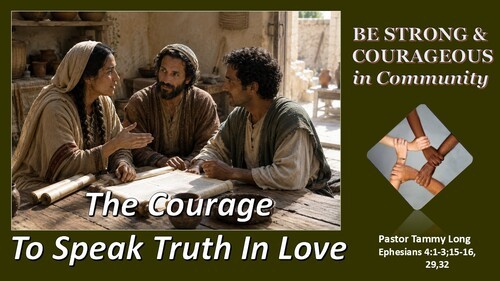
Be Strong and Courageous in Community: The Courage to Speak the Truth in Love
Ephesians 4:1-3, 15-16, 29, 32
By Pastor Tammy Long
For Your Heart Today
We live in a world where communication is constant, yet genuine understanding often feels increasingly rare. We can text, post, comment, email, and message at any moment, but many of us sense that something has shifted in the way we speak to one another. Conversations can become harsh, reactive, defensive, or avoidant. In response, we may either say too much or say nothing at all.
In Ephesians 4, Paul offers another way. He calls believers to live lives worthy of their calling by cultivating humility, gentleness, patience, unity, kindness, compassion, and forgiveness. Within that vision of Christian community, he gives a powerful invitation: "speaking the truth in love."
Speaking the truth in love is not about winning arguments, proving points, or getting something off our chest. It is participating in God's work of helping people, relationships, and the body of Christ grow toward maturity. Sometimes that means offering wisdom. Sometimes it means helping someone grow in understanding. Sometimes it means loving accountability. And sometimes it means having the courage to listen when someone speaks truth to us.
Whether we are called to speak or to receive, God invites us to approach one another with humility, trusting that He may use members of His body to help us grow.
Takeaways
- The goal of speaking the truth in love is growth, not victory. Truth spoken in love seeks the maturity of people, relationships, and the body of Christ rather than winning an argument or proving a point.
- Humility creates space for truth. We never see the whole picture or know the whole story. Humility reminds us to speak gently, listen carefully, and remain open to learning.
- Truth grows best in the context of relationship. Like Priscilla and Aquila with Apollos, meaningful truth is often shared where trust, care, and investment already exist.
- Both speaking and listening require courage. God may invite us to faithfully speak what needs to be said, or He may invite us to receive what someone else lovingly shares. Both are acts of spiritual maturity.
Breath Prayer
Inhale: Speak through me, Lord
Exhale: Help me listen well
Full Manuscript - Estimated Reading Time ~20-22 minutes

Be Strong and Courageous in Community: The Courage to Speak the Truth in Love
Ephesians 4:1-3, 15-16, 29, 32
By Pastor Tammy Long
Changing Times in Communication Today
We live in a world with more ways to communicate than any generation before us.
Beyond face-to-face conversations and phone calls, we text, email, post, comment, and message. We can communicate with one person or hundreds at any time of day. Receiving an actual letter or card is a true gift, since it's so rare.
Not only have our methods of communication changed, but our manners and tone are changing, too.
One survey from the American Bar Association found that 85% of Americans believe the way people speak to one another has become less respectful over the last decade. And it appears to be a growing trend.
Another study on Civility in America reported a severe civility deficit in our nation, one that shows no signs of letting up. In fact, the belief that the United States has a major civility problem has reached a record high. Seventy-five percent of the 1,100 adults surveyed indicated that incivility-a lack of basic kindness, politeness, and goodwill-has risen to crisis levels.
What's more, various studies of language and communication trends have found that norms around language itself have changed. And we see it, don't we?
Words and expressions that previous generations considered inappropriate or unacceptable have become commonplace in entertainment, media, and everyday conversation. Language that once shocked us barely registers anymore.
Different studies. Different observations. Yet together, they suggest that something has shifted in how we speak to one another.
A few weeks ago, as part of this Be Strong and Courageous in Community series, we talked about the courage to restrain-allowing the Holy Spirit to help us pause, breathe, and resist saying or doing the first thing that comes to our human minds.
We recognized that not every thought needs to be spoken, and not every feeling needs to become an action. By God's grace and power, restraint is one response. We choose to say or do nothing, to let whatever it is go, and leave it with God, who will have the last word. But there are times when we have to speak up.
Ecclesiastes 3:7 says there is a time to speak and a time to be silent. The question becomes: What do we say when it's time to speak? And how do we say it?
Paul addresses that question in Ephesians 4. We'll be looking specifically at verses: 1-3, 15-16, 29, and 32.
Speaking Truth in Love
Ephesians is one of several letters Paul wrote while he was in prison for preaching about Jesus.
This particular letter does not address a church controversy or conflict like some of his others. In this letter, Paul is writing to believers about what it means to live as followers of Christ.
He begins the chapter with the words, "Live a life worthy of the calling you have received."
Then he describes the kind of community God desires, one characterized by humility, gentleness, bearing with one another in love, and unity.
In the verses we did not read in this chapter, Paul writes that although they all have different gifts, they are one body in Christ. Each person has a role to play, and God's desire is that the whole body, working together in community, would grow together in maturity.
In the middle of this vision of what it means to live a life worthy of following Christ, Paul states our focus text: "Speaking the truth in love, we will grow to become in every respect the mature body of Christ."
Often, when we hear the phrase speak the truth in love, we think about confrontation. We think about speaking truth to power. We think about courageous speech in the name of the Lord. And there are times for that.
But in the context of the passage, speaking the truth in love is not about winning an argument, proving a point, or getting something off our chest. It is about helping sisters and brothers in the body of Christ grow together into maturity.
In other words, speaking the truth in love is not simply about civility, politeness, or kindness. It goes much deeper. Speaking the truth in love is one way God helps His body, His community, grow.
Why Speaking the Truth in Love is So Difficult
Now let's speak some truth right now. Paul's words sound simple enough.
Tell the truth.
Do it lovingly.
Yet most of us know from experience that it is far more complex than that.
Often when this passage is preached, you'll hear about the danger of truth without love and love without truth. They go together, and there is wisdom in that.
Truth without love is often harsh, brutal even. We can become so focused on being right, "telling it like it is," or speaking our truth that we miss how it lands with the person in front of us.
Conversely, love without truth can be too soft and detrimental. In our concern not to hurt someone or damage the relationship, we may choose to remain silent when a difficult conversation may be exactly what's needed for growth or healing.
But the challenge of speaking truth in love is even more complex.
Sometimes we speak up because we genuinely care, only to discover that we did not have the whole picture and misspoke.
Or we may hesitate because we are not sure whether what we want to share is actually truth, one perspective, or simply our own preference. We don't want to sound judgmental or impose on what's not our business. So, we say nothing.
Then there is another important factor. Most of us live fragmented lives.
We may have our worship world, our work world, our retirement world, our friends-who-don't-go-to-church world, our volunteer world, and so on.
We may love others, but we do not always know one another well enough to speak into their lives. We do not know the person's story, their struggles, or what God may already be doing in their life, so we're hesitant to say anything.
All of this makes speaking the truth in love more complicated than it first appears.
So the question becomes: If we are serious about following Jesus and want to be strong and courageous in community, how do we learn to speak truth in love as Paul envisions?
Well, Paul gives us some guidance a few verses later when he writes:
"Do not let any unwholesome talk come out of your mouths, but only what is helpful for building others up according to their needs, that it may benefit those who listen."
That's a huge insight because speaking the truth in love is bigger than simply what we say. It's also about why and how.
In other words, the deeper question behind speaking the truth in love is, "What will help this person, this relationship, and ultimately the body grow?"
If we look at Ephesians 4 again, we see the context and framing for speaking the truth in love quite clearly. The picture that emerges from the chapter for a strong and courageous community that speaks truth in love is a relational ecosystem shaped by:
- Humility.
- Gentleness.
- Patience.
- Unity.
- Being bound together with peace.
- Truth spoken in love.
- Words that build up.
- Kindness.
- Compassion.
- Forgiveness.
Taken together, these verses help us understand what Paul means and how we grow into it.
Speaking the truth in love is not merely about expressing what is true; it is about participating in God's work of helping people, relationships, and the body grow in unity and maturity. That is why humility matters so much. In fact, it might not be an accident that Paul starts the chapter there.
Humility reminds us that we do not see the whole picture or know the whole story. It reminds us that we may be mistaken in our perspective.
Humility does not mean staying silent, but it reminds us to speak with gentleness, openness, and a willingness to keep listening. Humility reminds us that the goal is not to prove a point or to speak our truth. The goal of speaking truth in love is growth and maturity as a follower of Jesus.
What It Looks Like
But what does speaking the truth in love actually look like?
Scripture gives us many examples, but we'll briefly look at three stories.
Our first story comes from Moses and his father-in-law, Jethro.
When we pick up Moses' story in Exodus 18, he is carrying an enormous responsibility. The Bible says people are bringing their disputes to him from morning until evening. Day after day, he listens, decides, teaches, and leads. Moses is sincere, devoted, and serving God as best he knows how.
But upon a visit, his father-in-law, Jethro, sees something Moses cannot see. He sees exhaustion, and that the burden is too heavy for one person to carry. He sees that what Moses is doing is not sustainable.
But Jethro doesn't just notice. He speaks the truth in love.
After observing what is happening and asking a lot of good questions-which is always a good idea before speaking, asking good questions for clarity and understanding-Jethro says:
"This is not good! ... You're going to wear yourself out-and the people, too. This job is too heavy a burden for you to handle all by yourself. Now listen to me, and let me give you a word of advice, and may God be with you." (Exodus 18:17-19, NLT)
Those are honest words. They are also loving words. Jethro is not attacking or criticizing Moses. He wants to help him. He is seeking to build him up. Further, his concern is not merely for Moses, but for the people who are waiting in line all day, too. Jethro's concerns are also for the good of the community.
Scripture tells us, "Moses listened to his father-in-law's advice and followed his suggestions."
Jethro's truth in love helped Moses become a healthier leader, helped the community function more effectively, and enabled God's work to continue strong and well.
Sometimes speaking the truth in love means noticing what another person cannot see for themselves and gently offering wisdom.
I wonder if even now someone comes to mind-something you feel you want to say, an insight you want to share, or support you want to offer out of love. Perhaps the thought has come to you more than once as you notice a need, a concern, or a struggle.
Perhaps that is the Spirit inviting you to speak truth in love. Humbly. Gently.
You might not even know the full picture, but what if God wants to use you to build them up? What if God is inviting you to be strong and courageous by speaking truth in love to whoever it is who keeps coming to your mind?
Our second story is about Priscilla and Aquila and a gifted teacher named Apollos.
When we meet Apollos in Acts 18, he is already doing many things well.
We read:
"He had been instructed in the way of the Lord, and he spoke with great fervor and taught about Jesus accurately, though he knew only the baptism of John. He began to speak boldly in the synagogue. When Priscilla and Aquila heard him, they invited him to their home and explained to him the way of God more adequately." (Acts 18:25-26, NIV)
Priscilla and Aquila recognized immediately that there were things Apollos did not yet know.
What is striking is how they responded. They did not publicly correct him, embarrass him, or criticize him behind his back. Instead, Scripture says, "They invited him into their home and explained to him the way of God more adequately."
Once again, we see truth and love working together.
Priscilla and Aquila cared more about Apollos' growth than proving he was wrong. They recognized his gifts. They affirmed what God was already doing in his life. And then they helped him take the next step. Their goal was not correction for correction's sake. Their goal was growth-his own growth and the growth of the believers who were listening to him.
As a result, Apollos became even more effective in the ministry God had called him to, and his ministry expanded. Continuing on in Acts, we read:
"He was a great help to those who by grace had believed. For he vigorously refuted his Jewish opponents in public debate, proving from the Scriptures that Jesus was the Messiah." (Acts 18:27b-28 NIV)
Sometimes speaking the truth in love means helping someone grow in understanding. Sometimes it means coming alongside another person and being willing to share honestly in their journey. In many ways, this is what mentoring looks like. I hear frequently from the next generation about their desire to find mentors they can walk alongside, and part of spiritual mentoring is being willing to speak the truth in love.
And did you notice how they engaged with Apollos?
They invited Apollos into their home. They made space for conversation. This story reminds us that truth spoken in love grows best in the context of a relationship. It grows where there is trust. It grows where there is investment. It grows where people make room for one another and create a safe space to speak truth.
I wonder if there is someone God may be inviting you to come alongside-not to criticize, fix, or convince of anything, but simply to encourage, support, and invest in their growth. Someone God may be inviting you to get to know more deeply. Someone with whom God may be creating the kind of relationship where truth in love can eventually be shared as the Spirit leads.
Our third story of speaking the truth in love comes from two of the most influential leaders in the early church: Paul and Peter.
By the time we reach Galatians 2, Peter is not a new believer. He is a mature follower of Jesus and a respected leader in the church. He has already experienced God's revelation that the gospel is for both Jews and Gentiles, and he has witnessed the work of the Holy Spirit among Gentile believers.
And yet Paul describes a situation that was concerning, and he had to speak truth in love. In Galatians, Paul writes:
"But when Peter came to Antioch, I had to oppose him to his face, for what he did was very wrong. When he first arrived, he ate with the Gentile believers, who were not circumcised. But afterward, when some friends of James came, Peter wouldn't eat with the Gentiles anymore.
He was afraid of criticism from these people who insisted on the necessity of circumcision. As a result, other Jewish believers followed Peter's hypocrisy, and even Barnabas was led astray by their hypocrisy… (Galatians 2:11-14 NLT)
What concerned Paul was not only Peter's behavior but the impact it was having on the community. Other believers began following Peter's example. What began as one person's actions was now affecting the life of the church.
In this story, we're told that Paul addressed Peter "in front of all the others." Not to embarrass him or call him out, but because the matter was that important. It was impacting the entire community, misrepresenting the Gospel, stirring divisiveness, and harming the unity of the body of Christ. Paul felt compelled to speak.
Sometimes speaking the truth in love requires accountability. Addressing what others would rather avoid. And having the courage to speak when silence would allow harm to continue. Yet did you notice? The goal is the same: growth, healing, faithfulness, and the building up of the body of Christ.
This story reminds us that speaking the truth in love is not always comfortable. Sometimes it involves difficult conversations. It requires courage to confront. And, when our motive is love and our goal is growth, God can use even difficult conversations to strengthen us and the body of Christ.
I wonder if there is a conversation you have been avoiding because you genuinely care and fear the conflict that may ensue. Perhaps you have been praying, waiting, and seeking wisdom, but the issue feels too pressing, too dire to let go.
Perhaps the Spirit is inviting you to move forward in loving accountability-not to win an argument or make a grand stand, but to raise a concern and allow the Spirit to work toward growth, healing, reconciliation, and maturity.
The Courage to Speak and Listen
When you consider the maturity God is seeking to do in us and in the body of Christ, we have to be strong and courageous because speaking the truth in love is not easy. But God chooses to work through us.
Of course, speaking the truth in love needs to be bathed in prayer-for listening well, empathy, timing, and choice of words. All the things we know we need for good and godly communication.
But as I reflected on the many ways speaking the truth in love was expressed in the stories we considered today, I noticed one more thing. Every one of them required someone courageous enough to speak.
Jethro spoke about the concern he noticed. Priscilla and Aquila spoke to address gaps in understanding. Paul spoke to address a disruption to the community.
And every one of them required someone courageous enough to listen.
Moses listened and reorganized the leadership of Israel for the good of the community. Apollos listened and became even more effective in the ministry God had called him to. And Peter had to decide what he would do next. Even though Scripture doesn't tell us his response, we do know the church continued on mission, bringing Jews and Gentiles together, and Peter remained one of its key leaders.
And this is an important truth to hold together. Jethro, Priscilla and Aquila, and Paul were responsible for speaking faithfully. But Moses, Apollos, and Peter were responsible for what they did with what they heard.
This same truth applies to us.
When we speak the truth in love, we are not responsible for what another person does with our words. We are simply called to speak faithfully, humbly, and lovingly as the Spirit leads.
At the same time, there will be moments when God invites us to listen-to the truth He speaks through someone He sends our way.
For some of us, speaking is difficult. For others, receiving is difficult. Yet both require courage. Both require humility because we can never see the whole picture or know how God is at work. Both require trust that God may be using us to help someone grow, or another member of the body to help us grow. Both require open hearts to speak and to listen, allowing the Spirit to do its work within us.
So the invitation today is simple: Be strong and courageous enough to speak the truth in love when love requires it. And, be strong and courageous enough to listen with humility when someone speaks with love.
In a world where communication is often anything but loving, may we be people who speak the truth in love and remain open to what God may want to say to us through others.
And as we do, may we keep growing together into the mature body of Christ.
Amen.
No Comments