
Be Strong Courageous in Community The Courage to Restrain
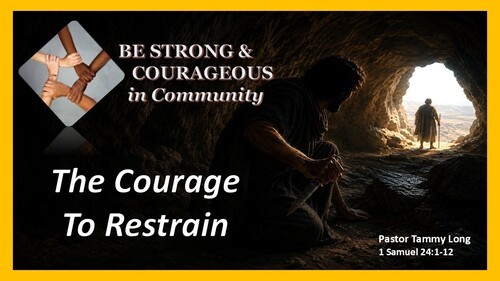
Be Strong and Courageous in Community: The Courage to Restrain
1 Samuel 24:1-12
By Pastor Tammy Long
For Your Heart Today
We live in a world that often rewards reaction.
The sharp response. The perfect comeback. The moment where we finally say what we've been holding in. And if we're honest, when we've been hurt, misunderstood, overlooked, or wounded, something in us naturally wants to strike back. But in this week's message, we encounter a very different kind of strength.
In 1 Samuel 24, David has every opportunity to retaliate against Saul, the man who has betrayed him, hunted him, and tried repeatedly to kill him. David has the power, the justification, and the support of everyone around him to act. And yet, in one of the most courageous moments of his life, he restrains himself. Not because Saul is innocent or the pain isn't real, but because David senses God stirring him toward another way.
This story reminds us that restraint is not weakness. Sometimes the deepest courage is found not in what we do, but in what we choose not to do.
And on Pentecost Sunday, we are reminded that this kind of mercy-shaped living is not something we sustain through willpower alone. The Holy Spirit helps us pause before reacting, interrupts retaliation with compassion, and teaches us how to respond out of the heart of Christ rather than out of woundedness.
Takeaways
- Restraint is not weakness. David had the power and opportunity to retaliate, yet chose restraint in alignment with God's heart rather than acting out of impulse, pride, or revenge.
- Discernment often requires slowing down long enough to notice what God is stirring within us. Something can appear justified and still not be God's way.
- Mercy interrupts retaliation. David's restraint was not simply self-control; it became an act of compassion that refused to let anger, ego, hurt, or the need to prove himself dictate his response.
- The Holy Spirit helps transform our responses. Pentecost reminds us that God's Spirit empowers us to respond with mercy, wisdom, and self-control rather than merely reacting out of instinct or emotion.
Breath Prayer
Inhale: Spirit of God
Exhale: Teach me mercy
Full Manuscript - Estimated Reading Time ~20-22 minutes

Be Strong and Courageous in Community: The Courage to Restrain
1 Samuel 24:1-12
By Pastor Tammy Long
We are continuing our series, Be Strong and Courageous in Community, and we've been exploring the courage it takes not simply to talk about loving others, but to live into it.
Because the idea of community sounds beautiful in theory. Loving people sounds beautiful in Kum Ba Ya moments. Even loving our enemies, while challenging, seems possible when our "enemy" is faceless and not standing right in front of us.
But the truth is, relationships in all shapes and sizes are not easy. Getting along with people at every level, from strangers we don't know to our closest companions, is hard.
I've been talking with a friend who is trying to navigate a deeply toxic work environment. There is an ongoing "them versus us" mentality between divisions in the organization. Upper management is riding middle management, and middle management is blaming the day workers. Everyone seems to be operating out of self-preservation, frustration, defensiveness, and fear. There are snide comments, backbiting conversations, passive-aggressive exchanges, and people quietly - and not so quietly - throwing one another under the bus.
My friend has tried to bring resolution and peace to the environment, yet has experienced unappreciative backlash. He never knows what challenges he will face each day, and some have become personal affronts he's had to defend.
The truth is, tension like this is not limited to workplaces. It can show up in families, friendships, churches, marriages, neighborhoods, and even online interactions with people we have never met.
We live in a world where restraint as a response can be perceived as failure. Our culture celebrates the snappy comeback, the takedown, the perfectly timed response, and the "got 'em" moment. We are taught that strength means making sure people know they cannot treat us that way - that silence is weakness and mercy is naïve. And if we are honest, there is something in us that naturally wants to strike back when we've been ignored, accused, attacked, or wounded.
And ye, some of the deepest courage in the Christian life is not found in what we do. It's in what we don't do… even though we could. It's found in what we restrain ourselves from doing.
Sometimes the strongest person in the room is not the loudest one, but the one who chooses not to let pain or pressure determine their response.
This struggle is nothing new. Human beings have wrestled with how to respond in such moments for a very long time.
Which brings us to our scripture today. We'll be reading an Old Testament passage found in 1 Samuel 24:1-12.
When Retaliation Feels Justified
This is such a dramatic story. It reads like a movie script, but beneath all the drama is a deep relational battle.
David has been running for his life. And this is not merely a small misunderstanding between acquaintances.
This is the grown-up David who, as a boy, conquered the giant Goliath. This is the same David who served Saul faithfully and was embraced like a son. He played music for Saul to lift his tormented spirits. He fought for Israel under Saul's leadership. He married into Saul's family. This is the David who loved Saul's son, Jonathan, like a brother. At one point, David was one of the most trusted people in Saul's inner circle. They were family.
But as David's victories grew and the people began praising him, jealousy began to grow in Saul's heart. What started as insecurity slowly turned into obsession, leading Saul to repeatedly try to kill David. He threw spears at him and drove him away from his home. He separated him from his wife, his closest relationships, and any sense of security or safety.
Now David is hiding in caves, constantly moving and looking over his shoulder. He's a hunted man.
Then, suddenly and unexpectedly, as we come to today's part of the story, the tables have turned. Saul walks into the very cave where David is hiding.
I have a vivid imagination, so I can see the men crouched in the back, in the dark, with wide eyes, their fingers to their lips. They can't believe their good fortune.
David's men immediately interpret the situation spiritually. The Bible says, in whispers, they declare, "This is the day the Lord spoke of. God has delivered your enemy into your hands."
For them, this moment is a no-brainer. Saul has been trying to kill David, and David has the opportunity to strike back. Everyone around him is saying the same thing: "Do it."
And it feels justified and divinely orchestrated because David is not dealing with a minor disagreement. He is dealing with betrayal, danger, injustice, and the abuse of power.
Saul has wounded David repeatedly, and not accidentally. Saul's intention was to kill him.
What makes this story so powerful is that David is actually in a position to retaliate and thwart Saul's plans. He has the power, he has support from the men around him, he has justification, and he has opportunity. "It does appear God opened this door. Surely this is your moment," his men urge.
And David agrees. The story says he crept close enough to Saul to cut off a corner of his robe.
Now this may seem unusual to us. We're expecting David to hold Saul at knife point at the very least, and perhaps even kill him. But David did not even publicly confront him in this moment. He only cut the robe.
But this was a significant move.
In the ancient world, the robe represented far more than clothing. A king's robe symbolized authority, identity, office, and anointing. To touch the robe this way was a symbolic attack. It was like taking hold of Saul's kingship itself and diminishing his authority.
But as David did this, something stirred in his spirit. The text says his conscience began to bother him.
How many of you know that God has a way of speaking to us through our conscience? Through our thoughts? Through something not feeling quite right in our hearts?
David knew in his spirit that he had crossed a line.
As much as it looked like a God-orchestrated opportunity, that was not God's way.
Sometimes something can appear to be of God, feel fully justified, be encouraged by others, and still not be God's desire.
Mature discernment often requires slowing down long enough to get quiet and pay attention to what God is stirring inside of us, despite the voices and circumstances around us.
David suddenly realized that even this act had pulled him in a direction he did not want to go. Not because Saul was innocent. He wasn't. But because David recognized that Saul was still the Lord's anointed, he refused to react or retaliate with violence, vengeance, or threat.
The Bible goes on to tell us that David not only restrained himself, but he also restrained his men from harming Saul, too.
The Courage to Restrain
I think this is where the story moves into our lives.
Now, I don't see any of us standing in a cave holding a knife over a king. But we all will face moments when we have the opportunity and the upper hand. Moments when we could say something or do something to make things go our way. Or when we've been wounded and have the opportunity to wound someone back.
What I love about this story is that, regardless of what society may say, we see that restraint is not weakness.
David is not powerless. He is not incapable of acting. In fact, just the opposite, and that is exactly what makes his restraint meaningful. He has the ability, support of those around him, justification, and opportunity to act. And yet he chooses not to - he restrains himself in alignment with what he senses from God.
Biblical restraint is not passivity. It is not silence because we are afraid. It is not enabling abuse of power. It's not holding back out of weakness or uncertainty.
Like it was for David, restraint is a choice to hold, aligned with God's ways, and that takes courage.
It is the decision not to repay evil for evil, even when retaliation feels warranted.
It is holding your tongue when you really want to say, "I told you so."
It is choosing not to dominate a conversation, force our agenda, prove our point, or insist on our own way simply because we have the power or ability to do so.
This is the tension we face every day because restraint for us does not involve spears and swords. It's in what we say or don't say in conversations and text messages. It's in how we show up in meetings, around dinner tables, in church spaces, at family gatherings, and in our marriages and friendships.
At its core, the courage to restrain is refusing to let ego, self-assurance, anger, humiliation, or woundedness dictate our response.
But let me be honest. I believe one of the biggest challenges for restraint is when we've been hurt. Our natural inclination is to hurt back.
It may be a sarcastic comment we know will cut deeply because we know where the other person is vulnerable. It may be a snide comment, a passive-aggressive response, gossip shared as a so-called prayer request, or an emotional withdrawal, letting ice fill the space.
Here's the truth, if we're honest - at least I'll speak for me - a part of us wants people to feel what they made us feel. We want them to hurt.
That is why restraint takes courage. Because it hurts not to hurt back.
When David walks out of that cave, he will still be hunted. He is still misunderstood. He is still hurting. Saul does not suddenly become trustworthy, and David's restraint does not erase the pain he has experienced.
And yet, in that cave, in his act of restraint, David does something extraordinary, really, when you think about it.
He extends mercy.
Later in the passage, when David is letting Saul know that he could have taken his life but didn't, he says, "I spared you."
The original Hebrew word for "spared" here conveys pity and compassion.
In other words, David does not simply restrain his hands. That stirring in his conscience that caused him to pause was a moment of compassion and mercy. His desire for retaliation and retribution was intercepted by something greater.
Now, please hear me when I say, Saul's behavior was still wrong. Saul was still responsible for his actions.
David speaks to this when he says, "Perhaps God will punish you for what you are trying to do to me."
David knows, as we know, God will have the final word. Vengeance belongs to God.
We also know that hurting people hurt people. Saul's jealousy, rage, and insecurity had consumed him. Perhaps David extends mercy as he not only recognizes God's appointed servant, but also the broken man before him.
The courage to restrain often begins right there, because restraint is an act of mercy - seeing another through God's eyes.
David refuses to let Saul's brokenness shape his response or his spirit.
Restraint when wronged is one of the hardest challenges in the Christian life. That's why we need courage.
It's hard to go through painful situations without becoming hardened ourselves. It's hard to feel wounded without wanting to wound back. Hard not to punish people through sarcasm, distance, silence, or the little digs that slip out before we even realize what is happening in our hearts.
It's hard because retaliation and getting even feel natural. And for a moment, it feels good, too.
Yet, this restraint, this mercy, this refusal to repay evil for evil, is exactly the kind of life Jesus taught about in the Kingdom of God.
Which raises a deeper question and challenge for those of us who follow Jesus:
Who can actually live this way?
Learning Restraint in the Kingdom of God
You know, sometimes I wonder, if I were on earth when Jesus was here, if I would have been drawn to His teachings or challenged by them? I suspect both.
Jesus said things that sound beautiful in devotionals, but become incredibly difficult when the rubber meets the road. Things like: Love your enemies. Pray for those who persecute you. Turn the other cheek. And forgive, not seven times, but seventy times seven. Bless those who curse you, to name a few.
This is not about simply "being nice." This is an entirely different way of being and relating in the world, and all of these speak to having the courage to restrain.
Now, let me pause and say: restraint is one Kingdom response; it is not the only Kingdom response.
There are times in scripture when God's people speak boldly, confront injustice, establish hard boundaries, and act decisively. Jesus Himself did all of those things.
The issue is not about passivity or activity. The question is: where does the response stem from? Is it shaped by woundedness, hurt feelings, or our desires, or is it shaped by the heart and Spirit of God?
And here's where things get exciting for us, especially on Pentecost Sunday, because this is the hard truth we must embrace: when we think about the relational life Jesus depicts, we simply cannot sustain it through willpower.
When we are hurt, our natural instinct is self-protection. We can't help it.
But praise God, Jesus knew that, too.
This is why Jesus did not simply teach this way of life and then leave us alone to figure it out.
Jesus said:
"If you love me, keep my commands. And I will ask the Father, and he will give you another advocate to help you and be with you forever." (John 14:15-16)
He promised the Holy Spirit. The Helper. The Advocate. The very presence of God dwelling within us, shaping us, convicting us, transforming us, and empowering us to live differently and love the way Jesus loves.
We won't get it perfect. We still have our human nature. But here's what's important to remember on Pentecost Sunday: Pentecost is not only about power displayed outwardly. It is about power transforming us inwardly, moment by moment and step by step.
The same Spirit that gives boldness also gives restraint. The same Spirit that empowers us to seek justice also empowers us with compassion. The same Spirit that teaches us truth also teaches us how to respond with mercy.
That is why one of the fruits of the Spirit is self-control. And boy, do we need that.
Because the truth is, left to ourselves, retaliation feels easier than mercy. Bitterness feels safer than vulnerability. And it is very difficult not to let other people's brokenness slowly harden our own hearts.
But when the Spirit is at work within us, something else becomes possible.
The Spirit helps us pause before we react. The Spirit helps us recognize when woundedness is shaping our responses. The Spirit interrupts retaliation with compassion. The Spirit teaches us how to hold power mercifully. The Spirit teaches us how to respond rather than merely react, and how to stay aligned with the heart of Christ even when we have been hurt.
Perhaps this is one of the clearest signs that the Spirit is truly transforming us: when we begin responding to people not simply out of instinct, but out of mercy - the same mercy we ourselves have received from God.
Recently, I watched a scene in a television show that struck me because it captured something about mercy and restraint so profoundly.
You may be familiar with the series Ted Lasso.
In the storyline, a young coach named Nathan deeply betrays a soccer team and publicly humiliates the head coach, Ted, who had believed in him, encouraged him, and helped give him confidence when others overlooked him. The betrayal wounds the whole team, but especially Ted and assistant coach Beard, who had also cared deeply for Nathan.
As the story unfolds, Nathan becomes humbled by his own failures and would like to return to the team he left, but Coach Beard struggles with allowing him to return after all the hurt and damage he had caused.
But something shifts in Coach Beard. Watch this clip.
Mercy Changes the Response
Now, this feels like a forgiveness and reconciliation scene, and it is. But what struck me was Beard's restraint and transformation.
Humanly speaking, he had every reason to keep Nathan out. Every reason to hold onto the hurt and keep his distance.
But instead, he restrained those human instincts and extended mercy. And here's the important part: he extended mercy because he remembered how mercy had once been extended to him.
That's our story. We live by mercy, too. In fact, God's Word tells us His mercies are new every morning.
And little by little, the Spirit softens our hearts and our reflexes, and gives us the courage to restrain - not in weakness, or passivity, or pretending wounds do not exist or matter, but the courage to restrain our instincts long enough to let the Spirit shape our responses while God meets our needs and heals our wounds.
As we prepare to close, I'm wondering…
Where might the Spirit be inviting us to pause before reacting? To listen more carefully before insisting on our own way? To release the need to wound back, control outcomes, prove a point, or let someone else's brokenness shape our spirit?
Perhaps the invitation this week is simply to notice one moment when the Spirit invites us to pause, respond differently, and embrace the courage to restrain.
Pentecost reminds us that we are not left alone in our own strength. The Holy Spirit is still at work within us even now, giving us the courage to restrain.
Amen.
No Comments