
Be Strong Courageous as Disciples: Get to Know Thomas
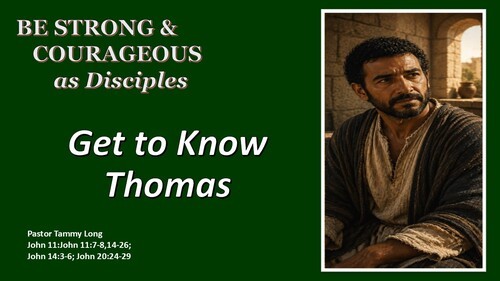
Be Strong and Courageous as Disciples: Get to Know Thomas
John 11:7-8, 14-16; John 14:3-6; John 20:24-29
Pastor Tammy Long
For Your Heart Today
For generations, one moment in Thomas' life has shaped the way we remember him. We even gave him a name: Doubting Thomas. But when we look again at the moments John gives us, a fuller picture begins to emerge.
Thomas didn't pretend. When the road ahead looked dangerous, he acknowledged the risk and chose to follow Jesus anyway. When he didn't understand, he asked the question. And when others told him they had seen the risen Jesus, Thomas was honest about what he needed in order to believe. Through it all, he kept reaching toward Jesus. And Jesus met him there.
Perhaps that's an invitation for us, too. Courageous faith doesn't require us to hide our questions or present a polished version of ourselves to God. We can bring our faith and our doubts, what we understand and what we don't, our confidence and our uncertainty. Jesus already knows us, and He meets us with grace as He invites us forward.
Thomas' story reminds us that courageous discipleship isn't pretending to have it all figured out. It's bringing our real selves to Jesus-and continuing to reach toward Him.
Takeaways
- Courage follows Jesus with eyes wide open. Thomas understood the danger of returning to Judea, yet still said, "Let's go." Faith doesn't require pretending the risks aren't real.
- Courage asks honest questions. Thomas didn't pretend to understand what he didn't understand. His question opened the way for Jesus to reveal, "I am the way, the truth, and the life."
- Jesus knows what we need and meets us there. Thomas wanted his own encounter with the risen Jesus, and Jesus offered him the very encounter he had asked for-without shaming him for needing it.
- Courageous faith keeps reaching toward Jesus. Thomas brought his real self to Jesus, and his journey led to a declaration of faith and worship: "My Lord and my God!"
Breath Prayer
Inhale: Jesus, here I am.
Exhale: Draw me closer to You.
Full manuscript - Estimated reading time ~20-25 minutes

Be Strong and Courageous as Disciples: Get to Know Thomas
John 11:7-8, 14-16; John 14:3-6; John 20:24-29
Pastor Tammy Longte
Introduction
For the last few weeks, we have been gathering around this campfire at our BASE Camp, getting to know some of Jesus' friends-friends who would become His apostles. And each one had their own journey with Jesus.
Today, as we get to know another one of Jesus' friends, Thomas, I want to invite you to imagine a biblical scene that may be familiar to you. It is evening. The doors are locked. Jesus' disciples are gathered in a room in Jerusalem, still trying to make sense of everything that has happened.
Just days ago, the One they had followed for three years had been arrested, beaten, crucified, and buried. But that wasn't the end of the story! Jesus was alive and had come to them in that very room! Not in a vision or a dream. Jesus, in the flesh. The text says He suddenly appeared before them and said, "Peace be with you." Then He showed them His hands and His side. They saw the wounds. They saw the living Jesus. And they couldn't stop talking about it. "We saw Him!" "He is alive!"
But one disciple wasn't there. Thomas.
Scripture doesn't tell us where he was. We only know that Thomas missed the whole thing. And now his friends are telling him the impossible has happened. Can you imagine Thomas looking from face to face as they recounted the story? These are men he knows, men who loved Jesus just as he did.
Thomas hears it all, and then says, "I won't believe it unless I see the nail wounds in His hands, put my fingers into them, and place my hand into the wound in His side."
Now, freeze the scene right there! Because if this were a movie about Thomas, this is probably the scene we know best. One scene. One statement. For generations, the church has remembered this disciple by two words: Doubting Thomas.
Osisver the centuries, we've added even more to the picture. Thomas has been described as pessimistic. Negative. A glass-half-empty kind of person, with a tendency to expect the worst. Maybe you've heard Thomas described that way. You've probably at least heard the term "a Doubting Thomas." This is where that phrase comes from.
But here's the question I want us to consider: Does John actually tell us that?
There is wisdom in considering the generations of believers who have wrestled with these texts before us. But sometimes an interpretation becomes so familiar that we begin to hear it as though it were part of the text itself. That's when it's good to look again and ask: What does the text actually say?
In Thomas' case, John gives us more than this one scene. There are other moments when Thomas steps out of the background, and we hear his voice-other encounters between Thomas and Jesus. So before we decide who Thomas is based on this one scene, I want to invite us to rewind his story.
Before Thomas is in this locked room, let's go back and meet Thomas afresh.
Meet Thomas
So, who is Thomas? Let's start with what we actually know.
Thomas was one of the twelve disciples Jesus personally chose to walk with Him. Matthew, Mark, and Luke include his name when they list the Twelve, but they don't tell us anything more about him. It is John's Gospel that allows us to hear Thomas' voice.
Apparently, Thomas had a twin. John refers to him as Thomas, also called Didymus, which is the Greek word for twin. Beyond that, Scripture tells us very little. We don't know what he did for a living, how Jesus called him, or much about his life before following Jesus.
So, if we really want to know Thomas, we have to pay attention to the moments John gives us. And Thomas speaks three times in John's Gospel.
So let's begin with the first time we hear his voice.
Scene One - "Let Us Go"
Our first scene takes place before Jesus is crucified. Jesus has received word that His friend Lazarus is sick. Lazarus lives in Bethany, just outside Jerusalem, and that location is important because Jesus has enemies in Judea. Not long before this, people there had tried to stone Him. So, when Jesus tells the disciples He wants to go back, they know exactly what that could mean.
And there he is. We meet Thomas and hear him say, "Let's go, too-and die with Jesus."
Now, some interpreters have read this as an example of Thomas' pessimism, seeing the worst possible outcome. But John doesn't tell us anything about Thomas' temperament. What we see in this account is that Thomas understands the danger-and is willing to go anyway.
And notice Thomas doesn't simply say, I'm going. He says, "Let's go." He's calling the other disciples to come too.
There is a strength in Thomas' voice here that we can easily miss. That's courage. Courage doesn't require us to pretend danger isn't real. Sometimes courage looks at the road ahead with eyes wide open and still says, "Let's go."
But here's what I love-don't miss the rest of Thomas' sentence. He says, "Let's go, too-and die with Jesus."
With Jesus.
That's courageous discipleship. Thomas doesn't know what Jesus is going to do in Bethany. He doesn't know that Lazarus is about to walk out of a tomb. He only knows that Jesus is going. Whatever Thomas thinks may happen in Judea, he would rather walk into the danger with Jesus than remain safely behind without Him.
If Jesus is going, Thomas is going.
And I think that's where this first snapshot of Thomas has something to say to us. Sometimes following Jesus means being honest about what might lie ahead. Faith doesn't mean the risks aren't real. Honesty about real concerns does not negate faith.
But with eyes wide open, we can weigh the risk against what we gain, because we do not go alone. As Thomas knew, being with Jesus is worth the risk.
We don't know everything Thomas contemplated in that moment. But we know the choice he made. Jesus was going. Even in the face of death, Thomas said, "Let's go, too."
Scene Two - "How Can We Know the Way?"
The next time we hear Thomas' voice, the circumstances are very different. It is the night before Jesus will die. Jesus and the disciples are gathered in the Upper Room. He has washed their feet, Judas has left, and Jesus is preparing His friends for something they still don't fully understand: He is leaving them.
I don't think I realized before that Thomas was the one who raised the question. Jesus says, "You know the way to where I am going." And Thomas essentially says, "No, we don't."
I love his honesty. Thomas doesn't pretend to understand something he doesn't understand. He courageously asks the question. Maybe others in the room were wondering the same thing. We don't know. But Thomas is the one who says it out loud.
I think there is something here for us, too. Especially if you've been in church for a while, we can become good at pretending we understand. We know the language. We know when to nod. We know when to say Amen. We know what we think we're supposed to believe.
Sometimes it takes courage simply to say, "I don't understand."
Thomas gives voice to the question. And look where his question leads. Jesus answers, "I am the way, the truth, and the life."
That word, translated as way is the Greek word hodos. It can mean a literal road or path, but it also means a way of life. Thomas is asking a concrete question: Where are You going, and how do we get there?
But Jesus doesn't give him directions. He gives Thomas Himself.
"I am the way," He says.
The path to the Father, the way of life with God, is found in relationship with Jesus. At the center of Christian faith is not simply a set of beliefs or doctrines or do's and don'ts, but a person to know.
Jesus.
Maybe you've carried a question because you thought you were supposed to know the answer by now. Maybe everyone else seems to understand something you don't. Maybe there are things about God or faith that simply don't make sense to you.
Go ahead and ask Jesus. Bring it honestly. And stay open to the ways God may answer-through His Word, through another person, through something you hear or learn. Sometimes that's how God answers us.
It can also be true that we may not receive the kind of answer we're looking for.
Thomas wanted to know where and how. Jesus answered with who.
Sometimes our questions remain: Why did this happen? What are You doing, God? How is this going to work out?
But even when our questions remain, we have Jesus. Ultimately, our faith doesn't rest in having every question answered. It rests in knowing the One who has the answers and says, "I am the way, the truth, and the life."
Even when we are holding giant question marks, Jesus is still the way, still the truth, and still the life.
And we know this truth today because Thomas was courageous enough to ask the question.
Scene Three - "Unless I See"
Now we return to the room where we started. The disciples are saying, "We have seen the Lord!" But now, we know Thomas a little better. We've heard the man who looked toward danger and said, "Let's go." We've heard the man who didn't understand and was willing to ask, "How can we know the way?" And now his friends are telling him that the Jesus he knew to have died is alive.
This is the moment that gave Thomas the name that has followed him for centuries: Doubting Thomas.
But perhaps there's more in this story. Consider this-Thomas is asking for an encounter with the risen Jesus that the other disciples have already received. When Jesus appeared to them, John tells us that Jesus showed them His hands and His side. They already saw. Thomas didn't.
What also strikes me is how concrete Thomas is. Thomas is seeking a physical and tangible encounter with the Jesus he knew had been crucified.
Thomas' desire for a concrete encounter made me think about the different ways God has made our minds. Some of us process intuitively. Some need time to reason. Some are highly concrete; others are comfortable with the abstract. We can experience and process the world very differently from one another.
Neurodivergence is a term that has become more familiar in recent years. I believe the Christian community has not always recognized that being wired differently doesn't mean deficient. Sometimes we have unintentionally made people feel there was something wrong with them-or with their faith-because they didn't experience God the way somebody told them they were supposed to.
Now, please hear me, I'm not saying Thomas was neurodivergent. We simply don't know, and I don't want to add to Scripture.
But what I do know is this: Jesus knew Thomas. He knew who Thomas was. He knew what Thomas had said. He knew what Thomas needed in this moment.
Eight days later, when the disciples are gathered again, Thomas is there. We read that the disciples are again behind locked doors. And suddenly Jesus is standing among them saying, "Peace be with you."
I love this part because after speaking peace to the room, Jesus speaks directly to Thomas and says, "Put your finger here, and look at my hands." The very thing Thomas said he needed to believe. "Put your hand into the wound in my side."
Jesus offers Thomas the very encounter he asked for. And then Jesus says, "Don't be faithless any longer. Believe."
Now, the Greek here is helpful again because Jesus' words carry a sense of movement-from unbelieving toward believing. Jesus is inviting Thomas forward.
When I look at what Jesus actually does in this scene-and what we know of the character of Jesus-I hear grace in that invitation. Jesus doesn't ignore what Thomas said he needed, nor does He shame him for needing it.
He comes to him and shows him His wounds.
In other words, it is as though Jesus is saying: Here I am, Thomas. You needed to see? See. You needed to know? Here I am.
In many ways, it feels as though Jesus came for Thomas. He knew Thomas and met him where he was, just like He meets us where we are, and extends the invitation to move forward:
To "Believe."
Conclusion - "My Lord and My God"
As we finish the story, Jesus came to Thomas. He offered him the very encounter Thomas said he needed. And He invites him to believe.
And how does Thomas respond?
"My Lord and my God!"
A declaration of truth, faith, and worship.
What a journey we've witnessed in our brother. We've seen Thomas beyond the one scene that gave him his name. I have to tell you, I've come to really admire him. I admire his honesty. His courage. His integrity.
Thomas doesn't pretend. He doesn't pretend the danger isn't real. He doesn't pretend to understand what he doesn't understand. He doesn't pretend to have experienced something he hasn't experienced.
He's authentic.
Thomas brings his real self to Jesus. What we see is someone who keeps reaching toward Jesus. When the road looks dangerous, if Jesus is going, Thomas wants to go. When he doesn't understand, he asks Jesus the question. When others tell him Jesus is alive, he wants his own encounter with Jesus.
When he does, you can hear the love and adoration in his voice when he says, "My Lord and my God."
As I've gotten to know Thomas, I've found myself resonating with his journey. I want that, too. I want even more of that kind of relationship with Jesus.
I want to keep bringing Jesus my real self-my faith and my questions, what I understand and what I don't-and keep reaching toward Him.
I want to know Jesus more. To love Jesus more. To want Jesus more.
I want that for you, too.
Whether you've followed Jesus for fifty years or you're not even sure what you believe, you can bring your real self to Jesus. Bring your questions. Bring your doubts. Bring your desire to know Him. Trust Jesus to meet you there.
Because Jesus' invitation to believe reaches beyond Thomas. Jesus said, "Blessed are those who believe without seeing me."
That's you and me!
We haven't seen what Thomas saw. But through his story, we have been invited to encounter the same Jesus.
My prayer is that as we keep getting to know Him, loving Him, and following Him, Thomas' testimony will increasingly become our own as we too, in worship, declare: "My Lord and my God."
No Comments