
Be Strong Courageous in this Season
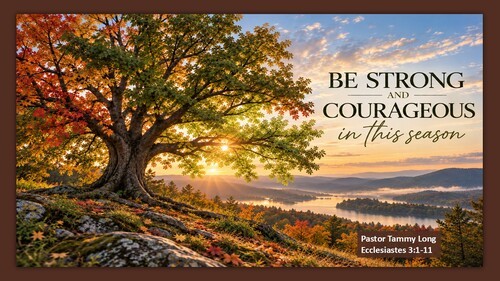
Be Strong and Courageous in This Season
Ecclesiastes 3:1-11
Pastor Tammy Long
For Your Heart Today
Life comes in seasons, and sometimes we are living in more than one at the same time. We can be celebrating in one part of life and grieving in another, planting something new while letting go of something old. Some seasons we choose. Others choose us.
Ecclesiastes reminds us that while we cannot see how every season fits into the whole of our lives, God can. We see the thread we are living right now; God sees the whole tapestry. And there is no season-not even the hard, confusing, or unwanted ones-that is outside of God's gaze and care.
Perhaps courage in this season begins by becoming present to the season we are actually in. Instead of longing only for what was or waiting for what will be, we can ask: What is God inviting me to notice, receive, learn, release, or cherish right now?
We do not have to see the whole to trust the One who does.
Takeaways
- Life comes in seasons-and we may be living in more than one at once.
- God is present and at work in every season.
- We see the threads; God sees the whole.
- Courage means being present to the season we are actually in.
Breath Prayer
Inhale: God, You are here.
Exhale: Help me trust You.
Full Sermon: Estimated reading time: 20-25 minutes

Be Strong and Courageous in This Season
Ecclesiastes 3:1-11
Pastor Tammy Long
Introduction
All year long, we've been exploring what it means to be strong and courageous with God. As we celebrated our 40th anniversary, we drew from the Old Testament story of the children of Israel crossing the Jordan into the Promised Land after 40 years in the wilderness. And we embraced God's word to them: Be strong and courageous.
So far, we've explored being strong and courageous in prayer, in the Word, in our bodies, minds, and spirits, in community, and most recently, what it means to be strong and courageous as disciples.
Today we begin another part of that journey: Be Strong and Courageous in This Season.
Over these next several weeks, we're going to pay attention to the seasons we're in-to our stories, how God has shaped us, and what God may be inviting us into now.
So this morning, I want to begin by simply inviting you to look.

Where does your eye go first? What colors draw your attention? Is there a particular part of the image that stands out? What do you notice?
Now, as you continue to look, I want you to consider: What part of this image feels most like your life right now?
There is no right answer. Just notice.
One thing I love about this image is the tree. It's subtle, but did you notice there is more than one season present in the same tree? Spring, summer, fall, winter-they are all there on the same tree.
Life is a lot like that.
Life comes in seasons, and at any given time, we could be in more than one. Some seasons we choose. Others choose us. Some seasons we welcome with open arms. Others we can't wait to be done.
And on this Grandparents Day, as a grandparent myself, I know we can look at a grandchild and see a season we remember, while realizing that we ourselves are standing in a season we have never lived before.
All of us are in a season-multiple seasons, even. The question becomes whether we recognize the seasons we're in and how God is inviting us to walk with Him in each one.
So the question we'll be holding for these next several weeks is this: What does it mean to be strong and courageous in this season of my life? What does faithfulness to God look like in THIS season?
Well, before we can answer that, we need to have a sense of the season we're in.
Thousands of years ago, a wisdom teacher crafted a poem about the seasons of life. As we go to God's Word, I suspect many of you will recognize some of these seasons personally. The words may even give language to the season you're in now.
Life Has Seasons
I don't know how it was for you hearing that text, but I can't hear that passage without hearing the song, Turn! Turn! Turn! by The Byrds. They recorded it in the '60s
What made that song so memorable is that the core lyrics weren't really written by The Byrds at all. They came almost verbatim from this ancient poem in Ecclesiastes.
And it is a poem. In fact, it's beautifully and intentionally crafted, which is striking given its age. It's dated somewhere between 2,400 and 3,000 years old. One biblical scholar compares its structure to a sonnet. The poem moves through fourteen pairs-that's twenty-eight different times or seasons. Both are multiples of seven, a number Scripture associates with completeness. This was a gifted and intentional writer.
Did you hear the rhythm in the pairs?
A time to be born and a time to die. A time to plant and a time to harvest. A time to cry and a time to laugh. A time to grieve and a time to dance.
You get the sense that the writer has considered the whole landscape of human experience and has concluded: life has seasons.
And here's the thing: we don't necessarily experience them one at a time. We can be celebrating in one part of our lives and grieving in another. We can be planting something new while we're letting go of something old. Something can be beginning in our families while something else is ending in our work.
As our Sisters in Women of Grace are fond of saying, Life be lifin'.
So Ecclesiastes nails it: For everything there is a season, a time for every activity under heaven.
Living in the Season We're In
When we get to verse 9, the writer turns and asks a question: What do people really get for all their hard work?
That feels a bit jolting, doesn't it? It's almost as though the writer steps back from this beautifully crafted poem, looks at all these seasons just named, and then says, But what does it all mean?
You know, it's one thing to say there is a time to cry and a time to laugh when you're laughing. But it feels entirely different when you've been crying for a long time.
It's one thing to say there's a time to plant and a time to harvest when you can see something growing. But it's another thing when you've been planting and planting, and you haven't seen a thing come up yet.
We all know that some seasons are beautiful while we're in them, and others can be hard, confusing, and last much longer than we want them to. I think that's what the writer is wrestling with in verse 10: I have seen the burden God has placed on us all.
Life is hard because we have to live inside these seasons. Often, we don't get to choose when a season begins. And we don't always get to choose when a season ends. The weight of it all can feel like a burden. We can feel trapped by the season we're in, or afraid of losing a season that's really good.
Sometimes, I think we can find ourselves living spiritually in the wrong tense.
And by that I mean wishing we could return to what was, or waiting for what will be, while God is present in what is.
We can miss that what is really beautiful because we're moving so quickly through it that we don't recognize the gift while we're living it.
And we get a glimpse of that truth in the next verse. Verse 11 reads: Yet God has made everything beautiful for its own time.
God Is Present in Every Season
Yet God has made everything beautiful for its own time.
I don't think that means that everything we experience is beautiful. There is nothing overtly beautiful about some of the things Ecclesiastes has just named: weeping, grieving, tearing down, and war.
But somehow the writer can look at the whole range of human experience and still say that God makes everything beautiful for its own time. That suggests that even in hard, dark, and painful seasons, a kind of beauty is at work that we may not yet be able to see or feel.
The truth is, the beauty isn't that every season feels good. The beauty is that God is present in every season-every season under heaven. No season is outside of God's gaze and care.
That means I don't have to grit my teeth and bear the season I'm in, even when it's hard. Nor do I have to try to engineer the next one.
Instead, I can ask: What is there for me to receive, to notice, to learn, to release, or even to cherish in this season?
Because God has made everything beautiful for its own time.
And then the writer takes us even deeper with these words: He has planted eternity in the human heart…
Eternity in the Heart
He has planted eternity in the human heart…
In studying this text, I was struck by that phrase. What does it mean that eternity is planted in the human heart?
When the writer says the human heart, that includes all of us. Whether we are believers or not, the writer asserts that we know there's more to life. We feel it, hunger for it, search for it. There is something in us that knows there is more than this moment, more than this season, and more than what we can see presently.
God has put within us an awareness of something broader than the part of life we're living right now.
So, we have this sense of more, but Ecclesiastes notes that we can't see the more. It says, …but even so, people cannot see the whole scope of God's work from beginning to end.
In other words, we have an awareness of the bigger picture, but we don't get to see the whole picture. And that's one reason seasons of life can be so difficult. The "more" we can't see, but we feel it.
We want to know how it all fits together. We want to know: Why did this happen? How long is this going to last? Where is this going? What is God doing?
Ecclesiastes tells us we probably won't get those answers. But it does tell us that there is a whole. It tells us God is at work.
From our vantage point, we cannot see from beginning to end. We can only see the season we're in.
But God sees the whole.
We See Threads; God Sees the Whole
That reminds me of the difference between looking at the front and the back of a tapestry.
From the back, you see threads. Knots. Loose ends. Colors that seem to start and stop without any apparent reason. If all you had was the back, you might wonder, What in the world is this supposed to be?
But then you turn the tapestry around. Suddenly you see the picture. The threads you couldn't make sense of from one side are part of something you simply couldn't see from where you were standing.
I think sometimes we live life from the back of the tapestry. We see this thread. This knot. This ending. This beginning. We want God to show us how it all fits. But Ecclesiastes reminds us that our vantage point is limited.
We see threads. God sees the whole.
And that's where faith comes in. Because if we can't see the whole, we have to decide whether we can trust the One who does.
We may not know why this thread is here, or why this season came. But we do know something about God. We know that we are God's masterpiece, created to do the good things God prepared for us, as it says in Ephesians 2:10. And we know that God is at work in all things for the good of those who love Him and are called according to His purpose, as Paul writes in Romans 8:28.
Notice, Paul doesn't say that all things are good. There are things that happen to us, and around us, that I would never call good. But the promise is that God is at work in all things.
I don't have to understand every thread to trust the Weaver. I don't have to know how this season fits into the whole to believe that God is at work in it.
Strong and Courageous in This Season
This is where being strong and courageous comes in.
The promise God gave Joshua was not that Joshua would get to see everything ahead of him. The promise was that God would be with him wherever he went.
And that is still our Good News.
Whatever season you're in today, God is there.
In the season you prayed for and the season you never saw coming, God is there. In the season that is bringing you joy and the one that is breaking your heart, God is there. In the planting and in the harvesting, God is there.
There is no season that is not under heaven's gaze. God is there.
And because God is with us, we can be strong and courageous in this season.
But to be strong and courageous in this season and recognize God's presence, we have to be present to the season we're actually in.
We have to notice.
What is happening in me right now? Where is there life and joy that I need to notice and receive? Where is God at work?
One way to discern the season we're in is through a practice we've done before-the Compass Exercise. It is simply a way of learning to stop, look, and listen-to pay attention to where we are right now and to God's nearness here.
The exercise invites us to look in four directions. East, where the sun rises, invites us to notice what is rising or beginning in our lives. South represents warmth, life, and joy-the things that renew and rejuvenate us. West, where the sun sets, invites us to notice what may be ending and what we are being invited to release. And North represents our True North-what is guiding us, and who the people are God has placed around us to help keep us oriented toward God.
East. South. West. North.
You may discover that there is something happening in every direction at the same time. That's seasons.
So begin paying attention to the season you're in. Notice what God is doing, receive what God is giving, and release what it is time to release.
Whatever season you are in, there is no season that is not under heaven's gaze. God is with you in this season. God is at work in this season.
Let us be strong and courageous in this season.
A Prayer for the Season
Lord, for all that is beginning and all that is yet to unfold, we thank You for new mercies every morning.
For the joy, gifts, and goodness You have given us in this season, we thank You for the warmth of Your love.
For what is ending, give us grace to release and to trust into Your care what we can no longer carry.
Keep our hearts oriented toward You. Be our Guiding Light as we walk into the days ahead.
And now, wherever we are facing, God is above us, below us, around us, and within us. God goes before us, and God goes with us.
From the rising of the sun to its going down, the name of the Lord is to be praised.
So go into the season God has given you.
Go with your eyes open to God's presence. Go knowing you do not have to see the whole.
And go strong and courageous, because the Lord your God is with you wherever you go.
Amen.
No Comments