
Be Strong Courageous as Disciples: Get to Know Simon
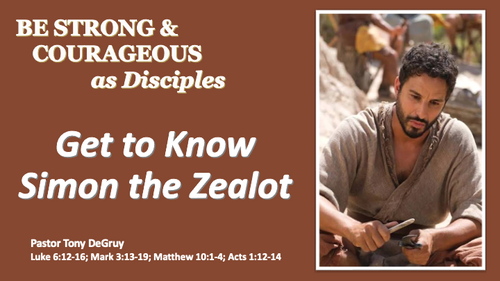
Be Strong and Courageous as Disciples: Get to Know Simon the Zealot
Luke 6:12-16; Mark 3:13-19; Matthew 10:1-4; Acts 1:12-14
Minister Tony DeGruy
For Your Heart Today
What happens to our passions, our causes, and even our anger about what is wrong when we give them to Jesus?
Simon was known as "the Zealot"-a man marked by strong passion and fierce commitment. Yet Jesus called Simon into a community that included Matthew, a tax collector whose life represented much of what Simon likely opposed. Jesus called them both, gave them a new allegiance, and taught them to follow Him together.
Simon reminds us that Jesus does not ask us to stop caring deeply about injustice or the things that are broken in our world. He does ask us to surrender our passion to Him. Our zeal may be real and even righteous, but Jesus must shape how we use it. His way moves us away from contempt and revenge and toward love, mercy, reconciliation, and faithful discipleship.
Whatever fire you carry-your passion, anger, pain, or hope for something to be made right-bring it to Jesus. Let Him redeem it, redirect it, and use it for His kingdom.
Takeaways
- Jesus gives us a greater allegiance. Simon and Matthew may have stood on opposite sides of deep political and social divisions, yet Jesus called both to belong to Him-and to one another.
- Discipleship does not extinguish zeal; it relocates it. Passion and a desire for justice are not the problem. Courageous disciples allow Jesus to determine how that passion is expressed.
- Following Jesus may mean sitting at the table with our "Matthew." Jesus calls us to love and serve alongside people we might never have chosen for ourselves.
- Faithfulness does not require fame. Scripture records no great speech or dramatic moment from Simon. His story reminds us that courage often looks simply like showing up and faithfully following Jesus.
Breath Prayer
Inhale: Jesus, I bring You my fire.
Exhale: Lead me in Your way.
Be Strong and Courageous as Disciples: Get to Know Simon the Zealot
Luke 6:12-16; Mark 3:13-19; Matthew 10:1-4; Acts 1:12-14
Minister Tony DeGruy
Sermon Summary
The sermon introduced us to one of the least-known members of the Twelve: Simon the Zealot. Scripture gives us remarkably little information about Simon. He never speaks a recorded word, performs no recorded miracle, and has no dramatic moment attached to his name. He appears four times, primarily in lists of the apostles. Yet even Simon's nickname-and the people Jesus called him to follow alongside-offers a powerful picture of discipleship.
Before choosing the Twelve, Jesus spent the night in prayer. Among those He chose were two men who could hardly have represented more different loyalties: Matthew, the tax collector who worked within the Roman system, and Simon, "the Zealot." Although we cannot know with certainty whether Simon belonged to an organized political movement, his nickname identifies him as a man of strong passion and fierce commitment, likely shaped by zeal for God, Israel, and freedom from Roman rule. Jesus deliberately called both men into the same community.
That unlikely pairing reveals something important about the kingdom of God. Jesus did not ask Matthew and Simon to pretend their histories and differences did not exist. Instead, He gave them something greater than either of their previous allegiances: loyalty to Him. They would walk the same roads, share the same table, listen to the same Teacher, and participate in the same mission. Jesus called people who might once have regarded each other as enemies and taught them how to become disciples together.
Simon's story also asks what happens to our passion when we follow Jesus. The sermon reminded us that passion itself is not the problem. Caring about injustice is not the problem. Wanting things to be made right is not the problem. The question is what fuels our passion and whom it serves. Discipleship doesn't extinguish zeal; it relocates it. Jesus did not teach Simon to stop caring about justice; He taught him a different way of pursuing it-a kingdom advanced not by the sword, but through the cross, sacrificial love, truth, mercy, courage, service, forgiveness, and the good news of Jesus.
For a man known as "the Zealot," that may have been one of the hardest lessons of following Jesus. Zealotry says, "My cause is right, so any method I use must be right too." Discipleship says, "My concern is real, but I give Jesus the right to tell me how to respond." Zealotry wants to destroy enemies; discipleship learns to love enemies without pretending evil is good. Zealotry makes winning the goal; discipleship makes faithfulness to Jesus the goal. Sometimes courage looks less like taking up a weapon and more like laying one down and picking up a towel to serve.
There is also something meaningful in how little Scripture tells us about Simon. Not every faithful disciple gets a headline. Simon has no famous speech, miracle, or dramatic Gospel scene. Yet he was one of the Twelve. He stayed. He followed. He served alongside people he may never have chosen for himself. His quiet presence reminds us that being strong and courageous may look less like a dramatic moment and more like faithfully showing up-again and again-even when nobody applauds.
Simon's story ultimately leaves us with three questions: What is my zeal actually fueling? Am I willing to sit at the table with my "Matthew"? Am I willing to be faithful without being famous? Our passion can become a gift in the hands of Jesus, but it can also become destructive when it turns into bitterness, contempt, or the belief that being right gives us permission to treat others badly. Jesus invites us to pursue justice with mercy, to make room for people we might otherwise reject, and to remain faithful even when our service goes unnoticed.
The final invitation was simple: Bring your fire to Jesus. Whatever we carry-anger, passion, pain, or hope for something to be made right-Jesus is not asking us to stop caring. He is asking us to let Him guide what we care about and how we respond: away from the sword and toward the cross, away from contempt and toward love, away from revenge and toward reconciliation, away from winning at all costs and toward faithful discipleship.
No Comments